
Unbiased headlines. Facts, not spin.
Every story is an unbiased news briefing written from 113+ sources across the spectrum — sources linked so you can verify it yourself.
 tech
Notable (6/10)
September 24, 2026 at 07:57 AM
tech
Notable (6/10)
September 24, 2026 at 07:57 AM
Meta Reveals VR Glasses Priced at $1,299, Shipping Spring 2027, Alongside New Ray-Ban Gen 3 Camera Glasses
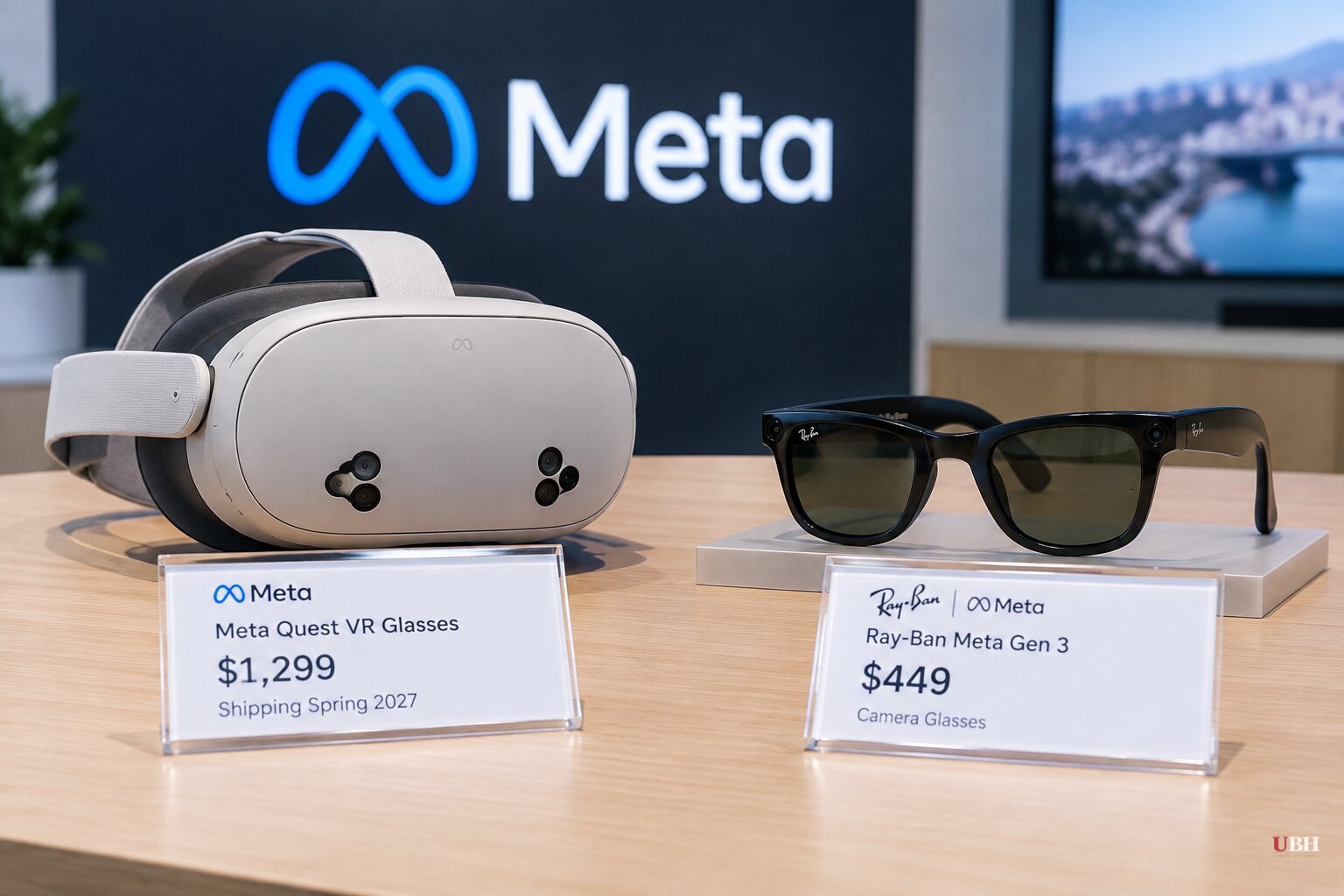
Since Meta's Wednesday night keynote at Connect 2026 in Menlo Park, the pricing and shipping details Meta held back in its pre-show preview are now public. The headline number: Meta's new VR Glasses cost $1,299 and won't ship until spring 2027, according to Mashable.
Meta demoed the device hands-on this week to reporters from Axios, The Verge, The Guardian and IGN.
What the glasses actually are
Meta VR Glasses weigh about 100 grams, roughly a fifth of the Quest 3's 515 grams, according to The Verge. They're made of magnesium alloy and look like oversized black sunglasses, per The Guardian.
The catch is the wire. All that weight savings comes from moving the processor, battery and storage into a separate puck you clip to your belt or stuff in a pocket. The Guardian puts the puck at 300 grams. IGN describes it as roughly iPhone-sized with 45W fast charging, but it only holds enough juice for three hours of continuous playback.
Inside the puck: a Snapdragon Reality Elite processor, 128GB of storage and 12GB of RAM, according to The Verge. The display is a 5K microOLED panel Meta calls its "Infinite Display," running 2412 by 2288 pixels per eye at 37 pixels per degree with up to a 120Hz refresh rate. Two front cameras handle color passthrough for augmented-reality features, and six external cameras track hand gestures, replacing handheld controllers entirely. Users pinch to select and make a fist-and-thumb motion to scroll, per The Verge and IGN.
Axios's reporter called it, after a half-hour demo, "the most practical combination I've seen of an Apple Vision Pro-class device in a headset I'd be willing to wear outside of the house." The Verge's Jay Peters said it felt "like a lightweight Vision Pro" that might execute Apple's own concept better than Apple did.
The competition Meta is racing
Meta isn't alone in betting on this format. Axios reports Google is building a similar device, Project Aura, in partnership with Xreal, expected to debut later this year. Meta executives told Axios they're delaying their own glasses until spring specifically to avoid a botched first impression inside the VR ecosystem, and that they have "modest expectations" for unit sales, per comments from Meta's Chang.
That's a notably cautious tone for a $1,299 product Zuckerberg is pitching as central to his "Personal Superintelligence" vision. At the keynote, Zuckerberg argued glasses will be the biggest wearable category because, as he put it, "they already are" and remain the only form factor that lets his Muse AI agent "see what you see, hear what you hear," according to Mashable.
The other half of the announcement: Ray-Ban Gen 3
Meta also launched the Ray-Ban Meta Gen 3 camera glasses, available to order now for $449, according to Mashable. They add six microphones for voice capture and wind noise reduction, Dolby Atmos spatial audio, adjustable temple tips, and new styles including Ray-Ban aviators. An entry-level "Adventurer" style is priced at $249, though Mashable couldn't find it listed for sale yet. Meta also unveiled new frames in partnership with Blackpink's Lisa, priced at $399, and said more than 100 total glasses styles will eventually be available.
Meta is also expanding its Ray-Ban Meta Display glasses, the model with a screen built into the right lens, to the UK and Canada starting Sept. 23 at £749 (CA$1,149), with France, Germany and Italy following Oct. 13 at €899, according to The Guardian.
The privacy question Meta can't fully dodge
Smart glasses with cameras have been dubbed "perv glasses" or "spy glasses" by privacy campaigners worried about covert recording in public spaces. That's a legitimate concern, given how easily a camera hidden in eyewear can film people who never consented to it and have no way to tell.
Meta's answer, per The Guardian, is a blinking LED that lights up during recording and improved "tampering detection" meant to catch attempts to disable that light, including mid-recording. Whether that satisfies critics is untested. Meta's camera-free audio glasses, which sidestep the issue entirely by not including a lens at all, remain the company's clearest concession that the backlash is real and commercially relevant, not just noise.
What's unresolved
Meta hasn't said how many VR Glasses units it expects to sell, only that Chang described success as pulling in people who "would have looked at the Quest and said, 'Nah, that's not for me.'" Whether a $1,299 wired-puck headset succeeds where the Quest line failed to break out of its gaming niche, or whether Google's Project Aura beats it to market first when it debuts later this year, won't be answered until spring 2027 at the earliest.
Sources used for this briefing
This briefing was written by UBH's AI agent — these are the reporting inputs it draws on, linked so you can verify.


