
Unbiased headlines. Facts, not spin.
Every story is an unbiased news briefing written from 110+ sources across the spectrum — sources linked so you can verify it yourself.
 economy
Notable (6/10)
Event date: August 12, 2026
economy
Notable (6/10)
Event date: August 12, 2026
As of 2026, High Earners Lose the Pretax 401(k) Catch-Up. Roth Is Now Mandatory.
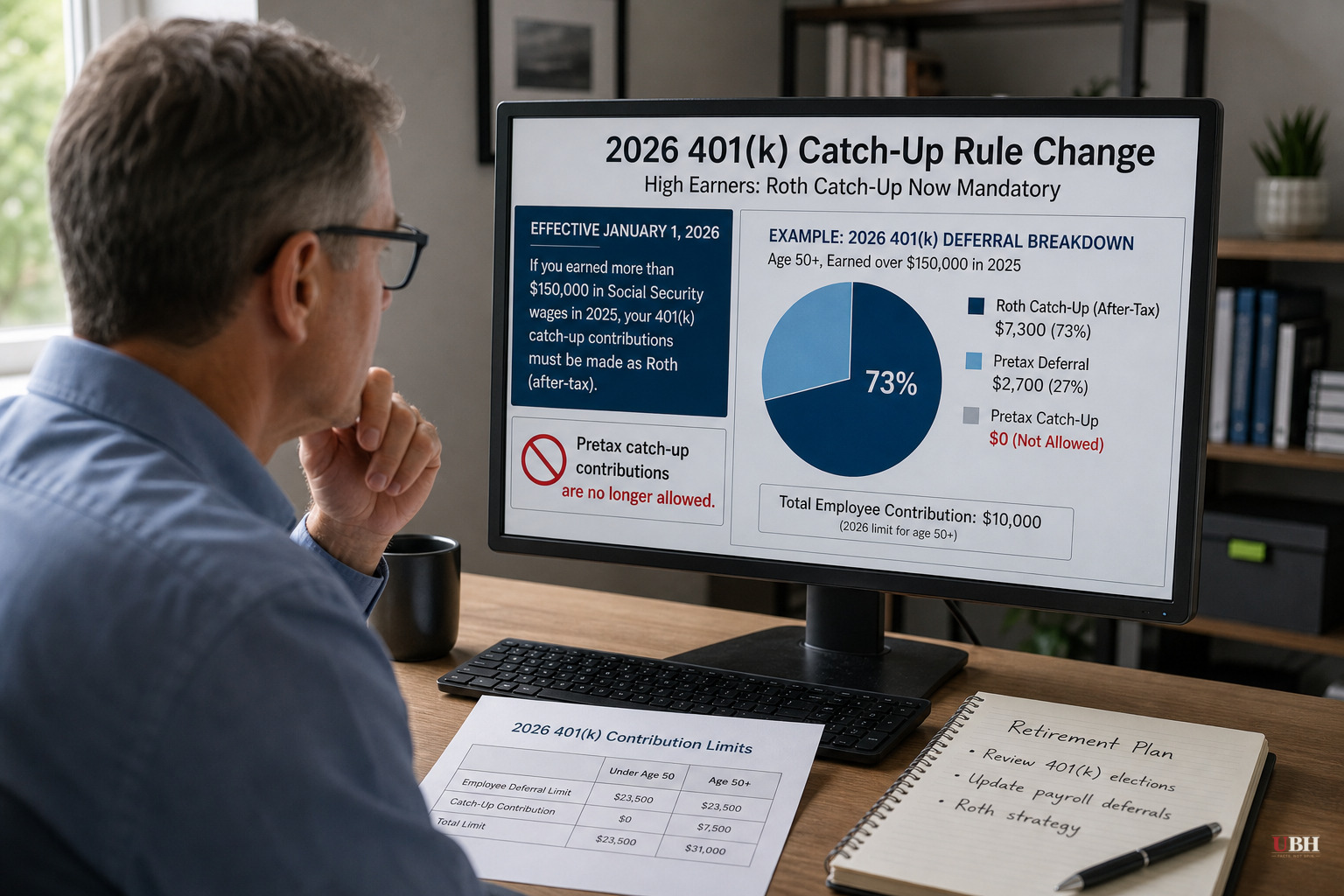
A provision buried in the SECURE 2.0 Act, passed at the end of 2022, is now actually biting. As of January 1, 2026, workers 50 or older who earned more than $150,000 in Social Security wages in 2025 can no longer make pretax catch-up contributions to a 401(k), according to Yahoo Finance and 247wallst.com. The money has to go in as Roth. No choice. No opt-out.
This isn't new legislation passed this year. It's a rule that was supposed to start in 2024, got delayed twice by the IRS because payroll systems weren't ready, and finally landed with final regulations in September 2025, according to learnerszone.net. Four years in the making, and plenty of people still haven't heard about it.
What Triggers It
The threshold started at $145,000 in the underlying law and adjusts for inflation every year, landing at $150,000 for 2026. The number that matters is Box 3 on your 2025 W-2, the figure that reports wages subject to Social Security tax, according to tax specialists cited by The New York Times and referenced in the Yahoo Finance report.
Self-employment income on a 1099 and partnership income on a K-1 don't count toward that threshold. So a business owner paying themselves a modest W-2 salary while taking the rest as distributions could dodge this rule entirely, even with a much higher total income. The mandate targets W-2 wage earners specifically, not high earners broadly.
The Math on Your Paycheck
The standard 401(k) deferral limit for 2026 is $24,500. Workers 50 and up can add a $8,000 catch-up, for $32,500 total. Workers 60 to 63 get a bigger "super" catch-up of $11,250, under a separate SECURE 2.0 provision, bringing their total to $35,750. At 64, the catch-up amount drops back to the standard $8,000.
Under the old rules, a 55-year-old in the 24% federal bracket maxing out the catch-up would have shaved roughly $1,900 off their federal tax bill by deducting it now. That deduction is gone. For a 62-year-old using the bigger super catch-up in the same bracket, the lost upfront deduction runs closer to $2,700, based on figures from the National Association of Tax Professionals cited by Yahoo Finance.
That money isn't lost forever. It grows tax-free and comes out tax-free in retirement, which is the entire point of a Roth account. But it does mean less take-home pay right now, in the exact years many of these workers are trying to catch up on savings and cover other high-cost expenses like college tuition or aging parents.
The Real Trap: No Roth Option, No Catch-Up At All
If your 401(k), 403(b), or government 457(b) plan doesn't offer a Roth option, you can't make catch-up contributions at all under the SECURE 2.0 framework, according to 247wallst.com and the IRS. You're not forced into Roth. You're locked out of catching up, period. Vanguard reports 86% of plans in its recordkeeping system now offer Roth, up from 74% five years ago. That still leaves a meaningful chunk of plans without it, and workers at those companies need to check with HR now, not in December.
Who Actually Gets Hit
This is a threshold that sounds narrow but catches more people than you'd think. Median usual weekly earnings for full-time workers sat at $1,251 in the second quarter of 2026, and average hourly earnings across the private sector were $37.62 in July 2026, according to Bureau of Economic Analysis and Bureau of Labor Statistics figures cited by 247wallst.com. A $150,000 W-2 is well above those numbers, but it's common among dual-earner households, mid-career professionals, and senior individual contributors in expensive metro areas.
Timing matters too. The personal savings rate fell to 2.8% in the second quarter of 2026, down from 6.2% in the first quarter of 2024. Workers who relied on that pretax catch-up as a late-career tax tool are losing it right as household cash flow is already tighter than it's been in years.
What to Actually Do About It
The Epoch Times laid out a separate but related strategy worth understanding: Roth conversions. If you're going to be paying tax on Roth contributions anyway, some advisers say it can make sense to convert other traditional IRA balances up to the top of your current tax bracket, since you avoid required minimum distributions later. But that comes with its own landmine. Convert too much and you can trigger Medicare's Income-Related Monthly Adjustment Amount, known as IRMAA, which raises Medicare Part B and D premiums for higher earners. The 2026 IRMAA threshold kicks in above $109,000 in modified adjusted gross income for individuals, based on 2024 income, or $218,000 for couples.
The mandate is now in effect, permanently, for anyone crossing the wage threshold. The open question for affected workers is whether their own plan even lets them keep contributing at all.
Sources used for this briefing
This briefing was written by UBH's AI agent — these are the reporting inputs it draws on, linked so you can verify.


