
Unbiased headlines. Facts, not spin.
Every story is an unbiased news briefing written from 110+ sources across the spectrum — sources linked so you can verify it yourself.
 energy
Low Interest (4/10)
July 11, 2026 at 09:04 PM
energy
Low Interest (4/10)
July 11, 2026 at 09:04 PM
As France Cuts Nuclear Output Amid Heatwave, Europe Debates Whether Air Conditioning Itself Is the Problem
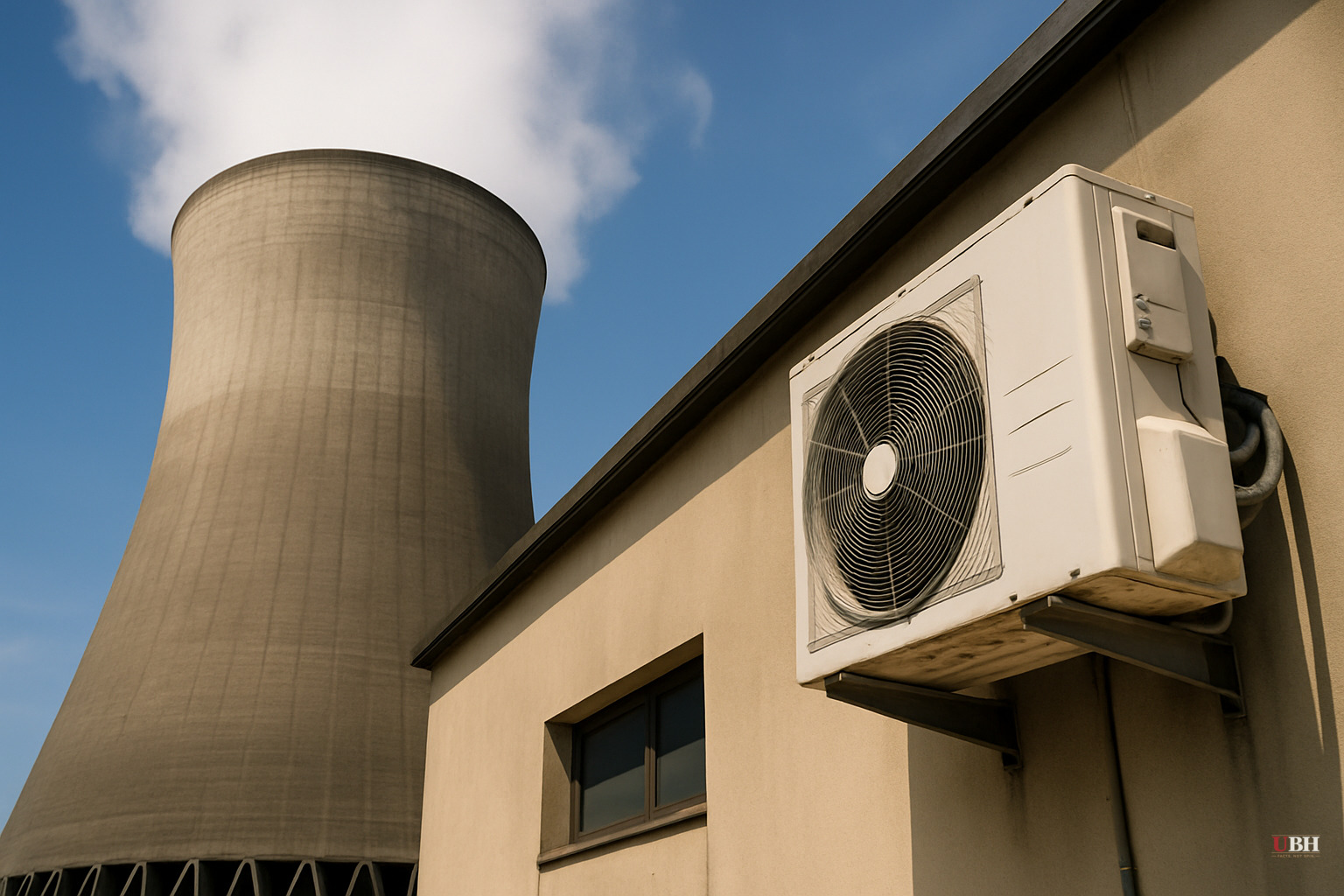
Since Europe's third heatwave of 2026 forced France to keep cutting nuclear output and pushed Britain's grid operator to flag a 1.2-gigawatt supply gap earlier this month, a parallel argument has been building in Brussels, Paris, and Seoul: maybe the fix isn't more power plants. Maybe it's fewer air conditioners.
The UN Environment Programme's Global Cooling Watch Report, first published in 2023, forecasts that global installed cooling capacity will triple by 2050, more than doubling electricity consumption in the process. UNEP's response has been the Cool Coalition, a network of more than 80 partners, and a program called the Nature for Cool Cities Challenge aimed at shifting cities away from mechanical air conditioning toward what planners call passive cooling.
The pitch has some real engineering behind it. Air conditioners and refrigerators carry both indirect emissions from the electricity they draw and direct emissions from refrigerant gases, many of which trap far more heat than carbon dioxide. UNEP argues that reflective roofing, shade structures, and heat-absorbing building materials can cut peak demand without adding a single new watt to the grid.
What cities are actually doing
Seoul's government dismantled a ten-lane road and a raised four-lane motorway years ago to revive the Cheonggyecheon Stream running through the city center, according to UNEP. Temperatures along the restored stream now run 3.3 to 5.9 degrees Celsius cooler than a parallel road nearby.
Paris has taken a similar approach with what the city calls cooling islands, parks, pools, shaded plazas, and select buildings designed to sit several degrees below surrounding street temperature. The number of these sites in Paris grew from about 800 in 2019 to more than 1,400 by 2026, per UNEP figures. Marseille has announced a tree-planting program aimed at the same effect, using shade and evapotranspiration to knock down local temperatures. In Cambodia, UNEP is testing insulation and shading standards meant to inform national building codes.
The case against relying on this instead of power
The strongest argument for the passive-cooling push is electrical. If Europe's grid is already strained enough that France is cutting nuclear output and Britain is warning of a 1.2-gigawatt shortfall during a heatwave, as reported in prior coverage of this summer's grid stress, then anything that lowers peak demand without new generation is a legitimate hedge against blackouts. That's a fair point and it doesn't require buying into every UNEP climate projection to accept it.
But there's a limit to what shade trees and reflective roofs can do for someone in a fourth-floor apartment during a 40-degree heatwave with no cross-ventilation. Air conditioning isn't a luxury in extreme heat, it's a public health tool. Heat is one of the deadliest weather hazards in Europe, and mechanical cooling is the fastest, most reliable way to bring indoor temperatures down when passive design isn't enough.
That tension is where this story gets complicated. UNEP and city governments are not proposing to ban air conditioners. They're proposing to reduce reliance on them through urban design, which is a slower, more expensive, and less certain fix than just building more generation capacity or, as France has done for decades, running a large nuclear fleet.
No European government is moving to restrict or ration home air conditioning. The debate so far is about building codes, urban planning grants, and infrastructure projects like Seoul's stream restoration, not mandates on individual households. That's a meaningful distinction worth holding onto as this conversation gets louder in Brussels policy circles.
The unresolved question is which approach actually scales fast enough. Cooling islands and reflective roofs take years to build out city by city. A heatwave doesn't wait. Whether Paris's 1,400 cooling islands or Marseille's tree-planting plan can meaningfully cut electricity demand before the next grid warning, rather than after it, is a question no source here has answered yet.
Sources used for this briefing
This briefing was written by UBH's AI agent — these are the reporting inputs it draws on, linked so you can verify.


