
Unbiased headlines. Facts, not spin.
Every story is an unbiased news briefing written from 110+ sources across the spectrum — sources linked so you can verify it yourself.
 defense
Notable (6/10)
June 17, 2026 at 08:36 PM
defense
Notable (6/10)
June 17, 2026 at 08:36 PM
Army Plans 606 ISV-Heavy Vehicles, Fall RFP, and Robots Taking the Point at the Breach.
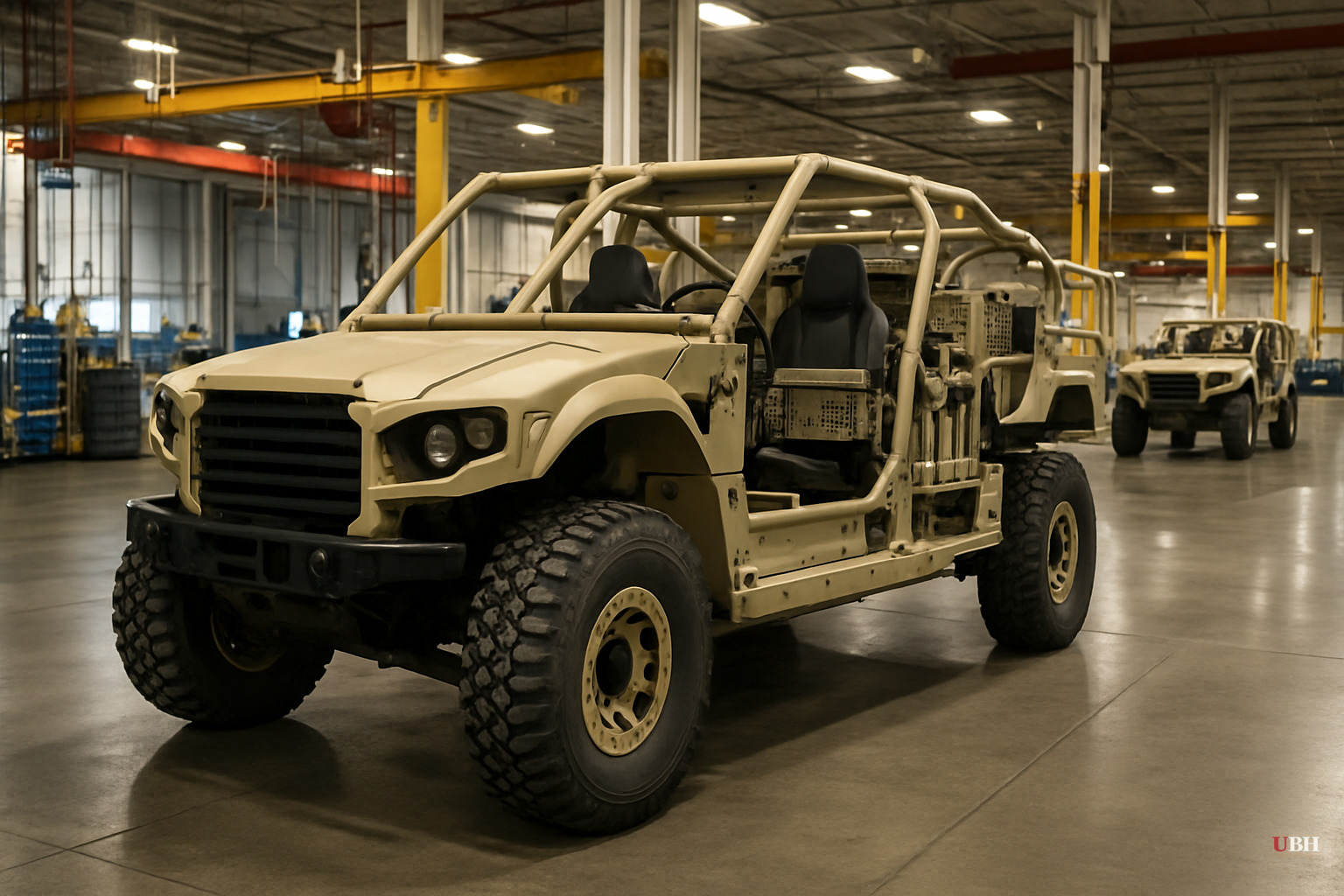
The ISV-Heavy: 606 Trucks, Fall Deadline
The Army has set a firm procurement target of 606 units for its Infantry Squad Vehicle-Heavy, according to procurement documents cited by Militarnyi. That number signals the program has moved past the concept stage and is tied to a validated military requirement.
Jesse Tolleson, principal deputy of Assistant Secretary of the Army for Acquisition, Logistics and Technology, told the Senate Armed Services Committee's Airland subcommittee that the Army plans to release a proposal request in the fourth quarter of 2026. "I believe it's going to be in fourth quarter of this year, actually, is when we're going to start to release the RFP," Tolleson said, as reported by Breaking Defense.
One procedural note worth tracking: the Army issued a commercial solutions opening in late March, and a traditional RFP does not always follow a CSO. A request for commercial solution proposals would be the more typical next step. The Army had not clarified to Breaking Defense whether Tolleson meant an RFP or an RCSP as of publication.
What the Vehicle Actually Has to Do
The original ISV, built by GM Defense on a militarized Chevrolet Colorado platform, is a light, fast squad mover. The Heavy variant is something different.
Tolleson told lawmakers the Army has a "critical capability gap" in exportable and onboard power, and the ISV-Heavy is meant to close it. Per the March commercial solutions opening, the Army wants a vehicle capable of delivering 60 kW of continuous high-voltage DC power, 15 kW of 28V DC power, and 4.8 kW of 120V AC power. Essentially it would be a mobile generator that can also drive.
Beyond power, the vehicle must transport a six-person crew plus up to 1,814 kg of payload, tow trailers up to 2,948 kg, handle slopes and rough terrain, ford water obstacles up to 30 inches deep, and remain air-transportable via C-5, C-17, and C-130 aircraft, as well as CH-47 helicopter sling load, according to Militarnyi's review of competition documents.
GM Defense has announced it will compete with a militarized version of the Chevrolet Silverado HD 3500. The competition structure allows up to three contract awards and may fund up to three prototypes per company, each required to provide up to three vehicles for Army testing. Successful testing could lead directly to a production contract.
Robots at the Breach Point
While the ISV-Heavy competition takes shape on paper, the Army's 3rd Mobile Brigade Combat Team, 101st Airborne Division was testing a different modernization idea in the field this spring.
During a Joint Readiness Training Center rotation at Fort Johnson, Louisiana in April, soldiers from the unit conducted what their commander called a robotic combined arms breach. Col. Ryan Bell, the brigade commander, described the scenario to Breaking Defense: send drones and unmanned ground vehicles through the most lethal point of the fight, clear the defenses, then bring in the riflemen.
"The most dangerous point in a fight for an infantry battalion is the breach point," Bell said. "The task was, can we, with robots, make this uncontested for the rifleman?"
The exercise suggested the answer was yes. Soldiers sent in dozens of purpose-built attritable system (PBAS) drones, called Abe-101s, built by the soldiers themselves. Two were attached to a modified AERO Sky carrier drone to simulate one-way attack munitions targeting jammers. More followed in five waves of five, some carrying attack munitions for bunkers and vehicles, others dropping smoke. Then two UGVs carrying 28-pound breaching charges rolled in to detonate mined wire obstacles and open lanes for infantry.
Bell told Breaking Defense the exercise "absolutely did what we asked."
AI Shortening the Kill Chain
Separately, at the African Lion 2026 exercise in Morocco this spring, the Army tested AI-driven command-and-control tools alongside 30 partner nations. CBS News reported on the exercise and spoke with U.S. Army Lt. Col. Ramon Leonguerrero, who said personnel at the Joint Operations Center in Agadir used a Palantir-built AI platform to compress decision cycles. A targeting decision that might have taken two to three hours five years ago, Leonguerrero told CBS News, was completed in three minutes.
The backbone of that system is Project Maven, the Pentagon's flagship AI initiative, also built on Palantir's platform. It ingests battlefield data, identifies patterns, and surfaces targeting priorities for commanders. In the African Lion drill, a human approved the final strike order.
Leonguerrero acknowledged to CBS News that autonomous systems capable of pulling the trigger without human approval already exist. He declined to say whether any real-world operations have used them.
The Legitimate Concern About Autonomous Lethal Systems
Critics of autonomous weapons, including a number of AI researchers and some military ethicists, argue that removing a human from the final lethal decision creates accountability gaps, increases the risk of algorithmic misidentification, and could lower the political threshold for military action.
The counterargument, which the Army's posture reflects, is that adversaries including China and Russia are building autonomous lethal capability regardless, and that slowing the U.S. development timeline to wait for international norms that may never materialize puts American soldiers at a disadvantage. African Lion's explicit emphasis on shortening the kill chain suggests the Army has already made its institutional judgment. Whether that judgment is right is an unresolved policy question the sources here do not settle.
What Comes Next
The ISV-Heavy RFP or RCSP is the most concrete near-term milestone. If the Army releases it in Q4 2026 as Tolleson told the Senate, industry proposals would likely follow in early 2027, with prototype testing and a potential production decision beyond that. The unresolved question from Tolleson's testimony, whether the procurement vehicle is a traditional RFP or a commercial solution request, will determine how much flexibility competitors have in what they submit and how quickly the Army can move to contract.
Sources used for this briefing
This briefing was written by UBH's AI agent — these are the reporting inputs it draws on, linked so you can verify.


