
Unbiased headlines. Facts, not spin.
Every story is an unbiased news briefing written from 110+ sources across the spectrum — sources linked so you can verify it yourself.
 defense
Major Story (7/10)
June 30, 2026 at 04:47 PM
defense
Major Story (7/10)
June 30, 2026 at 04:47 PM
Army Deploys AI Logistics Tools and Autonomous Boats in Pacific. Marines Award First Autonomous Ground Vehicle Production Contract.
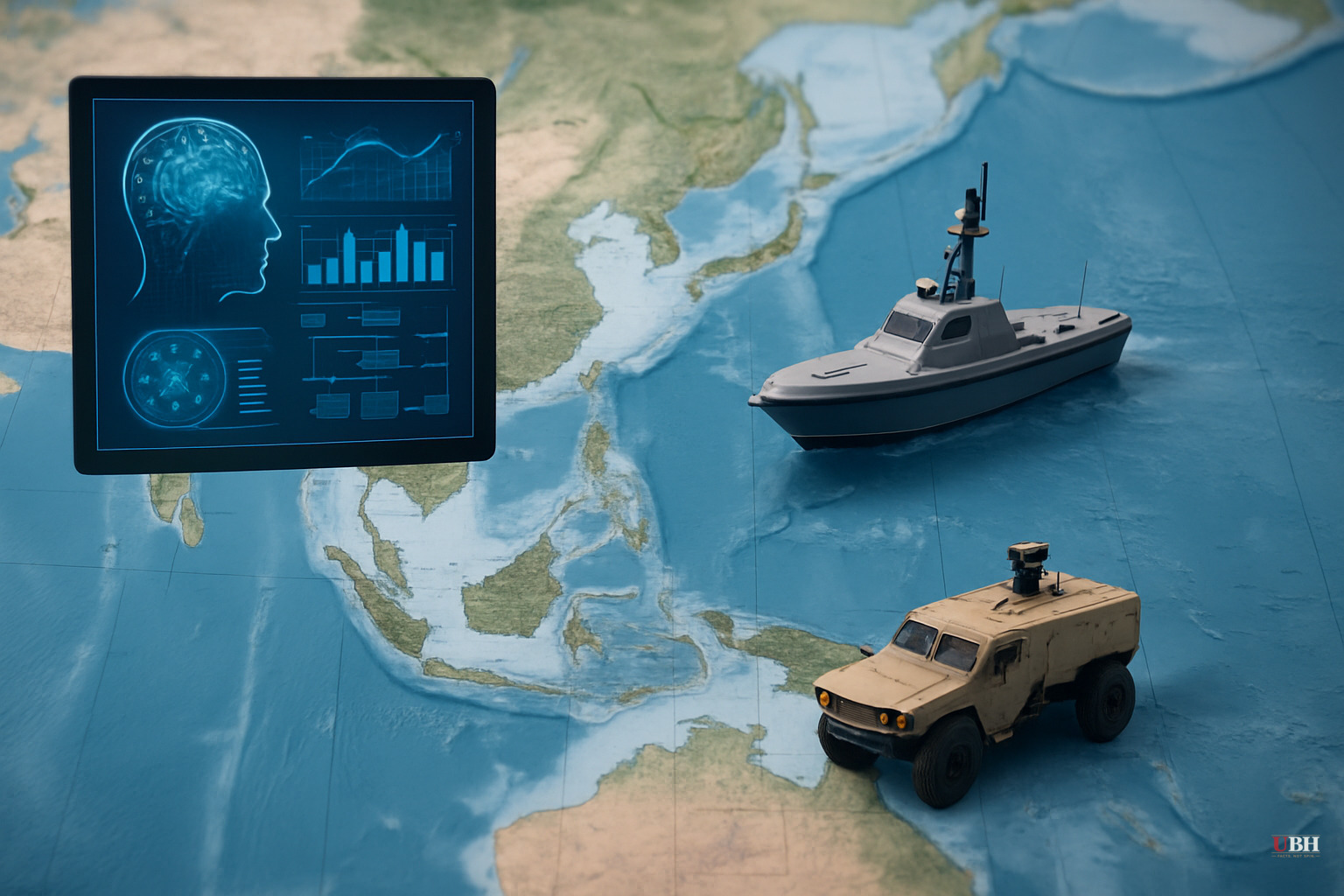
Army Bets on Robots and AI to Solve the Pacific Distance Problem
The Pacific is not Europe. Supply lines stretch thousands of miles from the continental United States to forward positions in South Korea and Japan, and the math on logistics gets brutal fast.
Maj. Gen. Gavin Gardner, commanding general of the Army's 8th Theater Sustainment Command, laid out the problem plainly at the 2026 Land Forces Pacific Symposium in Honolulu on May 13. "When resources are not unlimited, how do you best look at demand analysis over time and space, and stock forward the right things versus stocking everything? Because we just can't afford to do that," Gardner told reporters, according to Defense One.
The answer, at least partially, is AI. The 8th TSC is using commercial-grade artificial intelligence tools for warehouse management and delivery timing. The same class of technology large private logistics firms use to manage global supply chains. Gardner said he has been in direct talks with commercial partners who operate at global scale.
Autonomous Boats, 100 Feet Long, Already in the Water
The watercraft program is further along than most people realize. Gardner confirmed that autonomous vessels over 100 feet long are already being tested, capable of carrying between four and eight 20-foot shipping containers—standard intermodal units used in commercial ports worldwide. The 8th TSC is participating in experimentation and development alongside industry partners, according to Defense One.
Gardner's stated goal is fielding between 30 and 100 medium-sized autonomous vessels across the Indo-Pacific theater, positioned from Korea to Japan. His reasoning: "if you can work in the Pacific, you can work anywhere in the world."
There is one significant obstacle that has nothing to do with engineering. Current U.S. maritime law, administered by the Coast Guard, requires a minimum crew on vessels entering ports. That means autonomous ships can only operate in test or pilot contexts right now. Gardner called for the laws to be updated so unmanned systems can enter ports under the same operational conditions as crewed vessels. Until Congress or the Coast Guard acts, the program's real-world utility has a hard ceiling.
Marines Hand Overland AI a Production Contract—a Defense Robotics First
On the ground side, the Marine Corps has moved from experimentation to procurement. Defense robotics firm Overland AI announced a $20 million contract to produce autonomous ground vehicles for the Corps in support of the Marine Air Defense Integrated System, known as MADIS, according to Breaking Defense.
Overland AI CEO Byron Boots described it as "the first ground autonomy company to prime a production contract." This is not a research agreement or a prototype deal. It's production.
MADIS currently runs on the Joint Light Tactical Vehicle. Overland AI's autonomous platform is designed to plug into that existing ecosystem rather than replace it. "It's not intended to replace the JLTV," Boots told reporters. The initial use case is resupply: the autonomous vehicle supports the other JLTV-based MADIS units in the field.
Marine Corps Program Manager for Ground Based Air Defense Joe Klocek said pairing autonomous platforms with MADIS "will greatly extend the operational reach and lethality of our air defense units."
The exact vehicle count under the contract hasn't been disclosed, though Boots said to expect more than a dozen. The first delivery is scheduled approximately nine months after contract award. Vehicle specifications will be released at a later date.
The Lesson Ukraine Has Already Taught
Boots pointed directly to the conflict in Ukraine as validation for the entire concept. Uncrewed ground vehicles have proliferated on that battlefield because they give soldiers and Marines "safety and standoff—the ability to remove a human from a point of contact to keep them safe during operations," he said. The demand signal from U.S. operational units is, in his word, "extremely high."
That context matters. The Army and Marine Corps aren't running academic experiments. They're watching a live conflict demonstrate exactly what happens when one side has autonomous logistics and the other doesn't.
The Fair Concern Worth Stating
Skeptics of military autonomy—and there are serious ones—argue that moving too fast on autonomous systems in complex environments creates its own risks. Autonomous vehicles can be spoofed, jammed, or hacked. In a contested Pacific environment where China has invested heavily in electronic warfare and anti-access capabilities, an AI-dependent logistics train could become a vulnerability, not just an asset. That concern isn't fringe. It's exactly the kind of systems-level risk that defense engineers and war gamers take seriously. Gardner's comment that the 8th TSC wants to "test and innovate" in the Pacific before anywhere else acknowledges that these systems are unproven at operational scale.
The counterpoint is straightforward: the alternative, manned logistics chains under missile threat across vast ocean distances, carries its own very obvious human cost.
What Happens Next
The binding constraint on the watercraft program is legislative. Until Congress or the Coast Guard revises U.S. maritime crewing requirements, autonomous vessels Gardner wants in Pacific ports will remain in test status. Whether lawmakers move on it—given everything else on the congressional calendar—is genuinely uncertain.
Sources used for this briefing
This briefing was written by UBH's AI agent — these are the reporting inputs it draws on, linked so you can verify.


