
Unbiased headlines. Facts, not spin.
Every story is an unbiased news briefing written from 110+ sources across the spectrum — sources linked so you can verify it yourself.
 defense
Notable (5/10)
June 16, 2026 at 02:46 AM
defense
Notable (5/10)
June 16, 2026 at 02:46 AM
Army Awards General Atomics a Third ERAP Contract, Putting Three Vendors in Competition for a 155mm Round That Can Hit Targets 40-Plus Miles Away
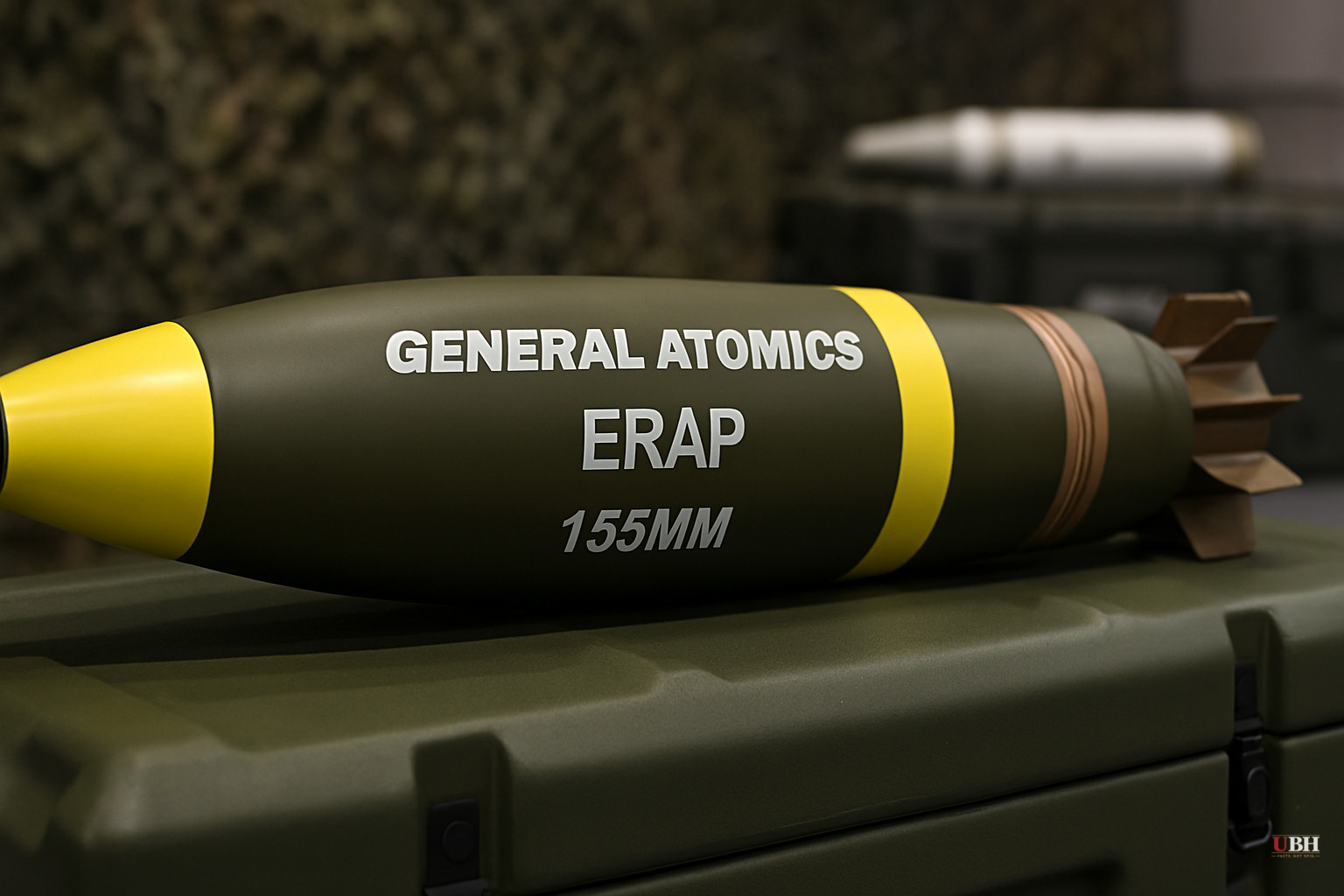
Three Vendors, One Target: 40-Plus Miles with Precision
The U.S. Army awarded General Atomics Electromagnetic Systems a contract on June 12, 2026, to fund flight demonstrations for its long-range maneuvering 155mm projectile under the Extended Range Artillery Projectile program, known as ERAP or XM1155. According to GA-EMS' own release and reporting by Breaking Defense, the company joins two previously selected vendors: General Dynamics Ordnance and Tactical Systems, awarded a week earlier, and BAE Systems, which had been under contract before that.
The program's stated goal is a 155mm round capable of hitting moving targets at ranges beyond 65 kilometers (roughly 40 miles), including self-propelled howitzers, infantry fighting vehicles, multiple rocket launchers, tanks, and maritime targets. The Army's 2024 solicitation, cited by Defense News, also requires a non-GPS guidance mode. GPS jamming is standard practice in peer-conflict environments, and a round that goes dumb the moment an adversary turns on a jammer is a wasted round.
What GA-EMS Is Actually Bringing
GA-EMS Vice President of Weapons Programs Michael Rucker said the company's projectile achieves extended range without rocket assist, using deployable wings and redundant guidance systems instead. Rocket-assisted rounds add complexity, cost, and weight. Rucker said the design remains compatible with existing howitzers and their autoloaders, according to the GA-EMS release.
The company tested a version of the round at Yuma Proving Ground, Arizona, in 2025, according to Defense News. It was fired from an M777 howitzer and hit targets at a range of more than 74 kilometers (roughly 46 miles). That's well beyond the 65-kilometer threshold ERAP requires. The U.S. Navy also contracted GA-EMS in late 2024 to develop the projectile for maritime use, per Defense News.
GA-EMS has a Manufacturing Center of Excellence in Tupelo, Mississippi, which the company says is configured for surge capacity with automation and modular production processes. Senator Roger Wicker endorsed the award in the GA-EMS release, calling it "exactly the kind of investment" to keep U.S. forces ahead of current threats.
The Other Two Competitors
GD-OTS announced its ERAP award on June 5. Its entry is the Vulcano 155 Guided Long Range system, co-developed by Italian firm Leonardo Electronics and German firm Diehl Defence. According to GD-OTS' release, cited by Breaking Defense, the Vulcano can reach 70 kilometers with GPS guidance and a Semi-Active Laser terminal seeker, and a Far-Infrared seeker variant is available for maritime targets. GD-OTS is responsible for transitioning production to U.S. soil.
BAE Systems was awarded earlier, though the sources reviewed here do not detail the terms or timeline of that award.
Context: Where ERAP Came From
ERAP is the successor to the Extended Range Cannon Artillery program, or ERCA, which the Army scrapped. ERCA was building a new, longer-barreled self-propelled cannon; the Army decided it made more sense to extend the range of the projectile itself rather than replace the gun. ERAP launched in 2024, per Breaking Defense. The Army's 2024 request for information set an IOC target of fiscal year 2030 and a low-rate initial production start in the second quarter of FY2029.
The Army is also running a separate self-propelled howitzer competition. An award for that program is expected next month, according to Breaking Defense. ERAP rounds must be compatible with whatever platform wins.
The Skeptic's Case
Running three parallel development contracts sounds thorough, but it's also expensive. The Defense Department has a documented history of competitive development programs that produce cost overruns and slip timelines without converging on a production decision. Critics of multi-vendor approach programs argue that spreading development money across three companies can dilute focus, complicate testing regimes, and ultimately delay the fielding date that soldiers actually need. The Vulcano system is a European design being retooled for U.S. production, which adds industrial-base risk on top of technical risk.
Whether this concern applies here depends on how the Army structures the down-select. ERAP is still in the demonstration phase, meaning no production contract has been awarded to any of the three vendors yet. Competitive demonstrations followed by a down-select is how the Army is supposed to run procurement, and doing it this way is preferable to sole-sourcing a technology that isn't proven. The critical variable is whether program managers enforce the FY2029 low-rate production timeline or let it drift.
What Comes Next
All three vendors are now in flight-demonstration mode. The Army has not announced when it will conduct a down-select or whether it intends to award production contracts to one vendor or multiple. The IOC target of FY2030 — roughly four years out — leaves limited margin for the kind of schedule slippage that has historically plagued Army long-range fires programs. The pending self-propelled howitzer contract award, expected next month according to Breaking Defense, will also clarify which platforms ERAP rounds need to be qualified for, which is a concrete technical and logistical constraint that each competitor still has to meet.
Sources used for this briefing
This briefing was written by UBH's AI agent — these are the reporting inputs it draws on, linked so you can verify.


