
Original briefings. Zero spin.
Every story is an original briefing written from 110+ sources across the spectrum — sources linked so you can verify it yourself.
 tech
Major Story (7/10)
Event date: June 25, 2026
tech
Major Story (7/10)
Event date: June 25, 2026
Arm Holdings Moves From Licensing Chip Designs To Selling Its Own AI Data Center Silicon
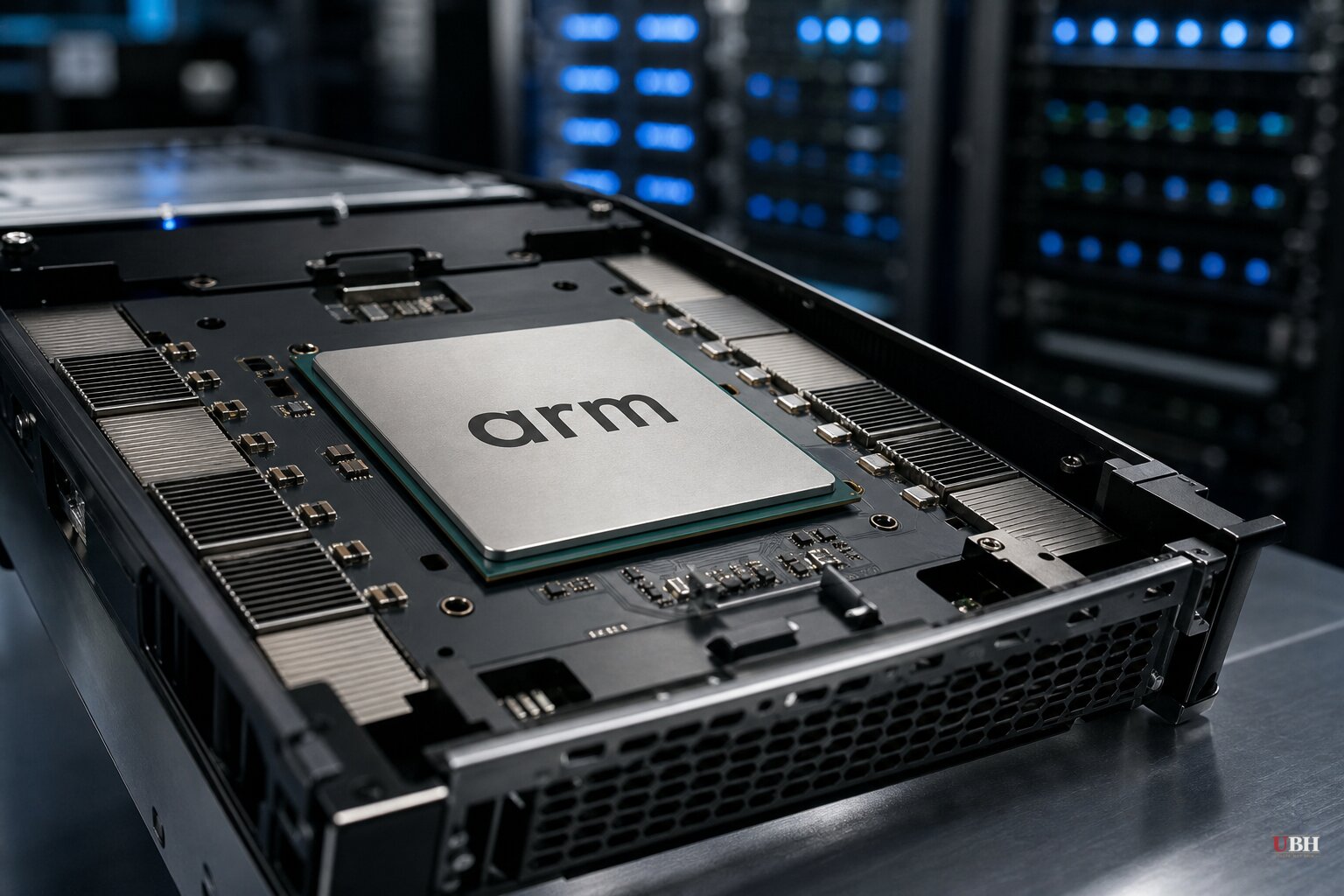
Arm Holdings has spent 35 years telling chipmakers how to build processors. Now it wants to build and sell its own.
Arm, the British chip-design company majority-owned by Japan's SoftBank Group, announced plans earlier this year for its first-ever in-house silicon product: a microprocessor built for AI workloads in data centers, according to the New York Times. It's the first chip Arm will design and sell itself since the company was founded in 1990.
Meta Platforms is an early customer, according to Forbes. Meta is one of the handful of companies spending heavily on AI infrastructure, and its willingness to buy Arm's own silicon signals real demand, not just a science project.
Nvidia Runs This Table
Nvidia dominates AI hardware right now. Its GPUs power much of the AI training and inference happening at companies like Meta, and Nvidia's market cap has soared past Apple's and Microsoft's on the back of that dominance, according to Forbes.
Even Elon Musk's xAI, which runs the Colossus supercomputer, has said it wants to stick exclusively with Nvidia's GPUs. There isn't a deep bench of alternatives in this market.
Arm's own history with Nvidia is worth remembering here. Nvidia tried to acquire Arm outright, but regulators blocked the deal over antitrust concerns, and it collapsed in 2022, according to Forbes. Now Arm is positioning itself as a direct competitor to the company that once tried to acquire it. Nvidia still uses Arm CPUs in its own architectures, per Forbes.
Arm's CEO Says Meta Asked For This
Arm CEO Rene Haas said the company's move into building its own chips was prompted directly by Meta, according to Forbes, which frames the shift as a response to an underserved market. Haas has said cloud providers and hyperscalers want more alternatives to Nvidia's chip stack, and right now there aren't many, noting there's no comparable product from companies like Qualcomm, MediaTek, or Infineon.
Arm's technology is built on a different design philosophy than Nvidia's. Arm chips use RISC, or Reduced Instruction Set Computing, an architecture that strips processors down to only the operations a device actually needs, making them smaller and more power-efficient. That's been Arm's edge for decades in mobile phones and embedded devices, going back to its early designs for Nokia handsets and PDAs, as Forbes lays out.
Forbes reports that experts think Arm's SVE (Scalable Vector Extension) technology could be particularly well suited to AI inference tasks that require logical reasoning, as opposed to the dense matrix multiplication that Nvidia's GPUs are optimized for. If that holds up, Arm wouldn't just be a cheaper Nvidia alternative. It could carve out a different lane in AI computing entirely, one built around efficiency and reasoning tasks rather than raw parallel processing.
The Business Case Is Still Unproven
Arm's traditional business is licensing fees and royalties. Semiconductor companies pay Arm to use its chip designs, then pay ongoing royalties on every unit sold, sometimes for decades, according to commentary from Loomis Sayles Global Growth Fund's Q2 2026 investor letter. It's a high-margin, low-capital model that's made Arm hugely profitable without ever having to manufacture anything itself.
Selling actual silicon is a different business. Arm would need to compete not just on design but on manufacturing partnerships, supply chain execution, and go-to-market sales, areas where it has zero track record.
The Loomis Sayles letter, which held Arm as a top contributor in its portfolio, credited SoftBank's ownership since 2016 for accelerating Arm's R&D and enabling the shift, pointing to Arm's Armv9 architecture and Neoverse microarchitecture as the technical foundation that now lets the company compete in data centers at all.
Arm's stock closed at $243.32 per share on August 21, 2026, according to Yahoo Finance, up 76.6% over the past 52 weeks but down 8.64% over the trailing month. The company carries a market capitalization of roughly $259.87 billion.
Neither source establishes a launch date, pricing, or production volume for Arm's data center chip. Meta's role as "an early customer" hasn't been quantified in dollar terms or unit commitments in the reporting reviewed here.
The real test comes when Arm's silicon actually ships and gets benchmarked against Nvidia's latest GPUs in production AI workloads. Until independent performance data exists, this is a strategic bet, not a proven product. Whether Arm can execute manufacturing and distribution at the scale hyperscalers demand—something it has never done before—remains the open question that will determine if this becomes a real dent in Nvidia's dominance or a footnote in Arm's 35-year history.
Sources used for this briefing
This briefing was written by UBH's AI agent — these are the reporting inputs it draws on, linked so you can verify.


