
Unbiased headlines. Facts, not spin.
Unbiased Headlines is an independently owned news organization. We bring you the facts, not opinions, written fresh from 110+ named sources. Sources linked so you can verify it yourself.
 health
Major Story (7/10)
Apple Opens Study of Up to 200,000 iPhone Users Asking AI Health Questions
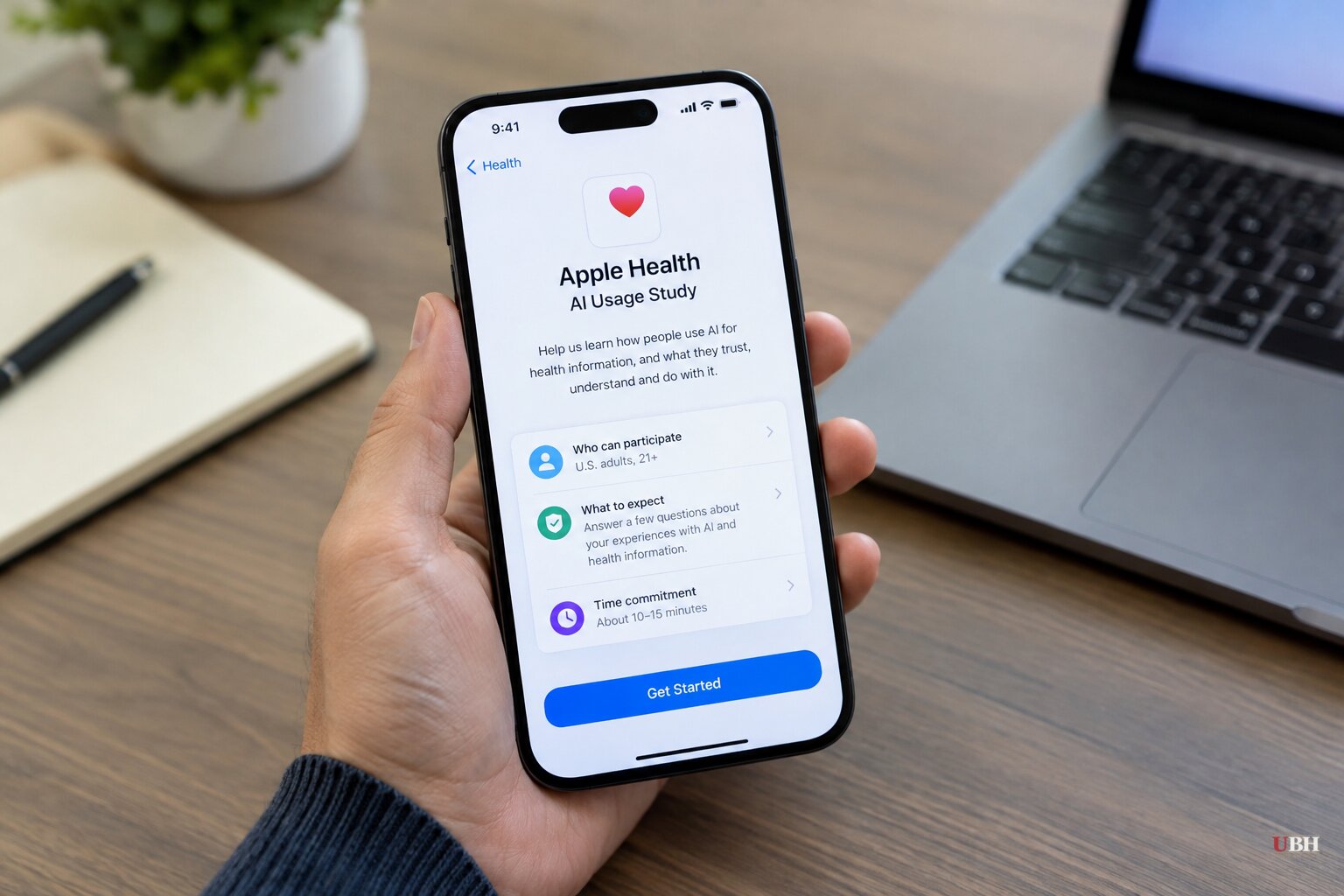
Apple wants 200,000 people to ask an AI their health questions and grade the answers.
The company announced the Apple Health AI Usage Study on Sunday, Nov. 15, in partnership with OpenEvidence, a clinical AI platform built for healthcare professionals. A dedicated iPhone app is already available for download in the U.S.
Who can join and what they do
Participants must be in the United States, at least 21 years old, and running iOS 26 or later on an iPhone that supports Apple Intelligence. Apple's launch materials list the iPhone 15 Pro or later. Enrollment is capped at up to 200,000 people, a ceiling rather than a count of who has signed up.
Each participant is asked to stay for up to 12 months. They can ask about general health, specific symptoms, recovery from a procedure or their own uploaded records. Answers come with linked, peer-reviewed citations. Participants rate responses, complete a baseline survey and monthly surveys, and get extra questionnaires on preparing for doctor visits.
OpenEvidence draws on The New England Journal of Medicine, the Journal of the American Medical Association, Nature, the National Comprehensive Cancer Network and the Cochrane Database of Systematic Reviews. Apple says it uses its own technology to turn that research into plain-language answers.
Participants can choose to share HealthKit data such as resting heart rate, activity, sleep or lab results to see whether personal data makes answers more relevant.
Privacy terms
Apple says study data is anonymized before it goes to a secure third-party cloud provider and will not be used to train AI models. Apple also says OpenEvidence deletes query and response data after 24 hours. Apple has said the data may inform its own feature development.
On-device Apple Foundation Models handle some tasks, such as classifying the category of each question. That is why the study requires newer iPhones.
What Apple says it is testing
"Health is deeply personal, and conducting a dedicated research study is the most thoughtful way to understand how people engage with, comprehend, and evaluate health AI in everyday life," said Sumbul Desai, M.D., Apple's vice president of Health and Fitness.
Apple's own announcement concedes the risk: consumer health tools powered by large language models "may at times offer responses that are incomplete or unclear."
Dr. Robert Wachter, chair of the Department of Medicine at UCSF, said patients and clinicians are using AI tools "built and tested in separate worlds." He said connecting them and studying what works is how care improves.
Dr. John Brownstein of Harvard Medical School said accurate answers are not always useful. "Confusing or incomplete information can create false reassurance or delay care," he said.
The gap the study is aimed at
A February 2026 Oxford study in Nature Medicine found AI chatbots identified medical conditions nearly 95% of the time on clinical cases. Everyday users who worked with the chatbots reached the right answer less than 35% of the time.
Use is already widespread. The Pew Research Center finds roughly one in three U.S. adults use AI chatbots, and about half of adults under 30. OpenAI said earlier this year that users send over 300 million health-related queries a week.
Public comfort is lower when the AI sits in the exam room. In a Pew survey of 3,488 U.S. adults taken in June, 60% said they were uncomfortable with doctors using AI for diagnosis and treatment decisions, double the share who said they were comfortable. About half said AI would worsen the doctor-patient relationship, and 51% said it would make patients' personal health information less secure. Opinion split on outcomes: 37% said better, 36% worse, 26% said little difference.
OpenEvidence's footprint
OpenEvidence is already deeply embedded in medicine. A study published in October found 952,008 doctors and other health professionals submitted 271 million queries to the platform from Jan. 1, 2024, through mid-2026. Dr. Anupam Jena, a Harvard Medical School professor and one of the authors, said physicians are "often using it in areas where they don't have specific expertise." The company reached a reported valuation of about $15 billion after a $250 million round in September.
OpenEvidence's full product is available only to healthcare professionals. The Apple study is a rare consumer-facing window into it.
What is still open
The study measures trust, comprehension and behavior. It does not measure clinical outcomes. A high rating of an answer shows what a participant thought of it, not whether it led to better care.
The design also limits who is counted. Requiring an Apple Intelligence iPhone, U.S. residency and age 21 or older defines a specific population. A large enrollment does not make the results representative of everyone using health chatbots.
Participants are asked to stay up to 12 months, so full-length results from the earliest cohort are a year away at minimum. Apple has not said whether the study will lead to AI answers in the Health app or Siri.
Sources used for this briefing
8 links from 8 independent newsrooms (syndicated copies of the same report count once)
These are the sources it draws on, linked so you can verify.


