
Unbiased headlines. Facts, not spin.
Unbiased Headlines is an independently owned news organization. We bring you the facts, not opinions, written fresh from 110+ named sources. Sources linked so you can verify it yourself.
 health
Notable (5/10)
Event date: October 30, 2026 ·
FDA Grants De Novo Authorization to Virtuoso Robot for Bladder Tumor Removal; Evidence Limited to Small Company-Sponsored Study
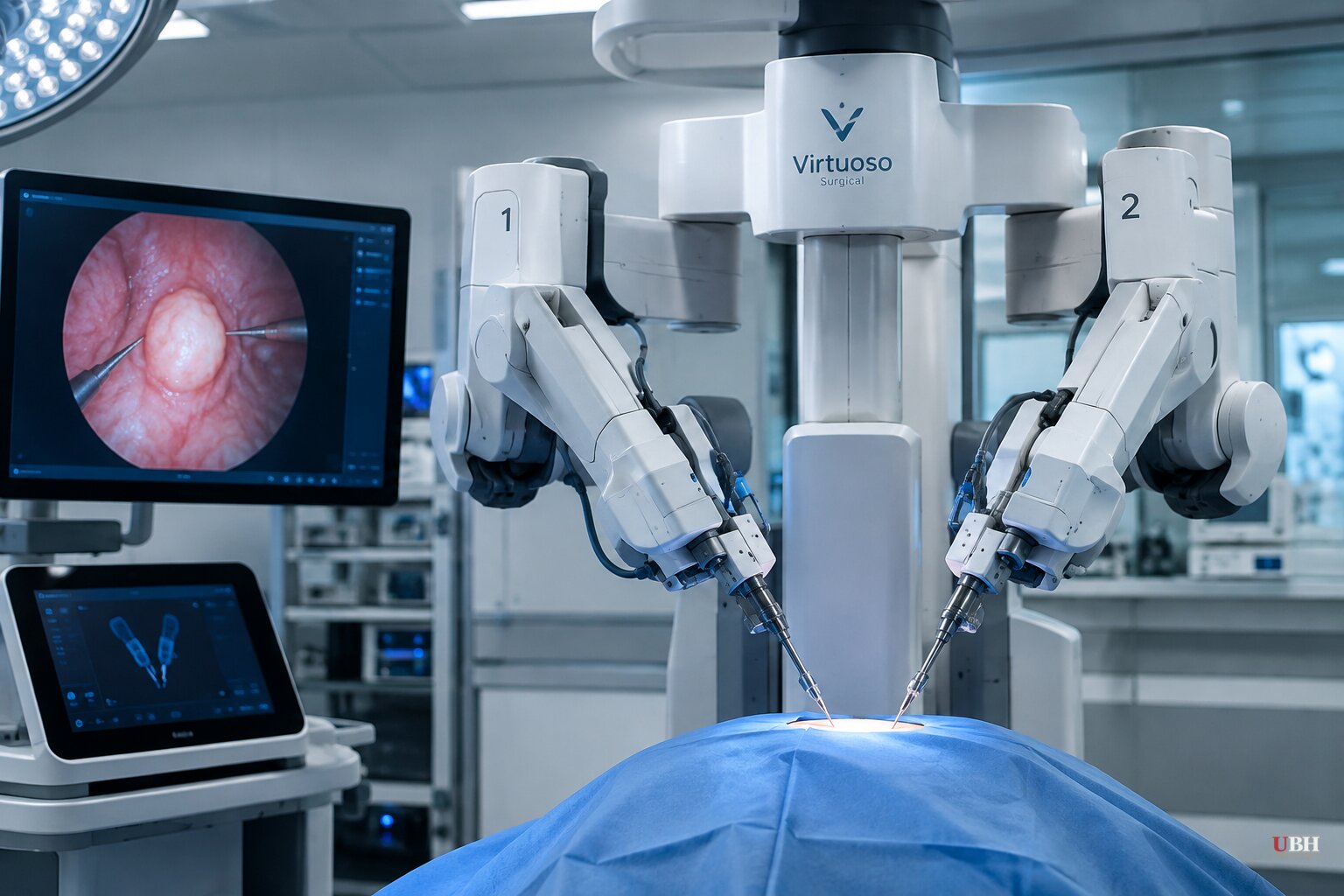
The FDA has authorized a new robot built to take bladder tumors out in one piece. Whether it helps patients live longer is not yet known.
The agency granted De Novo authorization to the Virtuoso Endoscopy System on October 30, 2026. Nashville-based Virtuoso Surgical announced the decision on November 10.
De Novo is the pathway for novel devices with no existing equivalent. The authorization creates a new FDA classification for electromechanical surgical systems used in endoluminal procedures.
What the device does
The system runs through a rigid endoscope that enters the bladder via the urethra. No cuts through the skin.
At the tip sit two miniature arms made of nitinol, a flexible metal alloy. A surgeon operates both from a console. One arm lifts and holds the lesion. The other separates it from the tissue underneath.
The robot does not think for itself. It follows the surgeon's hand movements and makes no surgical decisions.
The authorized use is narrow: removing bladder lesions in adults and obtaining tissue samples, including bladder muscle, to help in the diagnostic evaluation of bladder cancer.
Why one piece matters
The American Cancer Society estimates about 84,530 people in the U.S. will be diagnosed with bladder cancer in 2026.
A common procedure, transurethral resection of bladder tumor (TURBT), often removes tumors in fragments. Fragmenting can disrupt the tissue's structure and make it harder for pathologists to judge how deep the cancer has grown. Whether it has reached the detrusor muscle can change the recommended treatment.
Removing a lesion intact, known as en bloc resection, can preserve that information. Dr. Duke Herrell, a urologic surgeon and Virtuoso's CEO, said in the company's announcement: "Removing a tumor intact can provide a better tissue specimen, which supports clearer diagnosis and staging."
Surgeons can already do en bloc resection by hand. Dr. Sam Chang, chief surgical officer of Vanderbilt-Ingram Cancer Center, said in Virtuoso's statement that it "has been studied in randomized trials and is recognized in international guidelines, but it can be extremely technically demanding with today's instruments, and adoption has been very limited, especially in the U.S."
Chang, a former chair of the American Urological Association's bladder cancer guideline panel, is a paid consultant to Virtuoso.
What the data show
The evidence comes from the company-sponsored VIABLE study at The Chinese University of Hong Kong.
In the first phase, six patients with 12 lesions had en bloc or modified en bloc removal in 100% of cases. Detrusor muscle was present in all of them, and margins could be evaluated in 91%.
In an expanded interim look at the first 20 patients, detrusor muscle was present in 94% of removed lesions. That cleared the study's predefined goal of 60%. Margins were evaluable in 93% of malignant lesions. Virtuoso said the median rate of detrusor muscle presence in published studies of conventional resection is about 70%.
The company reported no intraoperative adverse events. The earlier six-patient phase did log two postoperative events: one case of temporary urinary retention and one chest infection later linked to a separate esophageal tumor.
The limits
The numbers are encouraging but thin. This is a small study at a single center, and the robot has not been tested against conventional instruments in a randomized trial. Virtuoso's comparison is to previously published research on conventional resection, not to a head-to-head arm.
Being able to evaluate a margin does not mean the margin is free of cancer. And the authorization does not establish that the robot improves survival or keeps cancer from coming back. Larger studies are still needed on long-term outcomes.
The system must be used by trained surgeons in an operating room.
What comes next
The FDA's September 2025 Breakthrough Device Designation preceded the authorization and gave the company extra regulatory guidance during development.
Virtuoso plans a focused U.S. launch at leading urology centers in 2027. The company has not said which hospitals will get the system first.
The company is also looking at other specialties that use rigid endoscopes. It has finished early non-human feasibility work in gynecology, pulmonary procedures and neurosurgery. Those uses are investigational and outside the authorized indication.
The open question is whether the better tissue samples the company reports in Hong Kong translate into better staging and treatment decisions in U.S. operating rooms. That will take larger trials, and none has been announced.
Sources used for this briefing
7 links from 5 independent newsrooms (syndicated copies of the same report count once)
These are the sources it draws on, linked so you can verify.


