
Unbiased headlines. Facts, not spin.
Unbiased Headlines is an independently owned news organization. We bring you the facts, not opinions, written fresh from 110+ named sources. Sources linked so you can verify it yourself.
 health
Low Interest (4/10)
Event date: November 3, 2026 ·
Chinese Team's Electric Comb Regrows 97.85% of Hair in Balding Mice. No Human Trials Announced
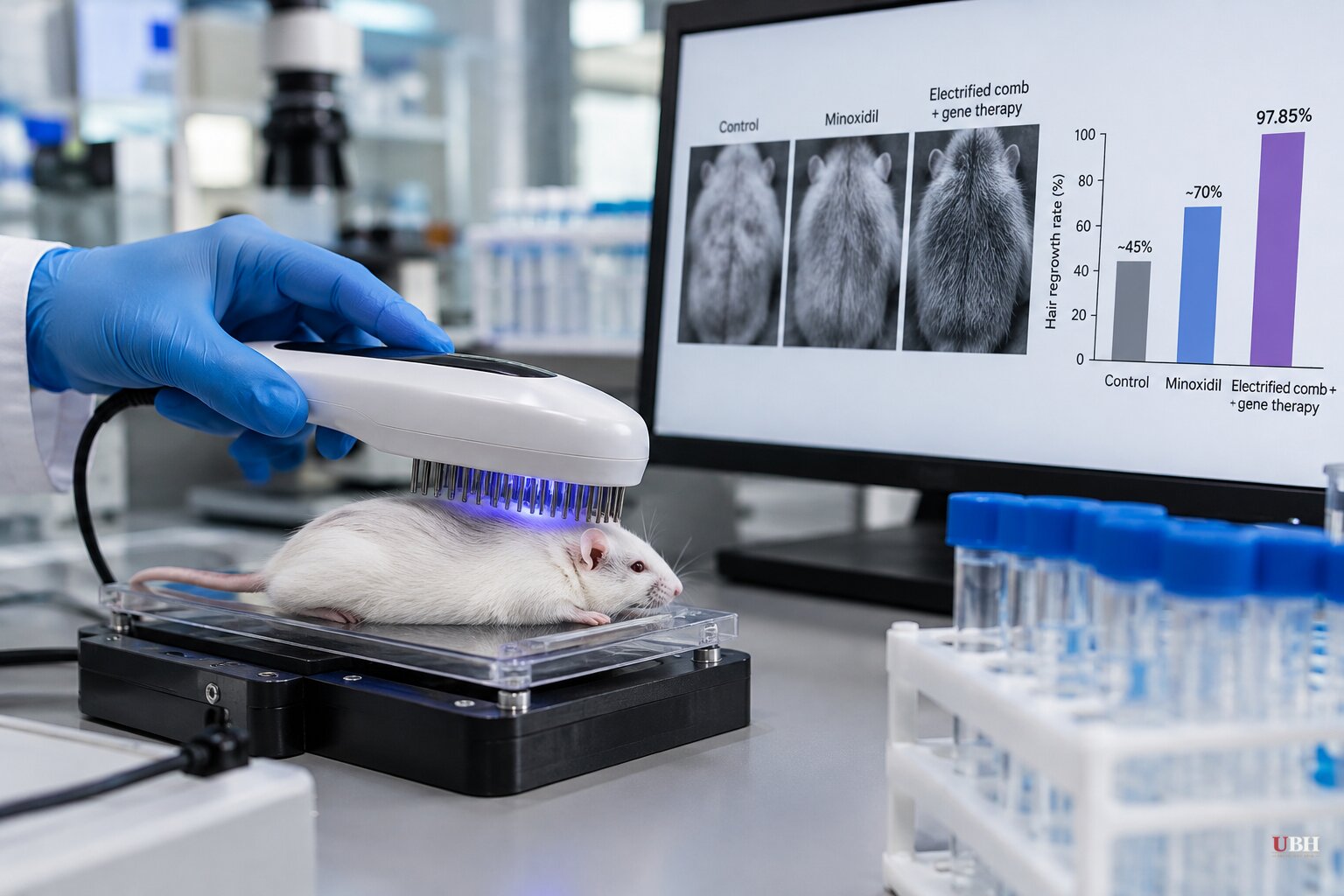
A comb that regrows hair is, so far, a comb that regrows hair on mice.
Researchers led by Beihang University in Beijing, working with the City University of Hong Kong, published results in Nature Communications on November 3, 2026. The device is called Detangle. The paper is titled "Combing-triggered electrostimulation synchronizing deep delivery for rapid hair regrowth in androgenetic alopecia."
What the device does
Detangle looks like a chunky pharmacy comb with a circuit board in a clear handle. Electrodes sit in the teeth, which alternate between long and short. The team says that height difference makes the pulsed electric field more than two and a half times stronger than evenly matched teeth would.
The shorter teeth hold two experimental treatments. One is a DNA fragment, a plasmid, carrying instructions for VEGF-A, a protein that builds blood vessels around the follicle. The other is an siRNA, a small RNA strand that blocks production of an enzyme tied to dihydrotestosterone (DHT). DHT is the hormone that shrinks follicles in pattern baldness.
The electric field temporarily makes skin cells more permeable. According to the researchers, that lets the treatments reach about 660 micrometres beneath the surface, roughly nine times deeper than a conventional topical application.
The mouse results
The team shaved mice and gave them testosterone to mimic androgenetic alopecia. Over 28 days, different groups received minoxidil, finasteride, the comb's electrical stimulation alone, or the comb with both experimental treatments.
The numbers, as reported from the study:
- Comb plus both treatments, used every three days: 97.85% hair regrowth.
- Minoxidil: about 70%.
- Finasteride: about 50%.
- Electrical stimulation alone: around 40%.
- Untreated mice: about 1%.
The researchers also reported higher follicle counts, better local blood flow and more blood vessel development in the comb group. They found no significant skin irritation, inflammation or nerve damage under the experimental conditions.
The convenience gap is notable on paper. The comb was used roughly 10 times in a month. The minoxidil mice got a 0.2 milliliter application every day, about 30 doses totaling 6 milliliters.
What the authors say, and what they don't
The team wrote in the paper that "these results demonstrate that electrostimulation via the Detangle system promotes hair growth and follicle regeneration in a safe and effective manner." That is a claim about mice.
The researchers also said it is still necessary to verify whether the same effect occurs in humans. Their own framing is that the work confirms the possibility of a new way to deliver hair-loss treatments deep into the scalp.
The caution is warranted, since mouse skin and human skin are not the same. The mice in this study were shaved and hormonally manipulated to mimic baldness. That is a model of the condition, not the condition itself. Human scalps, hair cycles and decades-long hair loss are a harder target.
No clinical trials have been announced. No commercial release plans have been announced. Neither has any regulatory pathway for a device that pairs electronics with gene-based drugs.
Why anyone cares
The study's authors say androgenetic alopecia affects more than 1.5 billion people worldwide. Some studies suggest up to 80 percent of men will experience pattern baldness, and between one fifth and two fifths of women may see pattern thinning.
Current options have drawbacks. Topical minoxidil can irritate the scalp. Oral drugs like finasteride act on the whole body, which the authors cite as a source of side effects. Transplants are expensive and surgical. A treatment built into a daily grooming habit and aimed at the follicle is an appealing idea.
The authors suggest the drug-delivery approach could eventually have uses beyond hair restoration, though that is a stated possibility, not a result.
What comes next
The open question is whether a plasmid and an siRNA, pushed through skin by electric pulses, can do in people what they did in mice, and do it safely over years. Answering that requires human trials. As of November 22, 2026, none have been announced.
Sources used for this briefing
7 links from 7 independent newsrooms (syndicated copies of the same report count once)
These are the sources it draws on, linked so you can verify.


