
Unbiased headlines. Facts, not spin.
Unbiased Headlines is an independently owned news organization. We bring you the facts, not opinions, written fresh from 110+ named sources. Sources linked so you can verify it yourself.
 health
Notable (5/10)
Event date: November 20, 2026 ·
FDA Approves Weekly Sogroya for Turner Syndrome; Trial Growth Rate Was Slightly Below Daily Shots
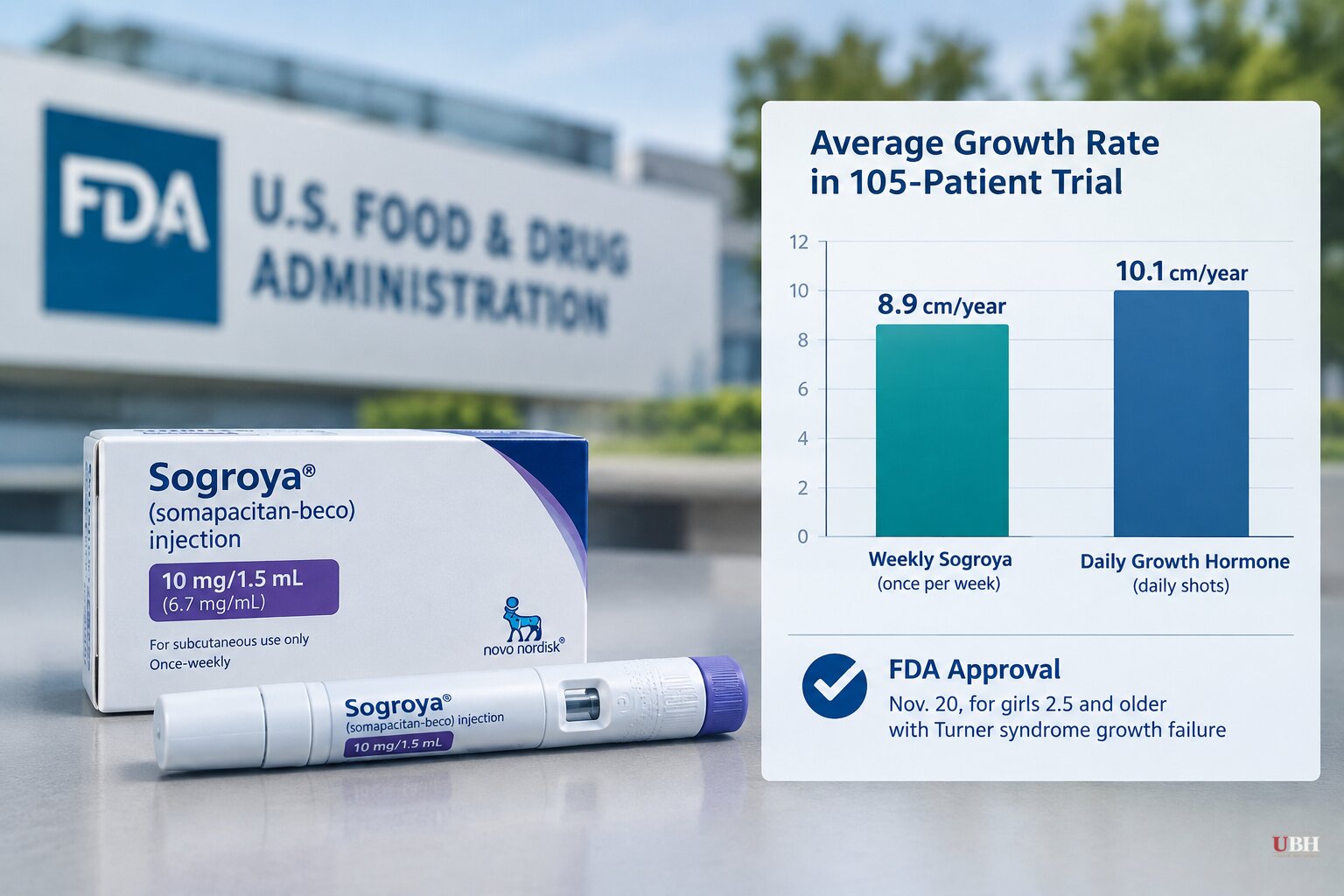
The U.S. Food and Drug Administration approved Novo Nordisk's Sogroya (somapacitan-beco) on Friday, Nov. 20, for children aged 2.5 years and older with growth failure associated with Turner syndrome. Novo says it is the first and only once-weekly, long-acting growth hormone approved for that population.
Turner syndrome occurs when one of the two X chromosomes in a female is missing or altered. Short stature is its most common feature. The condition occurs in about 1 in 2,000 female newborns worldwide, according to the figure cited by Securities.io.
What the trial showed
The approval rests on the Turner syndrome cohort of REAL8, a phase 3, multicenter, randomized, open-label, active-comparator basket study. It enrolled 105 growth-hormone treatment-naive, pre-pubertal girls aged 2.5 to 10.
Patients were randomized 2:1. Sixty-eight got Sogroya at 0.24 mg/kg once a week. Thirty-seven got daily somatropin at 0.05 mg/kg/day.
At week 52, the primary endpoint, mean annualized height velocity, was 8.9 cm/year on Sogroya and 9.7 cm/year on daily somatropin. The estimated treatment difference was -0.8 cm/year, with a 95% confidence interval of -1.58 to 0.07.
The supportive endpoint, change in annualized height standard deviation score from baseline, was 0.77 on Sogroya and 0.86 on somatropin. Baseline height scores were -2.8 and -3.0, respectively.
Both numbers came in numerically lower for the weekly drug. Novo characterizes the growth rates as comparable.
A discrepancy in the confidence interval
Novo's press release printed two different confidence intervals for the gap. The text gave -1.58 to 0.07, which includes zero. The release's table gave -1.57 to -0.11, which does not. Tech Times reported that the FDA-approved label carries the interval that includes zero and states no non-inferiority margin, and that the reason the table's numbers differ is unknown. Contemporary Pediatrics also did not report a margin.
The comparator dose
The daily somatropin dose in the trial was 0.05 mg/kg/day. The maximum U.S.-approved pediatric dose for Turner syndrome is 0.067 mg/kg/day.
Novo itself flagged that gap. Contemporary Pediatrics noted that the trial therefore does not show how Sogroya compares with the higher daily doses some U.S. clinicians use in Turner syndrome. It also noted that adult height data are lacking. Participants are continuing in a two-year safety extension that follows the 52-week primary treatment period.
The pitch: fewer injections
The argument for Sogroya is convenience. A weekly schedule means 52 injections a year instead of 365, and 313 injection-free days each year, according to Dr. Aristides Maniatis, a REAL8 investigator.
"Daily growth hormone therapy works well, but staying consistent with treatment over time can be difficult — especially in conditions like Turner Syndrome, where families may struggle with managing multiple comorbidities and medications," Maniatis said in comments distributed by Novo.
Colleen Silk, Novo's group vice president for rare disease, called the weekly option "a meaningful advancement in how we support growth in children with Turner Syndrome" and said it reduces the number of injections throughout that journey. Novo also said weekly administration may help address non-adherence associated with daily injections.
Contemporary Pediatrics noted that REAL8 was not designed to test whether better adherence offsets a modest difference in height velocity. The primary measure was growth over 52 weeks.
Safety profile
Adverse reactions in at least 10% of Turner syndrome patients through week 52 were respiratory tract infection, nasopharyngitis, ear infection, pyrexia, diarrhea, vomiting and injection-site reactions. Across pediatric indications, cough, headache and pain in an extremity are also among the most common side effects.
The two-year safety extension is the main source of additional long-term safety data now under way.
Where Sogroya stands
Turner syndrome becomes the fifth pediatric growth indication for Sogroya. The others are growth failure due to inadequate secretion of endogenous growth hormone, idiopathic short stature, short stature in children born small for gestational age with no catch-up growth by age 2, and growth failure associated with Noonan syndrome. The drug is also approved for adults with growth hormone deficiency, first cleared in the U.S. in 2020.
Novo Nordisk funded REAL8 and holds the marketing authorization.
For families, the choice comes down to how much a weekly schedule is worth against a trial that showed a numerically lower growth rate than daily dosing, at a daily comparator dose below the labeled maximum. Whether the 0.8 cm/year gap at week 52 translates into any difference in final adult height is not yet known, because adult height data are lacking.
Sources used for this briefing
8 links from 8 independent newsrooms (syndicated copies of the same report count once)
These are the sources it draws on, linked so you can verify.


