
Unbiased headlines. Facts, not spin.
Unbiased Headlines is an independently owned news organization. We bring you the facts, not opinions, written fresh from 110+ named sources. Sources linked so you can verify it yourself.
 health
Notable (6/10)
Event date: November 20, 2026 ·
FDA Creates CBER Safety Council to Review Vaccines and Gene Therapies After Approval
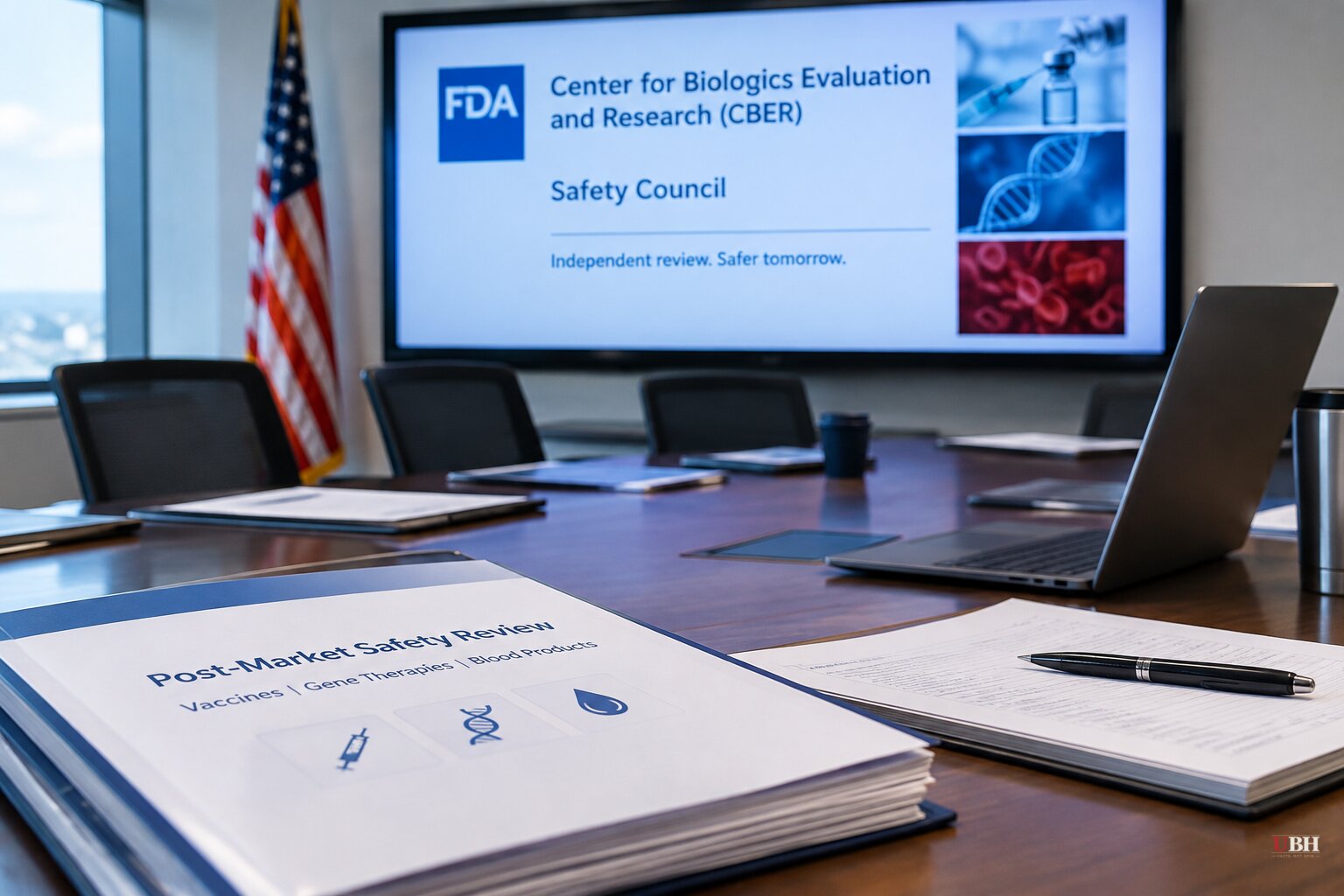
The Food and Drug Administration announced on Nov. 19 that it has established the CBER Safety Council, a new body inside the Center for Biologics Evaluation and Research. The council took effect that day.
CBER regulates vaccines, cell and gene therapies, and blood and blood products. The council's job is post-market safety: what happens after those products are approved and used by far more people than were in the trials.
What the council does
Per the FDA's announcement, the council will review safety signals in CBER-regulated products and run benefit-risk assessments. It can recommend regulatory action to the center director, including labeling changes, risk-management requirements, post-market studies and market withdrawals.
It will also publish public-facing safety communications and coordinate with outside partners, including the CDC. Its data will come from the FDA's Sentinel System, the Vaccine Adverse Event Reporting System (VAERS) and the CDC's Vaccine Safety Datalink.
The council will lean on three existing CBER units: the Division of Pharmacovigilance, the CBER Surveillance Program, and the Division of Analytics and Benefit-Risk Assessment.
Separate from the approvers
The structural change is the point. The council sits apart from the CBER product offices that handle premarket approval and reports directly to the CBER director.
The FDA's stated reasoning is that this adds "a layer of review that is distinct from the product offices that conduct premarket approval." The agency says that should make safety assessments behind post-marketing actions "comprehensive and consistent" and make the evidence behind FDA decisions "transparently communicated to the public."
The council is not a free-standing regulator. The FDA's announcement says the council "may recommend" actions and that the center director "remains responsible for appropriate regulatory actions." It cannot pull a product on its own.
It is also not entirely new. The FDA describes it as an evolution of CBER's long-standing Safety Working Group.
Who runs it
The council will be managed by a Senior Advisor for Postmarketing Safety, who reports to the CBER director. The FDA has not named that person or released the council's membership.
The director is Karim Mikhail, a former Merck official, according to The Epoch Times. Whoever fills the senior adviser role will answer to him.
The FDA said details on the council's structure, membership and operating procedures will be posted on its website.
Kennedy and the surveillance systems
The announcement lands amid a push from the top of the Department of Health and Human Services. Health Secretary Robert F. Kennedy Jr. has said the existing vaccine safety surveillance systems are deficient and that officials are overhauling them.
The new council is built on those same systems, including VAERS. The FDA has not said how the overhaul Kennedy describes will change what the council receives.
VAERS is an open reporting system. A report there is a signal, not proof that a product caused an injury, and the council's benefit-risk assessments are meant to sort signals from causation.
The FDA told manufacturers, healthcare providers and patient advocates to keep reporting adverse events through VAERS and MedWatch.
What was not announced
No specific product or group of injured patients triggered the council's creation, and the FDA named no therapy under review. It also published no evidence that the new arrangement has improved safety outcomes. Those points matter for anyone reading the announcement as a response to a particular problem.
The agency has set no publication timetable for the council's reviews. It has not said whether the underlying analyses will be released in full, only that significant safety determinations will come with public communications.
The gene therapy question
The harder test may come in cell and gene therapy. These products are often given to very small patient groups, and it remains unclear how VAERS and Sentinel will be applied to them.
Many recent approvals already rest heavily on evidence gathered after launch. Ultragenyx's Genglycos, approved for glycogen storage disease type Ia, carries a 10-year disease monitoring program. Companies with products on the market should expect those post-approval commitments to get closer, more centralized scrutiny.
The next concrete markers are the ones the FDA promised: the named manager, the member list and the operating procedures. Until they are posted, the council's independence from the approval side, and its ability to move a recommendation past the center director, cannot be measured.
Sources used for this briefing
7 links from 7 independent newsrooms (syndicated copies of the same report count once)
These are the sources it draws on, linked so you can verify.


