
Unbiased headlines. Facts, not spin.
Unbiased Headlines is an independently owned news organization. We bring you the facts, not opinions, written fresh from 110+ named sources. Sources linked so you can verify it yourself.
 health
Notable (6/10)
FDA Rejects Capricor's Duchenne Cell Therapy a Second Time, Cites Data Integrity Violations; Company Disputes Finding
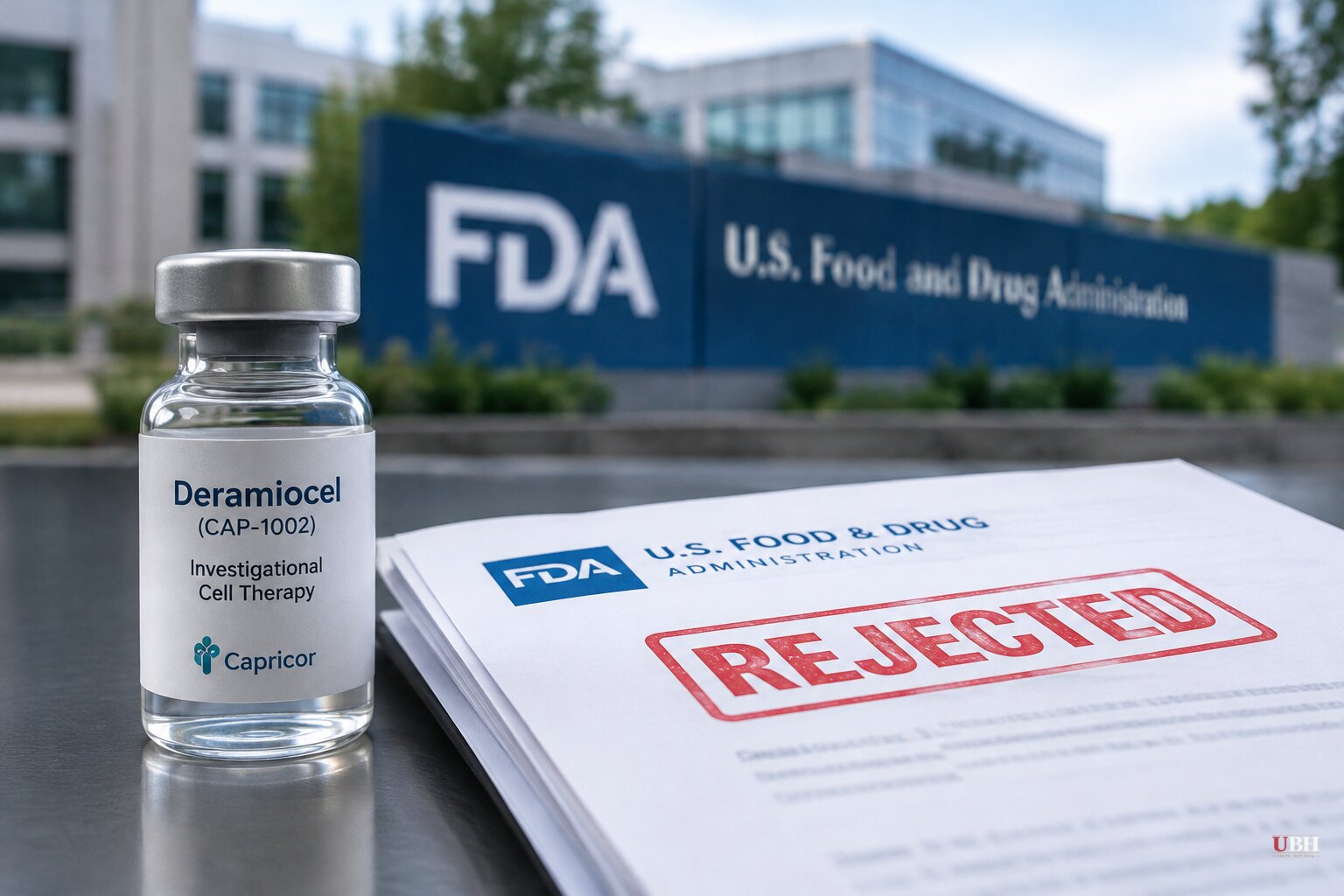
The FDA has rejected Capricor Therapeutics' cell therapy deramiocel for Duchenne muscular dystrophy for the second time. The agency issued a complete response letter on Friday, Nov. 20, two days ahead of the scheduled Nov. 22 action date.
The first rejection came in July 2025. This one carries a harsher charge.
What the FDA says it found
In a public statement, the FDA said the letter "identifies serious data integrity violations in the conduct of Study HOPE-3 that cannot be remediated post-hoc." The letter came from the Office of Therapeutic Products at the agency's biologics center.
The agency said its Bioresearch Monitoring inspection of Capricor found three problems: unauthorized post hoc changes to the statistical analysis plan, violations of study blinding procedures, and additional protocol violations. Individually and together, the FDA said, they compromise the reliability of the data.
The FDA also said HOPE-3 failed its prespecified primary and secondary endpoints, covering upper-limb function and cardiac imaging. The integrity problems, it said, amplified that concern.
"Even if the question of clinical meaningfulness could theoretically be addressed, the underlying data cannot serve as a reliable foundation for a marketing approval determination," the statement said.
A separate Regulatory Responsibility Letter dated Nov. 20 covers the inspection observations. Capricor has the opportunity to respond to it.
What Capricor says
Capricor's own announcement was narrower. It said the letter finds the data insufficient to establish "substantial evidence of effectiveness" and cites "certain other clinical deficiencies," which the company did not describe. Its release did not mention the data integrity findings.
CEO Linda Marbán said: "Deramiocel has been studied in two randomized, double-blind, placebo-controlled trials, HOPE-2 and HOPE-3, both of which met their primary endpoints. We stand behind the rigor of our clinical program and the integrity of our data, and we believe the data support approval."
The company said it is reviewing the letter and will share next steps after it finishes its evaluation.
The trial and the dispute over its endpoints
HOPE-3 randomized 106 patients with advanced DMD to deramiocel or placebo for 12 months. Capricor reported in December 2025 that the therapy met the primary endpoint on upper-limb function. NeurologyLive cited a 4.55% least-squares mean advantage on the PUL2.0 scale. Capricor also reported that it slowed decline in left ventricular ejection fraction on cardiac MRI.
FDA reviewers disputed whether HOPE-3 met its prespecified endpoints under the original statistical analysis plan. They also questioned how missing data were handled and the changes made to the analysis plan after randomization.
The distinction matters in trial design. A p-value carries weight only if the analysis was locked before the data were seen and participants could not tell which arm they were in. The FDA says both safeguards were compromised here.
A review that dragged on
The FDA's advisory committee met on July 29, 2026. It voted 9–3 against effectiveness of deramiocel for DMD cardiomyopathy, according to NeurologyLive. No formal benefit-risk vote was held, and the discussion acknowledged signals in skeletal muscle.
The review was then extended by three months. Capricor filed a major amendment with 24 months of open-label extension data and a narrower proposed indication for upper-limb function in patients older than 9.
The FDA said career scientists reviewed all of it, including the amendment, and concluded the evidence still fell short. According to the Tech Times account of the agency's reasoning, open-label follow-up from the same trial cannot restore the blinding and prespecified-analysis safeguards the FDA says were lost.
The agency framed the decision around patient protection. "Upholding rigorous evidentiary standards is precisely how the FDA protects patients, particularly those living with rare diseases, from interventions whose benefits have not been sufficiently established," the statement said.
The history between the two
The relationship has been rocky. After the July 2025 rejection, Marbán said the company was "surprised" and that the review had previously advanced with "no major issues." Capricor said the earlier letter also cited chemistry, manufacturing and controls deficiencies it believed it had already addressed.
BioSpace reported that the first rejection followed the cancellation of an advisory committee that had been scheduled by Nicole Verdun, then head of the Office of Therapeutic Products. It reported the meeting was canceled unilaterally by then-CBER director Vinay Prasad, and that Verdun and her deputy Rachael Anatol left the agency in June 2025.
The money
Capricor said it held about $198.5 million in cash, equivalents, restricted cash and marketable securities as of Sept. 30, 2026. It believes that funds operations for at least 12 months. The company said it is reviewing operating costs to extend that runway.
Capricor shares closed at $7.59 on Friday. In after-hours trading they fell nearly 80%, to $1.63, according to BioSpace. U.S. markets are closed today, so that remains an after-hours figure, not a regular-session price.
What comes next
Capricor has not said whether it will appeal, run another trial or contest the inspection findings. NeurologyLive reported that ex-U.S. regulatory pathways are being initiated.
Two questions are unresolved. The first is what the "other clinical deficiencies" in the letter actually are. The second is how Capricor answers the Regulatory Responsibility Letter, since the company's public statement so far has not addressed the FDA's data integrity findings.
Sources used for this briefing
7 links from 7 independent newsrooms (syndicated copies of the same report count once)
These are the sources it draws on, linked so you can verify.


