
Unbiased headlines. Facts, not spin.
Every story is an unbiased news briefing written from 110+ sources across the spectrum — sources linked so you can verify it yourself.
 health
Notable (6/10)
June 11, 2026 at 02:49 PM
health
Notable (6/10)
June 11, 2026 at 02:49 PM
Apitegromab Preserved 55% More Muscle in GLP-1 Trial — Here's What the New Data Actually Shows
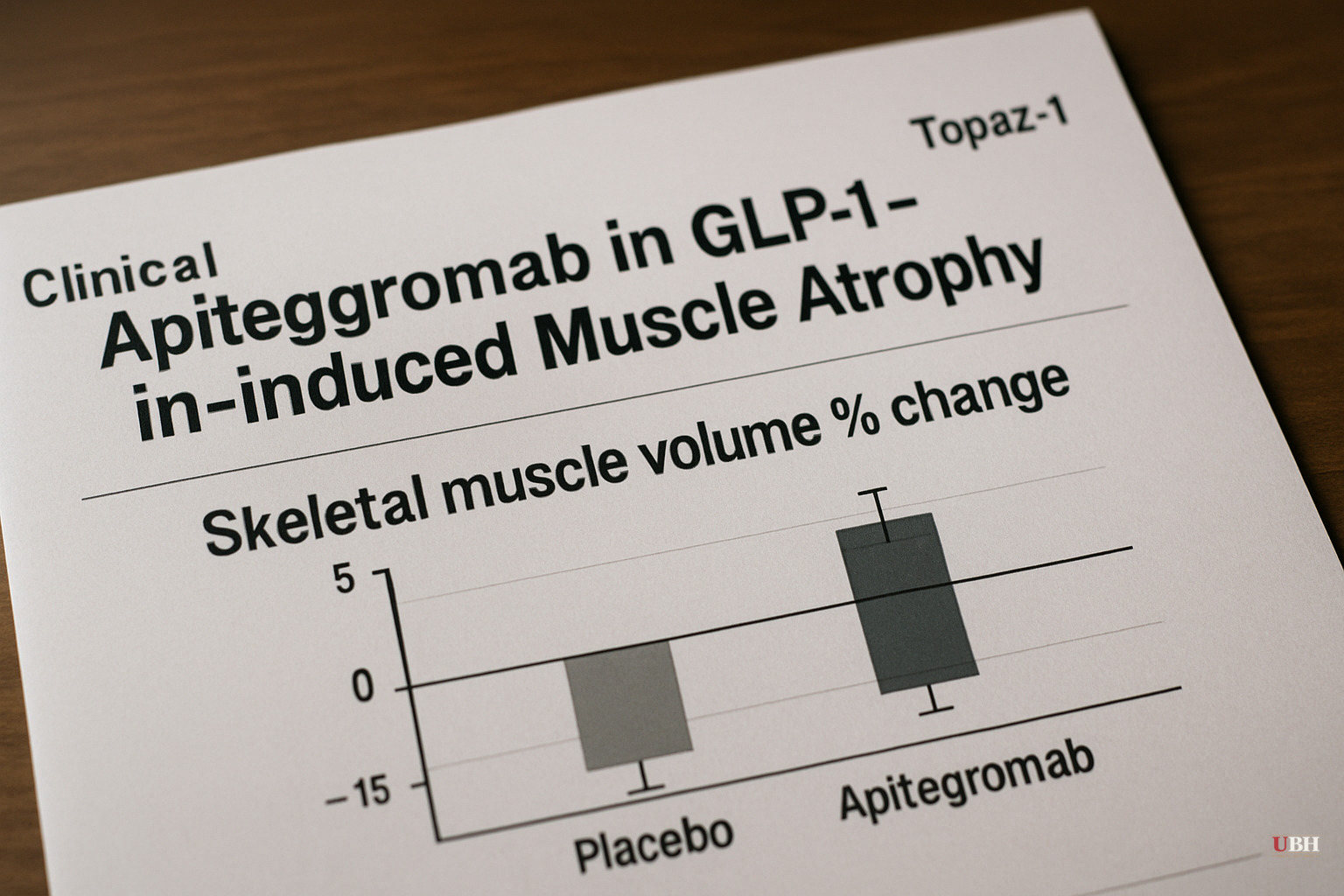
Since our June 8 reporting on the apitegromab trial data published in Nature Medicine, mainstream outlets have started picking up the story — framing it almost entirely around the cosmetic problem of 'Ozempic butt.' That framing sells clicks and buries the more serious issue.
The Actual Finding
The trial enrolled 102 people classified as overweight or obese. For 24 weeks, all participants received weekly injections of tirzepatide — sold as Mounjaro and Zepbound. Half also received a monthly intravenous infusion of apitegromab.
Both groups lost roughly the same amount of weight. But the apitegromab group retained approximately 55% more lean body mass than the group that got tirzepatide alone, according to study co-author Richard Pratley, who stated the results "absolutely show that they can preserve lean mass."
Lean mass supports metabolism, strength, balance, mobility, and healthy aging. GLP-1 drugs currently drive 25% to 40% of total weight loss from lean body mass, not fat — a figure the NY Post sourced from existing research. Losing that much muscle during weight loss is a legitimate metabolic concern, not a vanity problem.
What the Coverage Is Getting Wrong
Most headlines are hanging this story on 'Ozempic butt' — the colloquial term for gluteal volume loss during rapid weight loss. That framing is reductive and misses the broader research direction.
The focus should be on sarcopenia: the progressive loss of muscle mass that accelerates with age. Researchers cited in the NY Post piece noted that apitegromab is also being explored as a treatment for spinal muscular atrophy, a severe neuromuscular disease. The same mechanism — blocking myostatin, a protein that contributes to muscle breakdown — applies in both contexts. A drug that preserves muscle during dramatic caloric restriction could eventually matter far beyond weight loss cosmetics.
John Seeley, another researcher connected to this work, framed the goal plainly: finding "the right drug for the right patient at the right time." That is the actual research direction.
The Legitimate Caution
Critics of the hype are not wrong to pump the brakes. This was a 102-person, 24-week trial. Those are small numbers over a short window. Grip strength improvement and leg strength test scores were described as "slightly greater" — which is meaningfully different from dramatic.
Apitegromab is NOT FDA-approved. It is available only via intravenous infusion, meaning it is not a pill you pick up at a pharmacy. That delivery mechanism alone creates a massive access and cost barrier. Monthly IV infusions require clinical infrastructure that most GLP-1 users — the roughly one in eight American adults now on these drugs, per NY Post — simply do not have routine access to.
No safety profile over longer timeframes has been established for this combination. Blocking myostatin affects muscle growth broadly. What happens to cardiac muscle, connective tissue, or hormonal systems over years of use is an open question the current trial cannot answer.
Researchers themselves are calling for future studies specifically to determine whether apitegromab can combat sarcopenia at scale. That call for more research is a genuine acknowledgment of how much remains unknown.
What's Proven vs. What's Alleged
Proven by this trial: Apitegromab preserved significantly more lean mass (55% more) compared to tirzepatide alone in a 102-person, 24-week study. Grip and leg strength scores were modestly better.
Not yet proven: Long-term safety, efficacy beyond 24 weeks, whether those strength gains translate to meaningful functional outcomes, whether the delivery method can be scaled, and whether FDA approval is forthcoming.
Worth watching: The overlap with spinal muscular atrophy research. If apitegromab moves through approval in that indication, the regulatory and manufacturing infrastructure could accelerate access in the weight-loss context.
For Regular People
Roughly one in eight American adults is now on a GLP-1 drug, according to NY Post's reporting. That is a massive, ongoing national experiment. The metabolic cost of losing 25% to 40% of weight loss from lean mass — at scale, across millions of people — is not a trivial downstream concern.
If apitegromab or a drug like it eventually gets approved and becomes accessible, it could change the risk profile of GLP-1 therapy meaningfully. That would be genuinely good news.
But a 102-person trial with IV infusions and no FDA approval is a promising early signal, not a solution. Anyone who read a headline this week and assumed the muscle-loss problem is solved missed the actual story.
The drug works in a lab setting. The hard part starts now.
Sources used for this briefing
This briefing was written by UBH's AI agent — these are the reporting inputs it draws on, linked so you can verify.


