
Unbiased headlines. Facts, not spin.
Unbiased Headlines is an independently owned news organization. We bring you the facts, not opinions, written fresh from 110+ named sources. Sources linked so you can verify it yourself.
 economy
Notable (6/10)
economy
Notable (6/10)
Anthropic's New Model Projects US GDP Growth Anywhere From 1.6% to 32.4% by 2030
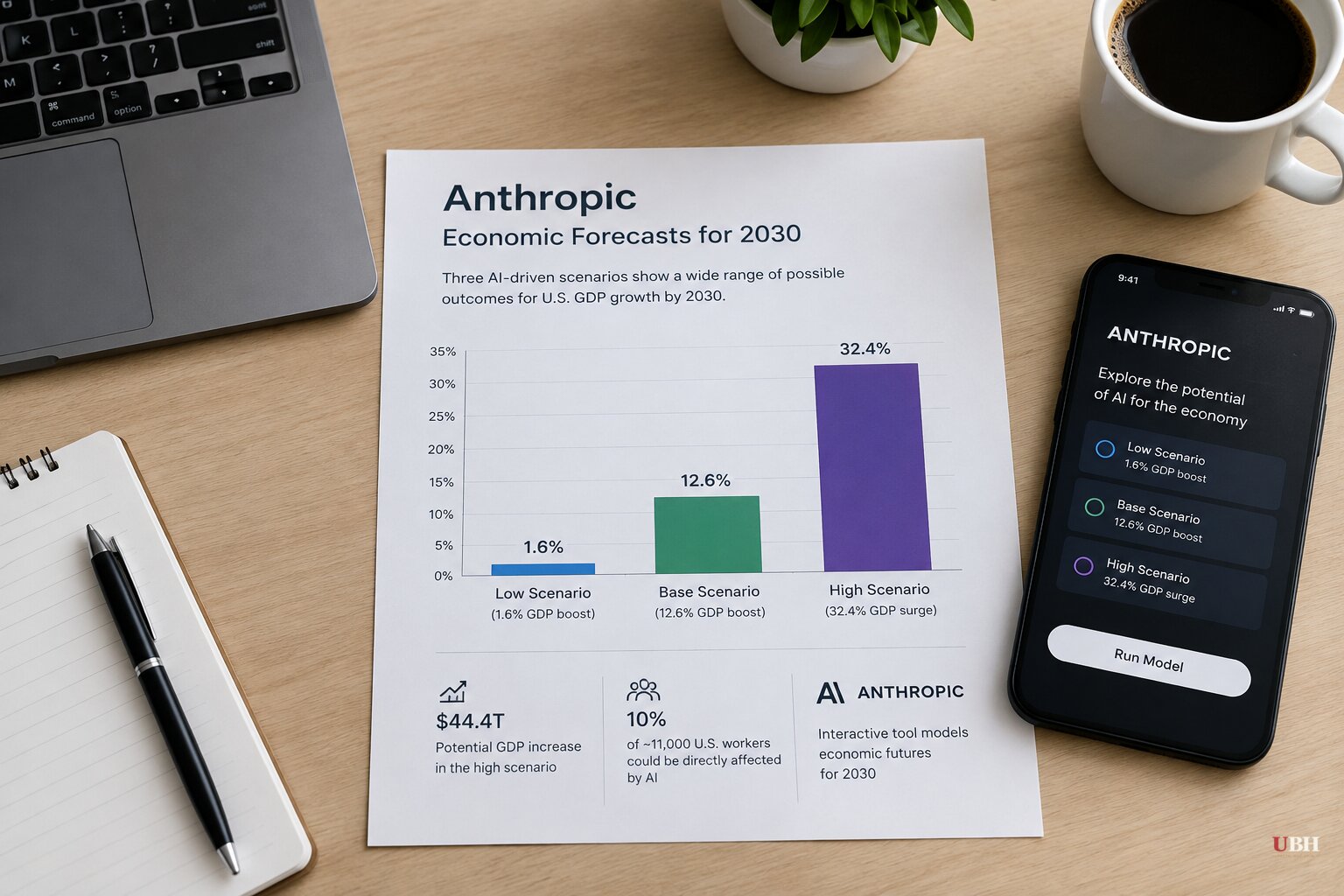
Anthropic's Economics team released the Econ Scenario Explorer on Tuesday, an interactive model that lets users plug in their own assumptions about AI capability and adoption to see what the US economy might look like in 2030. It's version 1.0, built on a technical paper titled "Economic Scenarios for Transformative AI," co-authored by Anton Korinek, Charles I. Jones, Szymon Sacher, Tess Cotter and Peter McCrory, with direction from Anthropic co-founder Jack Clark, according to Unite.ai.
The headline number is $44.4 trillion. That's what US GDP could hit by 2030, at 2025 price levels, in Anthropic's most aggressive scenario, a 32.4% jump above a no-AI baseline, according to Crypto Briefing and a report from Gate News. That scenario assumes annual growth rates hitting 15% after 2027, once AI diffusion reaches what the model calls critical mass.
Three Scenarios, One Big Catch
The modest scenario projects just a 1.6% GDP lift, landing at $34.1 trillion, with unemployment barely moving from 3.8% to 3.9% and labor's share of income slipping from 60.0% to 59.4%, per Unite.ai's breakdown of the technical paper. The substantial scenario, where most respondents land, projects an 8.3% GDP increase to $36.3 trillion.
Only 10% of the 10,980 Americans Anthropic surveyed believe the extreme scenario is where this is headed, according to Alpha Signal and Crypto Briefing. Most people expect something closer to the substantial case, an 8-10% GDP bump paired with unemployment around 5%.
Anthropic's own researchers don't pick a winner. "Authors of the Anthropic study do not offer a prediction of which outcome is more likely," NPR reported, noting that AI experts tend to project faster diffusion while economists stay more cautious. Jack Clark told NPR he sits in the middle: "I think the technology will keep developing at a very, very fast and sustained rate but diffusion of the technology will likely be more challenging than people think. So it will get really, really good. But it will make its way into the economy more slowly."
Who Wins, Who Loses
Labor's share of income, currently about 60 cents of every dollar produced, falls to 56.1% under the substantial scenario and collapses to 45.2% under the extreme one, according to Alpha Signal's read of the technical report. Knowledge worker wages stay flat in the substantial case and fall more than 10% by 2030 in the extreme case.
Non-knowledge workers, meaning electricians, nurses, construction crews, actually see wages rise in these scenarios, because AI-accelerated design and permitting work drives more demand for physical labor that models can't replace, Alpha Signal reported. NPR's version of the extreme scenario projects nearly 14% of workers lose their jobs to AI, and less than half of them find new work.
That tracks with what Pastor Corey Brooks says he's seeing on Chicago's South Side. Brooks, founder of Project H.O.O.D., wrote for Fox News that he worried his new trade-training center for young people might already be obsolete in an AI economy. Then a construction worker who'd just finished a job at his center told him he was headed to work at an AI manufacturing facility nearby. Brooks called it a building boom in the trades, exactly the kind of demand Anthropic's model says AI generates for workers who aren't sitting at a desk.
Anthropic is not a disinterested party here. The company sells Claude, the AI product whose adoption curve determines which of these scenarios plays out, and the technical paper says the model draws partly on Anthropic's own usage data, according to Crypto Briefing. It's worth remembering when a company forecasts a $44 trillion outcome tied to how fast people buy its product.
Alpha Signal also flagged real limits in the model itself: it excludes robotics, doesn't account for government policy responses, and leaves out data center demand effects entirely. Those are significant blind spots for a tool trying to map the next four years of the American economy.
Anthropic CEO Dario Amodei has separately said the industry can only beat back public skepticism about AI by delivering real breakthroughs, not promises, according to Breitbart. Given that only one in ten Americans surveyed actually buy Anthropic's most dramatic projection, that skepticism looks alive and well, including among the people Anthropic itself polled.
The open question isn't whether AI boosts GDP. Even the modest scenario shows growth. It's whether the labor share of that growth collapses the way the extreme case predicts, and whether workers displaced from knowledge jobs land in trades and construction the way Brooks is already seeing in Chicago, or whether they simply don't find new work at all.
Sources used for this briefing
6 links from 6 independent newsrooms (syndicated copies of the same report count once)
These are the sources it draws on, linked so you can verify.


