
Unbiased headlines. Facts, not spin.
Unbiased Headlines is an independently owned news organization. We bring you the facts, not opinions, written fresh from 110+ named sources. Sources linked so you can verify it yourself.
 economy
Major Story (8/10)
Event date: August 31, 2026 ·
economy
Major Story (8/10)
Event date: August 31, 2026 ·
US Debt Hits $40 Trillion as Global Bond Yields Climb to Multi-Decade Highs
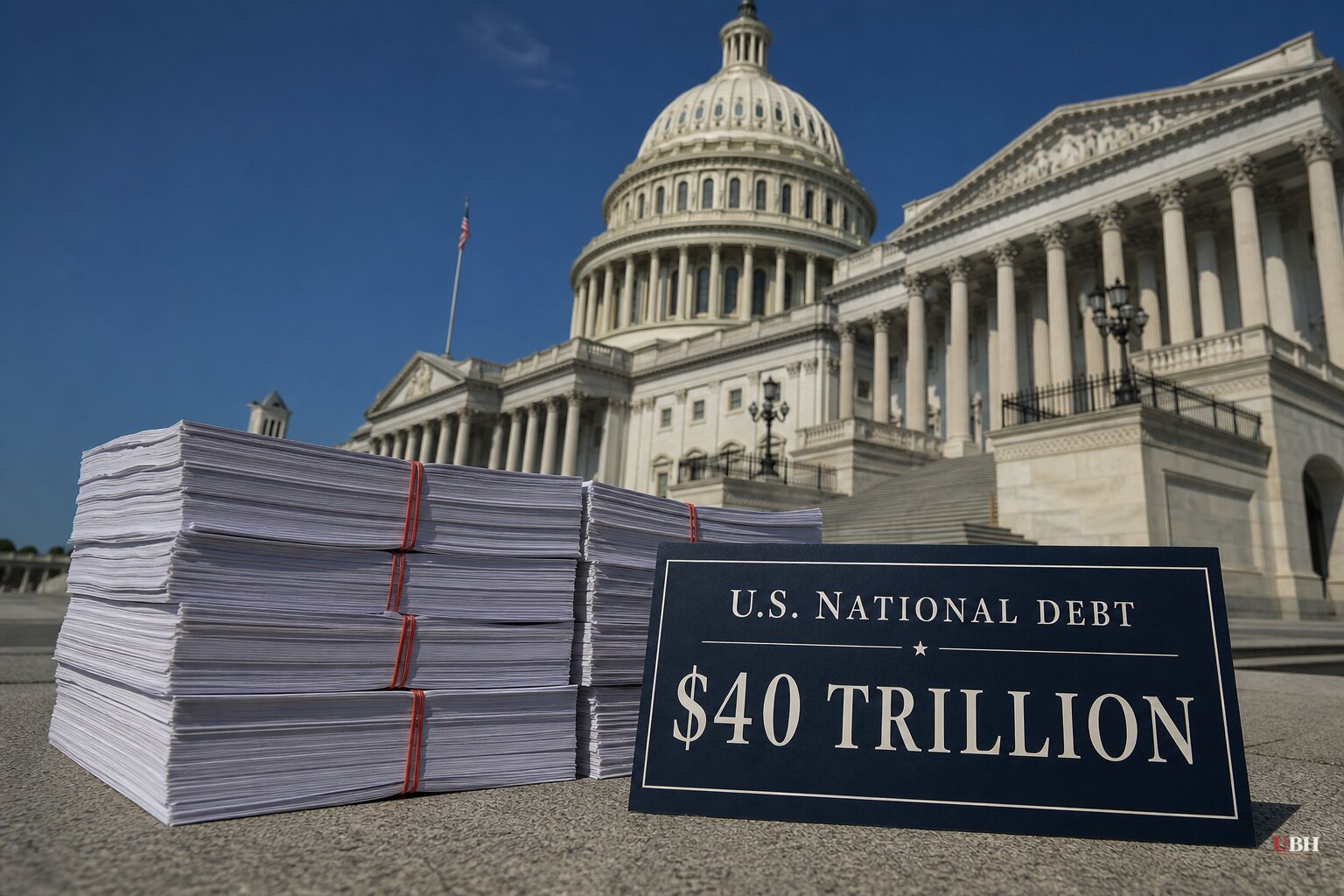
The US national debt crossed $40 trillion in mid-August 2026, according to the Treasury Department's debt-to-the-penny dashboard cited by the Epoch Times. It took only about three months to go from $39 trillion to $40 trillion, and the milestone arrived well ahead of the Congressional Budget Office's earlier baseline projection of 2027.
Debt held by the public now stands at roughly $32.2 trillion, with another $7.8 trillion in intragovernmental holdings, per the Epoch Times. The government is collecting a record $5 trillion in revenue but spending about $7 trillion, producing annual deficits near $2 trillion.
Interest Now Rivals Defense Spending
Net interest costs are running north of $900 billion for the fiscal year and are forecast to surpass $1 trillion for the first time, according to the Epoch Times and the Jerusalem Post, which cited a figure of approximately $970 billion in fiscal year 2025. That already exceeds total US national defense spending, per the Jerusalem Post and Crypto Briefing.
The CBO projects interest costs will roughly double again to about $2.1 trillion by 2036, consuming nearly a quarter of the entire federal budget, the Jerusalem Post reported. Fox News, citing CBO figures, put net interest at 3.3% of GDP in 2026, rising to 4.6% by 2036.
The Peter G. Peterson Foundation's fiscal confidence index sits at 39, well below the neutral reading of 100, according to the Epoch Times. Foundation CEO Michael A. Peterson said in a July 31 statement that "the growing debt adds to their cost of living, and they are calling for a more responsible approach that will improve our economic future," pointing to the November midterms as a test of whether candidates will address it.
A Global Bond Selloff, Not Just an American One
The debt story isn't confined to Washington. OECD countries collectively spent roughly 3% of their combined GDP on debt service in 2025, according to Crypto Briefing, which described borrowing costs at their highest in nearly two decades.
A global bond selloff deepened around Sept. 1, 2026, according to Reuters reporting carried by Euronext. Japan's 10-year yield hit 3% for the first time since 1996. Germany's yields reached their highest in 15 years, and the UK's touched levels last seen in 2008. The US 10-year climbed to 4.796%, near its highest since 2023.
David Krakauer, vice president of portfolio management at Mercer Advisors, told Reuters the pressure is "primarily a U.S.-specific story, though global currents are amplifying it," pointing to deficit spending, debt-servicing costs, and shifting Treasury auction dynamics as hedge funds and other price-sensitive private buyers replace central banks as the main purchasers of US debt.
PBS, citing the Associated Press, reported the 10-year Treasury yield reached 4.80% around the same period, the highest since early 2025, while the 5-year touched 4.55%, its highest since October 2025. PBS attributed the rise to renewed Middle East fighting pushing up oil prices, persistent deficits, heavy borrowing by tech firms to fund AI data centers, and Federal Reserve Chair Kevin Warsh signaling the central bank may still need to raise short-term rates if inflation stays elevated.
Treasury Secretary Scott Bessent downplayed the alarm in comments to Fox Business host Larry Kudlow at the G20 finance ministers' meeting, per PBS: "I don't think we are in any kind of a dire situation," arguing other countries have seen bigger yield jumps. Robin Brooks, a senior fellow at the Brookings Institution, took a different view, telling PBS "this stuff under the surface is really bubbling" and that policymakers are "starting to get pretty agitated." Bessent's Treasury Department intervened in bond markets last month through debt buybacks in an attempt to cap rising yields, PBS reported.
Britain and France Have Their Own Versions
The UK's annual debt interest payments run about £110 billion and could reach nearly 4% of GDP by 2030-31, roughly double pre-pandemic levels, according to Crypto Briefing, which cited UK Chancellor Rachel Reeves saying interest is on track to become Whitehall's second-largest spending category after health, ahead of defense.
France's annual debt service now exceeds its defense budget, and the country has cycled through three prime ministers since its 2024 elections, Crypto Briefing reported, with its 10-year borrowing costs widening as investors grow nervous.
The Political Fight Over Who's to Blame
On Capitol Hill, the blame game is bipartisan. Rep. Stephen Lynch (D-Mass.) told CNN both parties have added to the debt, saying Democrats did so "especially during difficult times" like COVID-era spending extensions, per Breitbart. Rep. David Schweikert (R-Ariz.) told Fox Business that the Trump administration's argument that the country can simply grow its way out of debt "isn't feasible." Sen. Rand Paul (R-Ky.) told Bloomberg he won't vote for a supplemental spending bill, calling the debt "the biggest threat to our country and to our national security."
The Jerusalem Post reported that Treasury officials attribute part of the recent acceleration to the Supreme Court striking down the Trump administration's emergency tariff package, which forced refunds to importers and turned tariff revenue negative for three consecutive months. From January through July 2026, the administration issued about $18.9 trillion in bonds, a 10.2% jump over the same period a year earlier, per the Jerusalem Post.
Both major parties share responsibility for entitlement spending and stimulus decisions that predate any single administration. The US has run large deficits for decades without a debt crisis materializing, yet the arithmetic that the CBO and the Peterson Foundation are pointing to remains significant: interest costs are on a trajectory to exceed both Medicare and Social Security as federal budget line items within the next decade if nothing changes.
Social Security's Old-Age and Survivors Insurance Trust Fund is projected to exhaust its reserves in 2032, after which incoming revenue would cover only about 78% of scheduled benefits without congressional action, according to Fox News. Medicare's Hospital Insurance Trust Fund faces a similar exhaustion date in 2033. Neither program has been reformed by Congress as of this writing, and the CBO's $50 trillion debt projection by 2030 assumes no major policy change between now and the November midterms.
Sources used for this briefing
6 links from 6 independent newsrooms (syndicated copies of the same report count once)
These are the sources it draws on, linked so you can verify.


