
Unbiased headlines. Facts, not spin.
Unbiased Headlines is an independently owned news organization. We bring you the facts, not opinions, written fresh from 110+ named sources. Sources linked so you can verify it yourself.
 economy
Major Story (8/10)
economy
Major Story (8/10)
China's 95% Grip on Rare Earth Refining Collides With a 30-Year U.S. Mine Timeline
The numbers behind the leverage
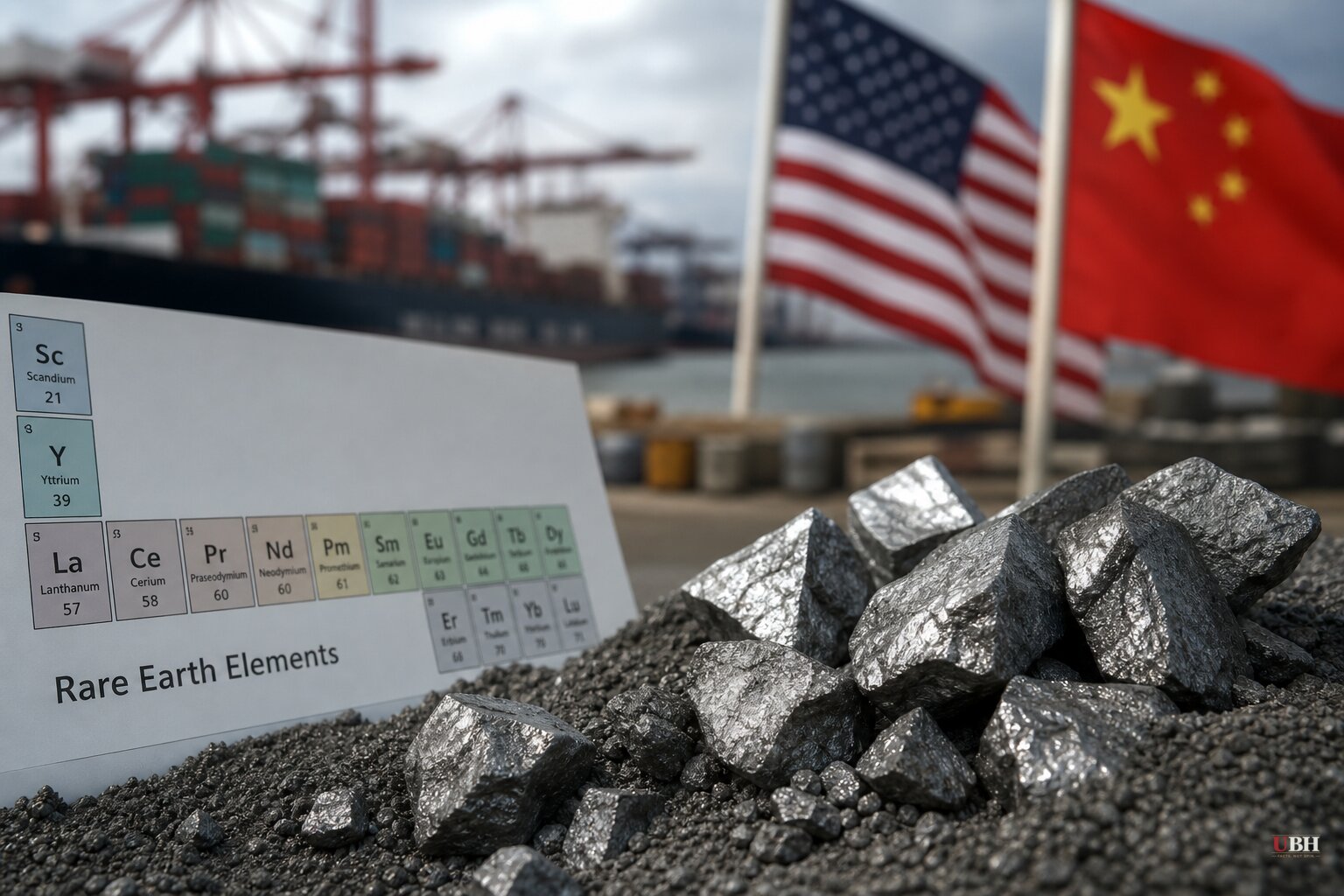
Christian Keller, Barclays' global head of economics research, co-authored a note published Tuesday laying out just how lopsided the critical minerals map is. China controls more than 95% of global refining capacity for heavy rare earths, according to Keller. That's not mining. That's refining, the step that actually turns ore into something usable in a magnet, a missile guidance system, or an EV motor.
"China's quasi-monopolistic position provides it with significant geopolitical leverage," Keller wrote. He's not talking about a niche market. Rare earths, gallium, germanium, graphite and tungsten feed electricity infrastructure, the AI data center buildout, and the current rearmament cycle simultaneously. Keller expects Chinese dominance to persist through at least 2030, no matter how much Western money gets thrown at the problem.
Exports ticked up, but the U.S. squeeze isn't over
China's customs data, released Tuesday, September 8, showed rare earth exports rose 12.1% month-on-month in August to 4,735 metric tons, up from July's 4,224 tons. August volume still ran 1.9% below the 2026 monthly average of 4,829 tons, and was down 18.2% from the same month a year earlier. For January through August, cumulative exports totaled 39,441 tons, down 11.1% year-over-year, a decline that's actually widening. Dollar value of those exports jumped 53.5% over the same period, which analysts attribute to higher prices and a shift toward pricier processed materials, not more volume moving.
Reuters reported last week that some Chinese rare-earth suppliers are refusing outright to ship to U.S. customers, a detail that's landing right before a Trump-Xi meeting scheduled for later this month. Beijing tightened export licensing on magnet-related rare earth technologies over the past year, and a more detailed breakdown of magnet exports specifically is scheduled for release September 20, which should clarify whether August's softness was seasonal noise or something worse.
Two deadlines nobody should confuse
The near-term Trump-Xi meeting is separate from a bigger clock. According to Jack Lifton of the Critical Minerals Institute, writing for Investor News, there are two distinct expiration dates buried in the U.S.-China trade truce: November 10, 2026, when the suspension of last October's broader export controls on rare earth materials, equipment, superhard materials and graphite items expires, and November 27, 2026, when a separate suspension covering gallium, germanium, antimony and superhard dual-use materials runs out. Notably, the ban on exports for U.S. military end-users was never suspended in the first place.
Lifton's argument is that China holding the reprieve buys American manufacturers something more valuable than cheaper materials: certainty they can keep producing. If Beijing lets it lapse, the pain is immediate for U.S. industry, but Lifton also argues it accelerates the incentive to build supply chains China doesn't control.
Money is moving, but mines don't move fast
Washington and Tokyo aren't sitting still. The Department of Defense announced a $174 million equity investment on August 31 to help build a gallium production facility at Alcoa Corporation's Wagerup refinery in Australia, backed by Japan's Sojitz Corporation and Export Finance Australia, targeting 100 metric tons of gallium a year for radar and missile defense systems. The Department of Energy said on August 20 it would put $500 million into seven critical minerals and battery projects through its Office of Critical Minerals and Energy Innovation, according to Asia Times.
Dr. Ari Rostami, CEO of mining technology firm AiMinr, told Mining.com that moving a U.S. mineral deposit from discovery to commercial production can take more than 30 years once engineering, financing and permitting are factored in. Updated Defense Federal Acquisition Regulations take effect in January 2027, and the Department of War will begin enforcing a ban on Chinese-origin rare earth magnets in covered defense systems starting January 1. Asked whether U.S. production is on pace to meet that deadline, Rostami said plainly: "With the current infrastructure that we have in place, the answer is no, unfortunately."
Rostami's warning cuts both ways. He pointed to cobalt as a cautionary tale. EV demand forecasts drove a wave of cobalt project interest, but battery makers shifted toward cobalt-free lithium-iron-phosphate chemistries before that supply came online. "By the time our domestic mines come online, the technology they were supposed to be addressing, they may have already moved on," he said. That's the fair counterargument to just throwing money at more mines: national security planners sometimes chase yesterday's demand curve.
The military stakes are already visible
Dr. John Ringquist, writing in Small Wars Journal on September 8, cited CSIS estimates that the recent conflict with Iran drew down roughly 1,000 Tomahawk cruise missiles from a prewar inventory near 3,100, more than 1,000 JASSMs from a 4,400 stockpile, 45% of Army Precision Strike Missiles, and roughly half of the more than 1,000 Patriot interceptors on hand as of April 2026. Rebuilding those stocks requires the same rare earth magnets and specialty metals China dominates.
Not every company sees a crisis. Ian Croston, vice president of operations at optical components maker Lumentum, told Asia Times that Chinese export friction is just part of doing business now, comparable to Brexit disruptions or U.S. tariffs. "We have to work around" it, Croston said, adding that chipmakers can still secure adequate supplies, just with more paperwork and higher prices.
Whether that remains true past November, when the truce's suspensions lapse, and past January 2027, when the Pentagon's magnet ban takes effect, is the open question nobody in these reports can answer yet.
Sources used for this briefing
7 links from 6 independent newsrooms (syndicated copies of the same report count once)
These are the sources it draws on, linked so you can verify.


