
Original briefings. Zero spin.
Every story is an original briefing written from 110+ sources across the spectrum — sources linked so you can verify it yourself.
 economy
Major Story (7/10)
September 9, 2026 at 06:02 AM
economy
Major Story (7/10)
September 9, 2026 at 06:02 AM
Nepal Asks UN Climate Fund for $20 Million as Flood Death Toll Holds Near 1,300, Formal Attribution Study Still Pending
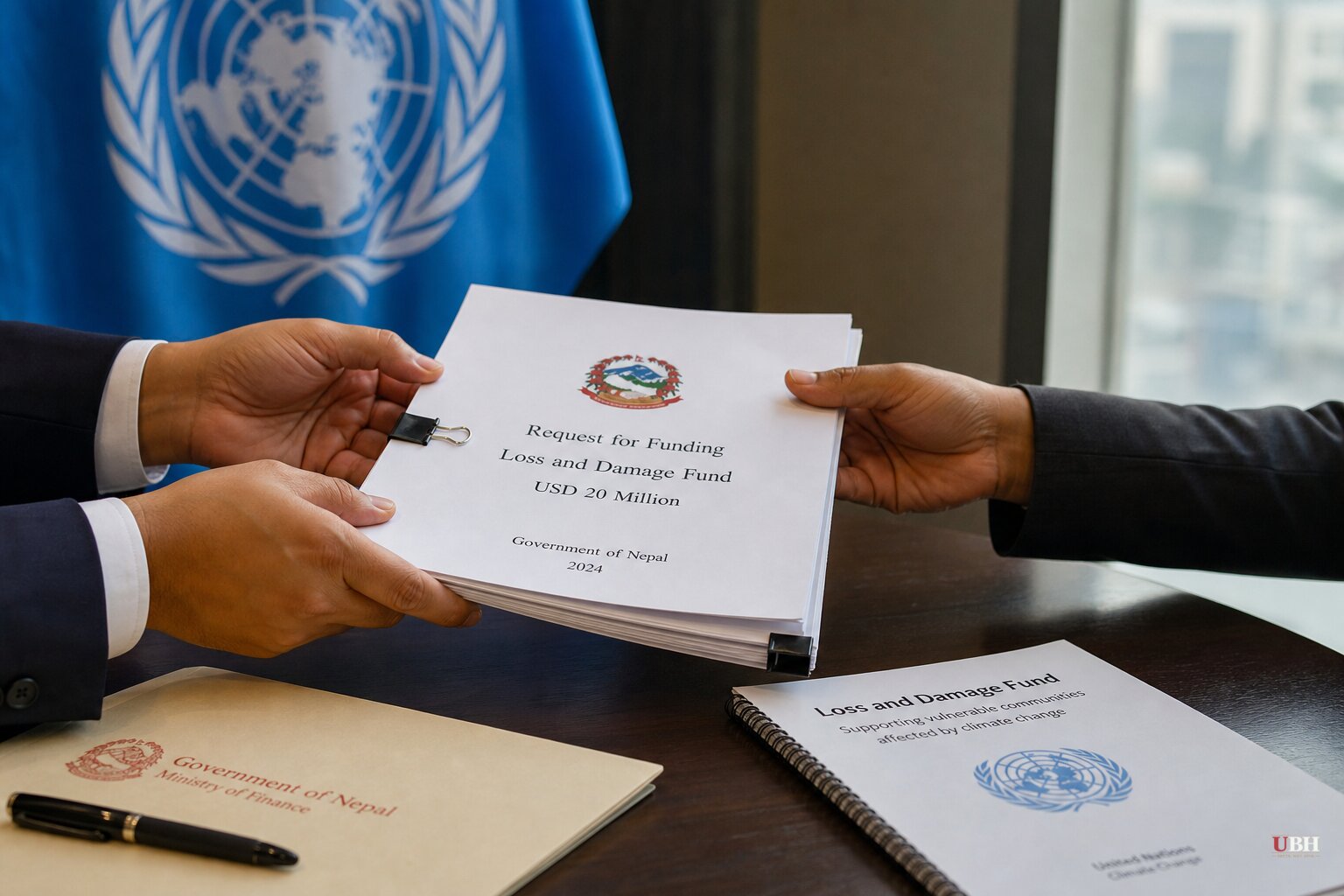
Since the Aug. 26 bedrock and glacier collapse that sent a wall of water and debris through the Nepal-Tibet border region, confirmed deaths have held near 1,300, with thousands still listed as missing. Nepal's government has now taken a concrete step: formally requesting $20 million in compensation from the United Nations' loss and damage fund.
Nepal's foreign minister, Shisir Khanal, told The Guardian that his country's ministries of finance and environment sent a joint letter to the fund, which was created in 2022 under the Paris climate agreement to help vulnerable nations recover from climate-linked disasters. Khanal said the world's most polluting economies need to "wake up" and accept shared responsibility.
"This felt like a tsunami that was coming from the Himalayas," Khanal told the Guardian, describing waves as high as 60 to 70 feet moving at roughly 180 kilometers per hour. He noted Nepal contributes less than 0.1% of global greenhouse gas emissions, while neighbors India and China rank among the world's largest emitters.
A report from the HiRisk scientific consortium, published Aug. 28 and detailed by Carbon Brief, lays out the mechanical sequence. A mass of bedrock and glacier ice broke off Langtang-Lirung mountain, falling from roughly 5,200 meters to the valley floor at 3,000 meters. The collapse shook the ground hard enough that the U.S. Geological Survey initially logged it as a magnitude 4.4 earthquake before revising that assessment to an equivalent magnitude 5.2, attributing the shaking to the glacier collapse and debris flow rather than tectonic activity.
The debris slammed into the Lhende Khola river, forming a debris lake that burst and sent a flood wave downstream through Nepal's Bhote Koshi and into China's Poiqu river system. Carbon Brief calls this a "multi-hazard cascade" rather than a single glacial lake outburst, correcting earlier initial theories.
Carbon Brief also notes that some climate skeptics seized on the bedrock-collapse finding to claim warming played no role. Scientists pushed back on that framing, but they're careful about what they can actually claim. No formal attribution study of this specific event has been completed. What is documented is that rising temperatures, glacier retreat and permafrost thaw are reshaping Asia's high-mountain region and making ice-rock avalanches more likely generally.
Not every expert frames this purely as a climate story. Göran Ekström, a professor of earth and environmental sciences at Columbia University, told TIME that landslides in these high Himalayan landscapes predate global warming. "There's a lot of erosion going on," he said, noting that warming has sped up the erosional process but didn't invent it.
Rajiv Ghimire, a lecturer at the University of Michigan's school for environment and sustainability, pointed to a separate driver: economic development has concentrated people, tourism and hydropower facilities directly in these river valleys. Ekström put it bluntly: "What 100 years ago maybe would have kill[ed]" far fewer people is now catastrophic because far more people and infrastructure sit in the flood path.
Climate change may be loading the dice toward more frequent slope failures, but the scale of the death toll also reflects decades of settlement and construction in terrain that has always been geologically unstable. Both things can be true, and treating the disaster as purely a climate-emissions story risks ignoring the land-use and building-safety side of the equation, which is squarely within Nepal's own policy control.
The Associated Press, in a wire story carried by Newsmax, WTOP, KSAT and others, reported that French and Italian communities around Mont Blanc are bracing for similar risk. Meteo France recorded the warmest July average ever on the Aiguille du Midi peak this year, 3.3°C, more than double the 1.6°C recorded in 1994. Stéphane Bozon, deputy mayor of Chamonix-Mont-Blanc and the town's safety chief, said rockfalls increased sharply from mid-July onward as permafrost that has held Alpine cliffs together for millennia gave way.
In Italy's Lombardy region, glaciers have lost more than 40% of their surface area since 1991, according to the region's glacier service, cited by both the AP and Times of India. Bozon says Chamonix now has to plan for "serious scenarios" involving chunks of glacier or mountain falling toward inhabited areas.
Nepal's $20 million request now sits with the UN's loss and damage fund, which has no binding timeline for a decision. Whether major emitters respond, and whether scientists complete a formal attribution study tying the Aug. 26 collapse directly to human-caused warming, remain open questions with no announced date for resolution.
Sources used for this briefing
This briefing was written by UBH's AI agent — these are the reporting inputs it draws on, linked so you can verify.


