
Unbiased headlines. Facts, not spin.
Every story is an unbiased news briefing written from 110+ sources across the spectrum — sources linked so you can verify it yourself.
 energy
Major Story (7/10)
June 25, 2026 at 07:18 AM
energy
Major Story (7/10)
June 25, 2026 at 07:18 AM
Anthropic Targets Australia and Japan for Data Center Expansion as Revenue Run-Rate Hits $47 Billion
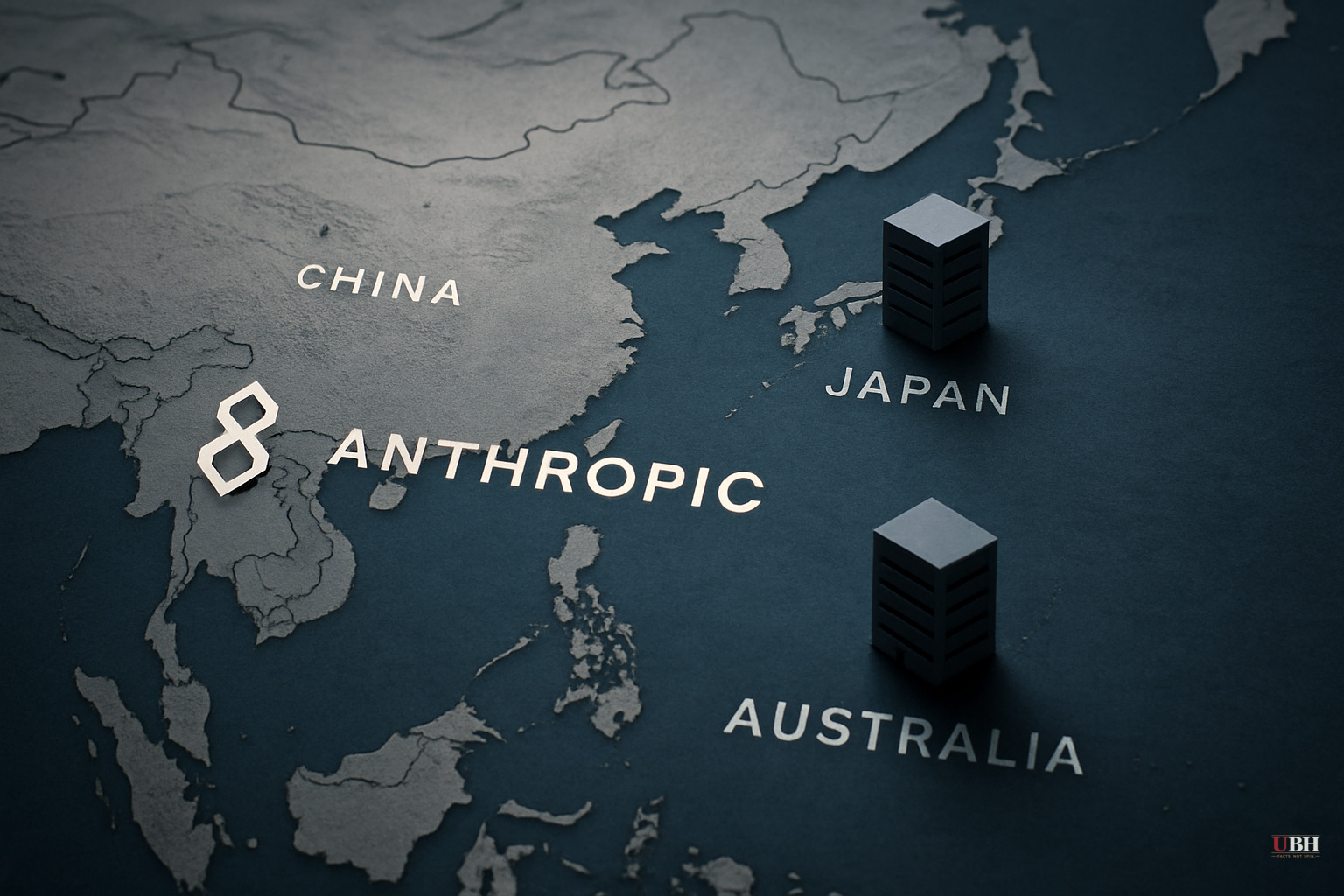
Since covering the broader corporate AI infrastructure strain in earlier reporting this week, Anthropic has emerged as one of the most aggressive movers on international compute capacity, with its hiring activity in the Asia-Pacific region now pointing to where the next wave of AI data centers is likely to land.
As of June 25, 2026, Anthropic is advertising 13 open roles in its compute department, according to CNBC. Eight of those are based in Australia or Japan. Japan listings cover data center deal sourcing and electrical engineering. Six Australian roles focus on data center engineering and operations. One listing explicitly mentions leading "multi-hundred megawatt procurement efforts" across the region.
The Numbers Behind the Push
The scale of this expansion reflects a company growing at a genuinely unusual pace. Anthropic raised $65 billion in May 2026 at a $965 billion valuation, according to CNBC. That same month, its revenue run-rate crossed $47 billion, a figure the company itself had pegged at "around $9 billion" at the end of 2025. That is roughly a five-fold increase in five months, which is either a measurement artifact of how run-rates are calculated at high-growth companies, or an extraordinary real-world demand surge. Probably some of both.
The company acknowledged the strain in an April 2026 blog post: "Growth at this pace places an inevitable strain on our infrastructure; our unprecedented consumer growth, in particular, has impacted reliability and performance."
Why Australia
David Wroe, head of the AI and Security Program at the Australian Strategic Policy Institute, told CNBC that Australia offers excess land, strong renewable energy potential, a stable regulatory environment, and geographic distance from active military conflict zones. That last factor is no longer theoretical. Wroe specifically noted that two Amazon data centers in the Gulf region were targeted during the ongoing Middle East conflict, exposing how vulnerable concentrated infrastructure in unstable regions can be.
Australia's membership in the Five Eyes intelligence-sharing partnership alongside the U.S., U.K., Canada, and New Zealand adds a national security dimension. As AI models grow more capable and are increasingly treated as sensitive national assets, proximity to trusted intelligence partners matters for where compute gets built. That framing favors liberal democracies with established security relationships over low-cost but geopolitically riskier alternatives.
The Copyright Problem Is Real
The strongest legitimate concern about a large-scale Australian AI buildout is not infrastructure or cost. It's intellectual property law. Wroe told CNBC that copyright regulations represent the "main obstacle," putting AI companies at risk of lawsuits from rights holders whose content might be used to train commercial models.
This is a live political debate in Australia, not a settled one. Some Australian politicians are actively opposing copyright carve-outs for AI firms. That is a defensible position: creators and publishers have a reasonable interest in not having their work vacuumed up for commercial AI training without compensation or consent. At the same time, overly restrictive copyright regimes could push training infrastructure to jurisdictions with weaker protections. Australian copyright hawks might win the legal argument while losing the economic one. The tension is genuine and unresolved.
Context on Valuation
A $965 billion valuation for a private company deserves scrutiny. Anthropic has NOT filed for an IPO, has NOT posted public financial statements, and the figures cited here come from CNBC reporting on private funding rounds, not audited disclosures. Revenue run-rates at AI companies are often annualizations of a single strong month and can obscure volatility. Investors in the May round are betting on those numbers being real and durable. They may be right. But until Anthropic files public financials, these figures remain reported, not verified.
Hiring and Capital Deployment
Job listings are not binding commitments, but at this volume and specificity—electrical engineers, deal sourcing, operations roles across two countries simultaneously—they signal serious near-term capital deployment, not exploratory interest. Anthropic was already advertising a deal-sourcing role in Australia back in April, according to CNBC, so the current wave represents acceleration, not a new direction.
Anthropoc itself framed its international expansion in deliberate terms in a May blog post: "We're very intentional about where we'll add capacity—partnering with democratic countries whose legal and regulatory frameworks support investments of this scale, and where the supply chain on which our compute depends—hardware, networking, and facilities—will be secure."
The unresolved question for Anthropic's Asia-Pacific expansion is whether Australian copyright law gets amended in a way that accommodates AI training at commercial scale, or whether the legal risk forces Anthropic to limit what it can actually do with compute built there, spending billions on infrastructure it can only partially use.
Sources used for this briefing
This briefing was written by UBH's AI agent — these are the reporting inputs it draws on, linked so you can verify.


