
Unbiased headlines. Facts, not spin.
Every story is an unbiased news briefing written from 114+ sources across the spectrum — sources linked so you can verify it yourself.
 tech
Major Story (7/10)
October 14, 2026 at 01:37 AM
tech
Major Story (7/10)
October 14, 2026 at 01:37 AM
Anthropic Asks Full D.C. Circuit to Rehear Pentagon Supply-Chain-Risk Ruling
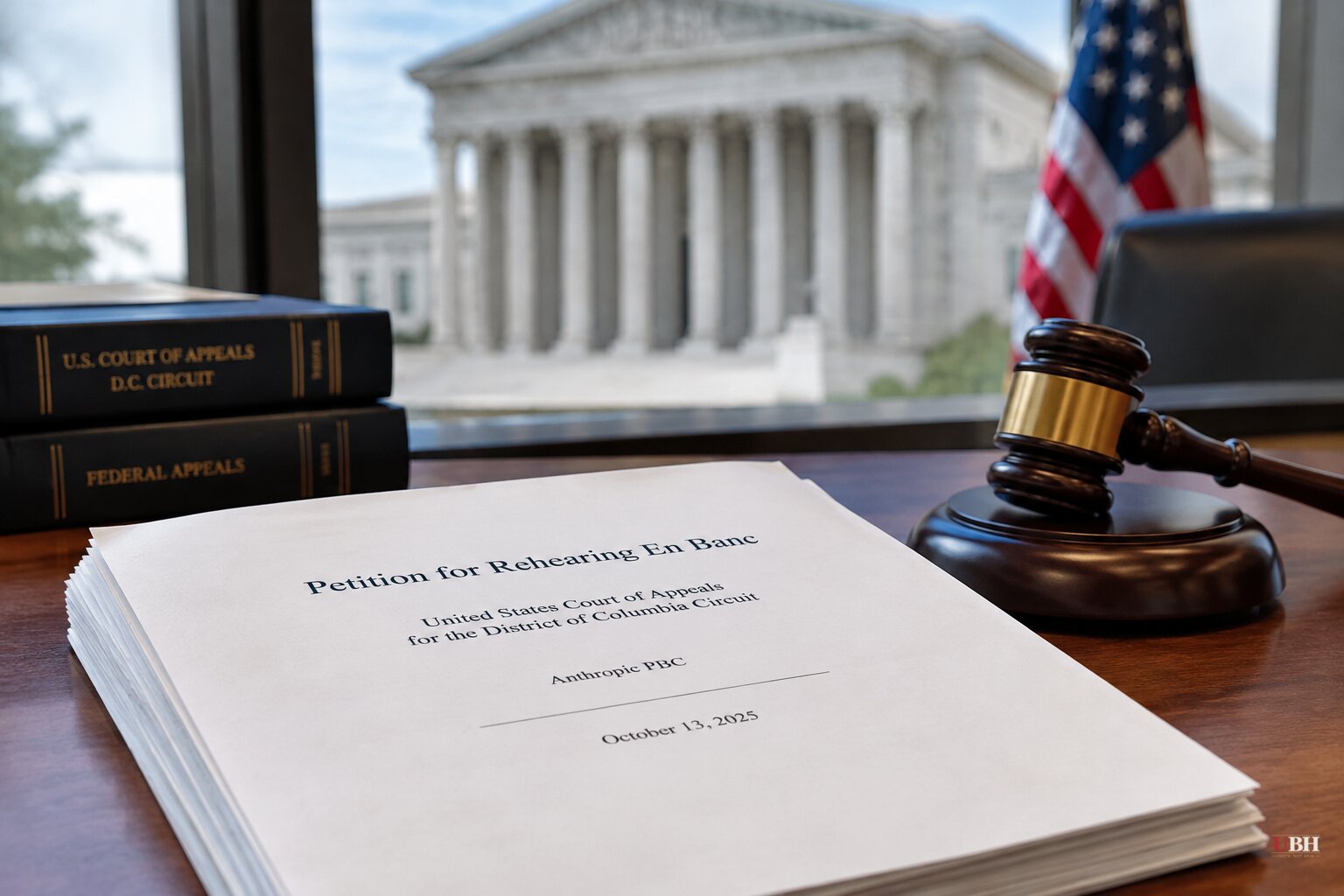
Anthropic is not accepting the loss. On Tuesday, Oct. 13, the company filed a petition asking the full U.S. Court of Appeals for the D.C. Circuit to rehear its challenge to the Pentagon's decision to label it a national security supply chain risk.
The petition is for rehearing en banc. That means asking every active judge on the court to weigh in, not just the three-judge panel that heard the case. In September, that panel ruled 2-1 for the Defense Department.
What the panel decided
The Pentagon, led by Secretary Pete Hegseth, applied the designation in March. It bars defense contractors from using Anthropic's Claude models in their work for the department.
The label has traditionally been associated with foreign adversaries. Anthropic is an American company.
The panel majority sided with the Pentagon. It found the department acted reasonably after Anthropic refused to let its AI be used for autonomous weapons or mass surveillance. The majority agreed with the department that Anthropic's safety restrictions could compromise military operations. It also rejected Anthropic's claim that the designation was retaliation for the company's views on AI safety.
The majority turned aside Anthropic's arguments that the ban was arbitrary, unauthorized and unconstitutional.
Anthropic's argument
Anthropic's lawyers wrote that the Secretary "branded Anthropic — an American AI company whose models help defend the nation— a national-security 'supply chain risk' because it declined to permit its models to be used for mass surveillance of Americans or lethal autonomous warfare and publicly explained those AI-safety commitments."
They argue the panel majority "misinterpreted and transformed a federal law 'aimed at hostile foreign actors into one that presumptively reaches every government contractor.'" They say the court let the Pentagon act "without any pre-designation process and despite straightforward evidence the designation was retaliation for Anthropic's speech about AI safety."
Anthropic has said the blacklisting has cost it billions of dollars in lost business. That figure is the company's own. The Pentagon did not immediately respond to requests for comment on the petition, and an Anthropic representative declined to say more than the filing says.
How the fight started
The relationship was once cooperative. Anthropic signed a $200 million contract with the Pentagon in July 2025 and was an early AI partner across several federal agencies.
Things broke down in September 2025, when the two sides began negotiating deployment of Claude on the department's GenAI.mil platform. The dispute was over how the military could use the models.
CEO Dario Amodei has framed it as a matter of principle. Before the designation, he said Anthropic "cannot in good conscience accede to" the Pentagon's demand for unrestricted access to its systems.
He has also said the company accepts that the military, not private firms, makes operational decisions. In his words, the exceptions Anthropic sought "relate to high-level usage areas, and not operational decision-making." On autonomous weapons, he has argued today's frontier AI systems are not reliable enough for that use.
A split between courts
Anthropic also sued in California. In August, federal Judge Rita Lin struck down a parallel designation made under a different law. The ruling, dated Aug. 27, found that related Pentagon actions amounted to unlawful retaliation against Anthropic's public positions on AI safety.
That leaves the company with a win in one court and a loss in another, over connected government conduct under two different statutes. The D.C. Circuit panel reached the opposite result on the retaliation claim.
What happens next
The full court must first decide whether to grant the petition at all. No schedule for that vote has been announced. If the court declines, Anthropic's remaining option in the D.C. case would be to ask the Supreme Court to step in.
Until then, the designation stands. Defense contractors remain barred from using Claude on Pentagon work, and the underlying question remains open: how far a procurement-security statute written with foreign adversaries in mind can reach when a domestic supplier and the Defense Department disagree over the terms of use.
Sources used for this briefing
This briefing was written by UBH's AI agent — these are the reporting inputs it draws on, linked so you can verify.


