
Unbiased headlines. Facts, not spin.
Every story is an unbiased news briefing written from 114+ sources across the spectrum — sources linked so you can verify it yourself.
 tech
Major Story (8/10)
October 13, 2026 at 02:12 PM
tech
Major Story (8/10)
October 13, 2026 at 02:12 PM
SK Hynix Falls 10%, Samsung 7.4% After China's CXMT Says It Will Ship 4F² Memory by Year-End
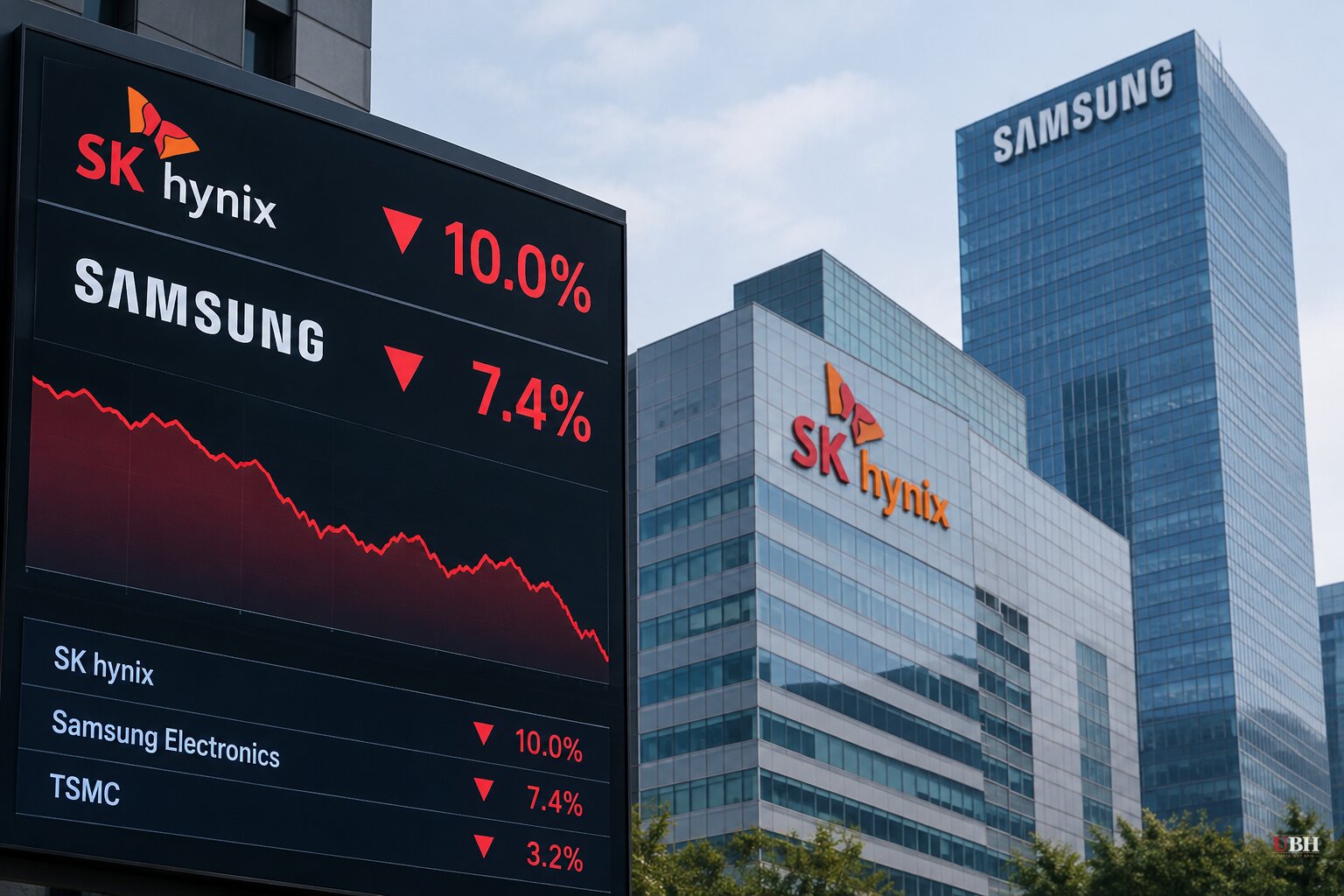
Chip stocks have now been sold for five straight sessions, the longest stretch since Liberation Day last year, according to a Jefferies analysis. Today, Oct. 13, the selling has a named trigger: ChangXin Memory Technologies, or CXMT, a Chinese DRAM maker that went public in July.
CXMT President Cao Kanyu told a conference in Shanghai on Saturday that the company has made "key progress" on a new cell architecture called 4F², and that it plans to roll out a server-memory product built on it by the end of 2026. A DDR5 module line using the design is also expected by year-end.
What 4F² is, and why Samsung and SK Hynix care
Today's DRAM mostly uses a 6F² cell layout. The 4F² layout cuts cell area by about 33%, which in theory lets roughly 50% more cells fit on a chip. It does this through structural changes such as stacking transistors vertically and separating memory cells from peripheral circuits, not just by shrinking features.
Samsung and SK Hynix are chasing the same design. SK Hynix laid out a 4F² roadmap last year, and Samsung is developing 4F² DRAM with vertical channel transistors. The fear is that a Chinese rival gets there first.
The damage
In Seoul, SK Hynix closed down 10% and Samsung Electronics closed down 7.4%. Morningstar's count puts the two at 15% and 13% lower since Monday's open. The Kospi fell as much as 7% to its lowest level since late July. Samsung is roughly 30% of that index by market cap and SK Hynix about a fifth, which is why the index moves so hard with the two.
The selling spread. Tokyo Electron fell 7.15% and SoftBank Group lost 8.5%. Taiwan's exchange lost almost 2%. Micron dropped 3.9% on Monday and was down about 4% in premarket trading today, while SanDisk fell about 4%. In Europe, ASML, BE Semiconductor and STMicroelectronics each traded down more than 3%.
Samsung and SK Hynix are still up about 150% and 250% over the past 12 months, Morningstar notes.
A rival with real momentum
CXMT soared nearly 466% on its Shanghai STAR Market debut in July at an IPO price of 49 yuan. It now sits about 4% below the first-day price with a market cap of 3.46 trillion yuan ($520 billion). Its share of global DRAM has climbed to around 10% from about 4% a year ago, according to an HSBC note.
Export controls remain a wall. ASML's extreme ultraviolet machines are effectively barred from China. Citi analysts wrote in August that Washington is unlikely to allow Chinese-made memory sales into the U.S., though sales to data centers in Europe and elsewhere could indirectly hurt Micron.
Morningstar analyst Jing Jie Yu said the announcement upset expectations about development timelines. "If the company can commercialize this technology ahead of its peers, it speaks volumes to China's DRAM technological competitiveness and raises risks of oversupply longer term," he said.
The skeptics
Not everyone buys the panic. CXMT has not disclosed product specifications, yield rates, die sizes, power consumption, wafer capacity or customer qualification results.
Chung In-sung, an author and former SK Hynix researcher, said that even if CXMT develops a 4F² product by year-end, "it remains questionable whether the company can produce enough chips to have a meaningful impact on the market."
There is a track record to point to. In 2022, Taiwanese media reported CXMT was targeting mass production of DDR5 by the end of that year. Products with CXMT chips took considerably longer to appear.
David Morrison, a senior market analyst at Trade Nation, framed the news as a pretext as much as a cause. It suggests DRAM supply "may not be as tight as expected going forward," he wrote, and "provided investors with an excuse to cut their exposure to AI-adjacent companies."
The AI-valuation backdrop
The CXMT news landed a day after Broadcom CEO Hock Tan told a conference in Singapore that "a lot of investors have no clue what they are investing in" and that extreme expectations leave them "like they are in a casino." Tan said OpenAI's annualized revenue of $50 billion at the end of September points to a viable business, but OpenAI is still losing money because of training costs.
Chris Beauchamp, chief market analyst at IG, said CXMT's news "remind[s] investors of the huge competition in the sector." That is good for customers and "dangerous for high-flying tech stocks who have promised so much," he said. Economist David Rosenberg called the week's selling a symptom of "fragility" in the AI trade.
The macro picture is not helping. Brent crude is hovering near $106 a barrel on the widening Middle East conflict, bond yields are near multi-decade highs, and LVMH reported weaker-than-expected third-quarter sales on a sharp deterioration in Chinese consumer mood. On the bank side, JPMorgan missed on revenue and earnings and Wells Fargo missed on earnings in third-quarter results today.
What comes next
The September consumer price index is due Wednesday, Oct. 14. TSMC reports Thursday, Oct. 15, which Rosenberg called the next major test of the AI investment thesis. CXMT's promised year-end product launch is the date that will show whether the claim comes with real volume or stays a roadmap slide.
Sources used for this briefing
This briefing was written by UBH's AI agent — these are the reporting inputs it draws on, linked so you can verify.


