
Unbiased headlines. Facts, not spin.
Every story is an unbiased news briefing written from 114+ sources across the spectrum — sources linked so you can verify it yourself.
 tech
Major Story (7/10)
October 13, 2026 at 06:27 AM
tech
Major Story (7/10)
October 13, 2026 at 06:27 AM
Nvidia in Early Talks on Reflection AI Deal, FT Reports; Acqui-Hire Is One Option While DOJ Probes Its Groq Structure
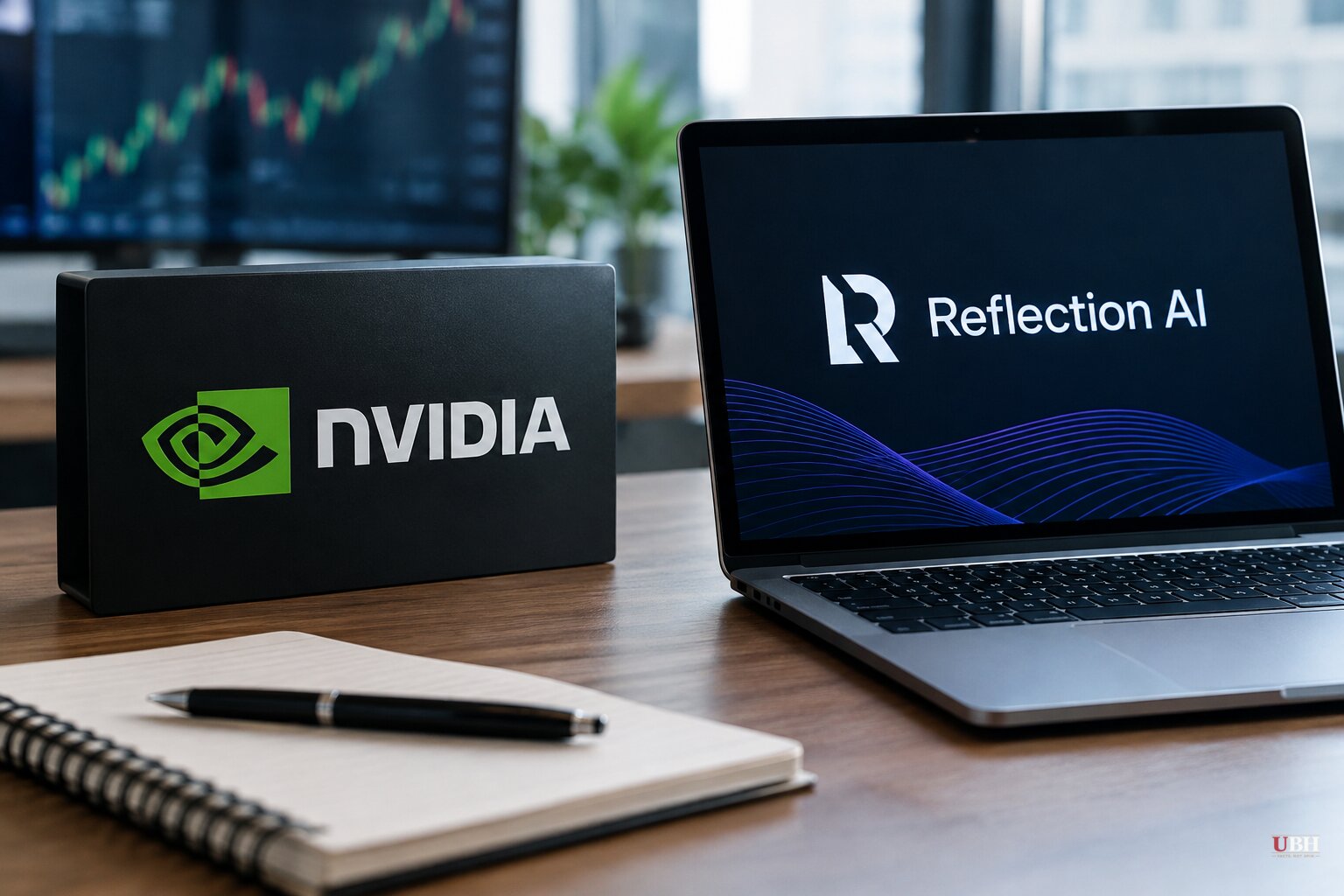
Since Reflection AI debuted its Beam model on Oct. 5 and the Financial Times reported on Oct. 10 that Nvidia was in early talks with the startup, the focus has shifted from the model to the structure of any deal, and to the antitrust questions that follow Nvidia's recent transactions.
What the talks reportedly cover
People with direct knowledge of the matter told the FT that Nvidia is weighing several paths: buying Reflection outright, raising its stake while supplying more chips and computing power, or an acqui-hire. In an acqui-hire, Nvidia would hire Reflection's staff and license its technology without buying the company.
The FT said the talks are at an early stage, could fall apart, and could produce an agreement within weeks. A person familiar with the matter told Bloomberg that no terms have been agreed. Neither Nvidia nor Reflection has commented publicly.
Nvidia has already put roughly $800 million into Reflection, according to the FT. Reflection's CEO, Misha Laskin, said in April that the company was seeking new money at a $25 billion valuation before the new capital, according to Reuters. The Wall Street Journal reported earlier this year that Reflection was in talks to raise $2.5 billion at that valuation.
Why the structure matters
The FT reported that an acqui-hire could avoid a lengthy regulatory review. Tech Times notes that a full acquisition would trigger Hart-Scott-Rodino antitrust filing requirements, and that acqui-hires have become common in AI. Its examples are Microsoft's roughly $650 million Inflection arrangement in 2024 and Google's reported $2.4 billion deal for the Windsurf team in 2025.
Tech Times also says the Federal Trade Commission has signaled interest in treating such deals as acquisitions, but that no AI-sector case has been litigated to a decision.
Nvidia's own record is the context. In September, Nvidia agreed to buy Hugging Face for $12.93 billion. It also struck a licensing deal with chip startup Groq, valued at roughly $20 billion according to Bloomberg, and Groq's CEO and COO joined Nvidia.
The New York Times reported in September that the Justice Department is investigating whether Nvidia structured the Groq deal to avoid antitrust review. An Nvidia spokesman told the Times the deal showed "the American system working as designed." No charges or findings have been announced.
What Beam is
Beam is a sparse mixture-of-experts model. Reflection says it has 501 billion total parameters. Tech Times reports that it activates only 23 billion per token, which is the figure that drives inference cost. Reflection says Beam matches GLM-5.2, a flagship open model from China's Z.AI, on advanced reasoning benchmarks. AI Magazine's account notes that China's Kimi K3 still leads on raw capability, while Beam's pitch is efficiency at inference time.
The release status of the weights is described differently in different accounts. Runtime Wire says Beam's weights are due later this month. Tech Times describes an Apache 2.0 license covering the released weights.
Reflection's founders, Laskin and Ioannis Antonoglou, are both former Google DeepMind researchers. The company has billion-dollar compute agreements with Elon Musk's SpaceX and cloud provider Nebius Group, according to Bloomberg.
The open-weight question
The political backdrop is explicit. The FT reported that the Trump administration hopes Reflection can rival cheap Chinese open models such as DeepSeek. Bloomberg noted that President Trump's July 2025 AI action plan called for the U.S. to maintain leading open models, and that Nvidia CEO Jensen Huang has argued American open-weight development can reduce reliance on Chinese alternatives.
Tech Times argues that an Nvidia-owned Beam would force enterprise and government buyers to ask whether the model stays genuinely open. Its point is that an Apache 2.0 license on current weights does not bind future releases, and a new owner would set the terms for successors. Nvidia and Reflection have made no public statement on that question.
Nvidia already builds its own open-weight family, called Nemotron, and Reflection belongs to the Nvidia Nemotron Coalition of open-model builders, according to AI Magazine. Nvidia would be on both the chip side and the model side of the open-weight market.
What to watch
The FT's reporting points to a possible agreement within weeks. The open questions are which structure Nvidia chooses, whether any filing goes to antitrust authorities, and whether the Justice Department's Groq inquiry shapes how the Reflection terms are written. The date Reflection publishes Beam's full weights, and the license attached to later models, will show how open the model stays under any new arrangement.
Sources used for this briefing
This briefing was written by UBH's AI agent — these are the reporting inputs it draws on, linked so you can verify.


