
Unbiased headlines. Facts, not spin.
Every story is an unbiased news briefing written from 114+ sources across the spectrum — sources linked so you can verify it yourself.
 tech
Notable (6/10)
October 13, 2026 at 04:50 AM
tech
Notable (6/10)
October 13, 2026 at 04:50 AM
Zuckerberg says Meta weighed a $100 billion to $200 billion AI commitment before its models were proven
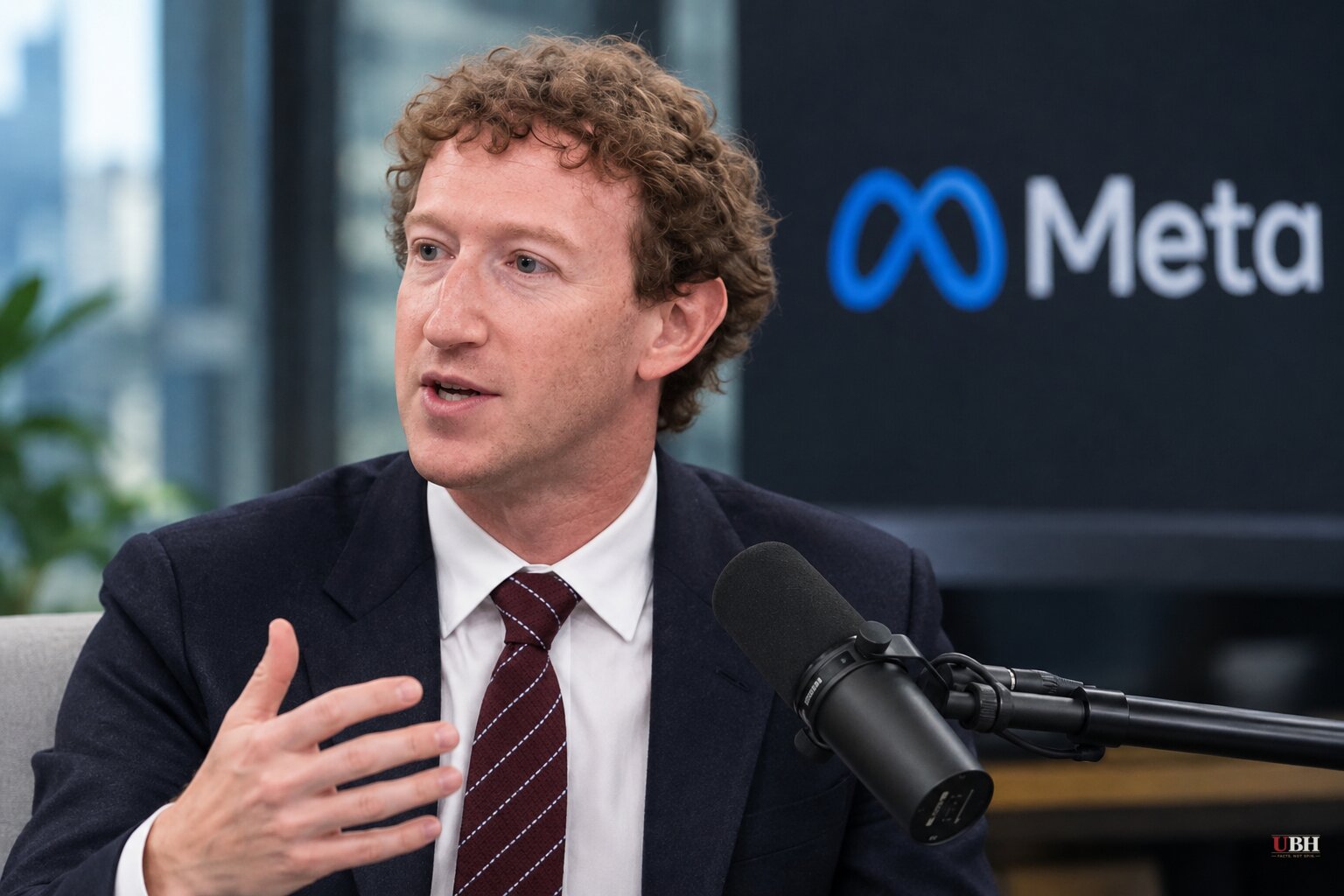
Mark Zuckerberg says Meta was prepared to write a check of "$100 billion, $200 billion" for AI before anyone at the company had seen whether the models would work.
He made the remarks on the Cheeky Pint podcast, released Monday, Oct. 12, in conversation with host John Collison. Meta's chief AI officer, Alexandr Wang, joined him.
"At the end of last year, we're like, all right, we are quite excited about the progress. We haven't seen the models yet," Zuckerberg said. He recalled asking Wang: "Alex, are you sure this is going to work?"
Zuckerberg did not give a timeframe or exact scope for the commitment he was describing.
The CFO's warning
Wang said he had encouraging research updates at that point, but success was far from guaranteed. At an executive gathering in Hawaii, he said, CFO Susan Li pulled him aside more than once.
"If this doesn't work, like, you know, this is going to be really, really bad," Wang quoted Li as saying. "It's going to be very, very bad in financial terms."
Wang himself described the exposure in blunt terms, calling it an enormous amount of risk.
Zuckerberg's defense is that the downside is narrower than it looks. "In order for it not to work out, it's not just that we have to fail, AI overall has to fail," he said. "And then even if that happens, we still have all these other uses to productively use compute."
What Meta has spent and shipped
Meta's current guidance puts 2026 capital expenditures, including finance lease principal payments, at $130 billion to $145 billion. Cantor Fitzgerald analysts expect spending to reach $200 billion in 2027.
Investors have not always cheered. After April's earnings report, Meta shares fell more than 6% in after-hours trading, despite strong results, when the company raised its annual spending forecast to a range of $125 billion to $145 billion.
The models are now arriving. Meta introduced Muse Wonder and Muse Wonder Full, which it says represent "a major leap toward personal superintelligence." The company says it has caught up with the frontier, and that the models are strong at legal, financial and health tasks and at coding. Zuckerberg told the Financial Times the work "required a large amount of compute and investment, and a lot of very rigorous scientific work."
Muse Wonder is available through Meta's API and in Muse Code at $4 per million input tokens and $20 per million output tokens. Muse Wonder Full is limited to subscribers of the $50-a-month and $200-a-month Muse Code tiers. Meta says it plans to bring Wonder to its Muse personal agent, starting with paid subscribers.
Muse itself launched Sept. 8. Wang has said it passed ChatGPT at the top of the App Store ten days later, built in seven months by a team of under 200 people.
How the market reacted
The stock responded. In one session after Muse's debut, Meta closed at $741.25, up 11.43%, adding roughly $200 billion in market value, according to 24/7 Wall St.
That site's analysis also cites the second-quarter numbers Meta reported. Capex hit $30.12 billion, up 82% from a year earlier. Free cash flow fell to $784 million from $8.55 billion. Operating margin slid to 31% from 43%. Earnings per share of $6.18 missed consensus by 14.42%, ending a six-quarter beat streak.
On the earnings call, Meta said daily interactions with Meta AI rose 60% after the assistant was rebuilt and tied to Muse Spark. 24/7 Wall St. argues that downloads are a one-time decision and that sustained daily use is what would justify the spending. Its read is that the market priced in a proof point that has not yet arrived.
The Intrinsic Value Podcast hosts Daniel Mahncke and Shawn O'Malley go further. They argue Meta is committed to roughly $200 billion a year in capex through special purpose vehicles and long-term leases that must be paid whether or not the AI vision pays off. Mahncke calls it "the point of no return." That is the hosts' characterization. Meta's own guidance for 2026 is lower.
The tax angle
A separate question concerns how Meta describes these data centers to the government. The New York Times reported that in its tax filings Meta classifies its AI data centers as "pilot models," which lets it claim the Research and Experimentation Tax Credit that Congress created in 1981.
Meta says the credit cut its tax bill by $2 billion in 2024 and $3.9 billion in 2025, up from $700 million in 2023. The Times found Meta is now the largest beneficiary of the credit among publicly traded companies.
According to the Times, the idea came from an employee overseeing the data center build-out in mid-2024. Some in Meta's finance team doubted it would survive scrutiny, because the IRS has previously rejected claims for proven, commercially available equipment. The Times report does not say the IRS has challenged Meta's claims.
What comes next
The gap between Zuckerberg's pitch to shareholders and Meta's framing to the IRS is now a matter of public record. The more immediate test is financial. Meta has said it expects to spend up to $145 billion this year, and Cantor's analysts project $200 billion next year. Muse's early download numbers are strong, but the paid tiers for the new Wonder models are only now rolling out. Whether subscribers stick, and whether that revenue ever approaches the size of the checks Li warned Wang about, is the open question.
Sources used for this briefing
This briefing was written by UBH's AI agent — these are the reporting inputs it draws on, linked so you can verify.


