
Unbiased headlines. Facts, not spin.
Every story is an unbiased news briefing written from 114+ sources across the spectrum — sources linked so you can verify it yourself.
 tech
Major Story (7/10)
October 13, 2026 at 01:35 AM
tech
Major Story (7/10)
October 13, 2026 at 01:35 AM
Huawei Says Ascend Chips Outsell Nvidia in China, but Top AI Labs Still Train on Nvidia
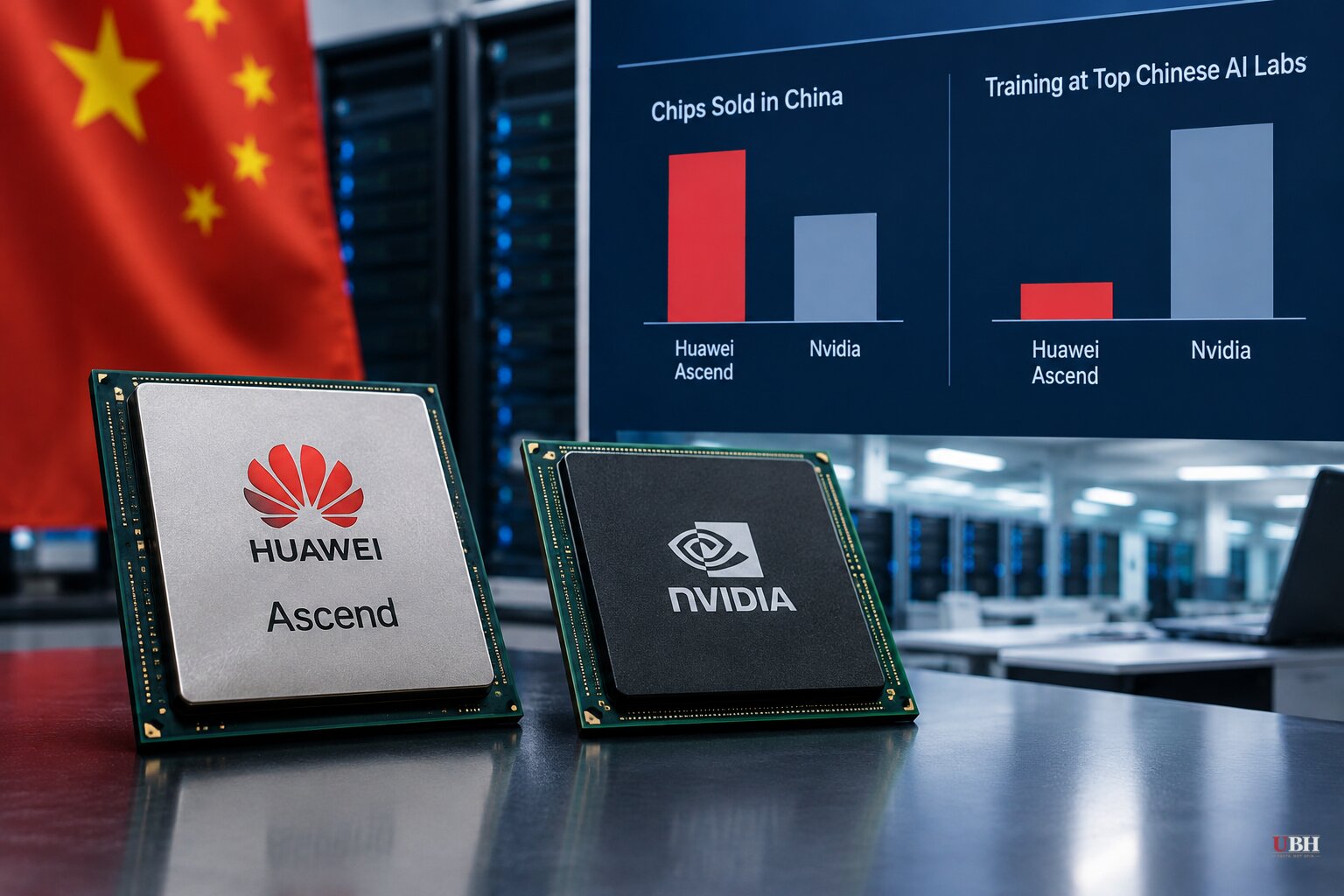
Beijing wants its tech giants running on homegrown silicon. Its best AI developers keep reaching for Nvidia anyway.
The Financial Times reported this week that China faces an uphill battle weaning its technology firms off Nvidia chips. The latest numbers and court filings show why.
Huawei claims the sales lead
Eric Xu, Huawei's rotating chairman, said the company's Ascend AI chips now outsell Nvidia's inside China. That is Huawei's own estimate, not an audited market-share figure. Xu said Ascend makes up in volume what it lacks in raw power.
Xu also said Huawei cannot meet even Chinese demand. The company has no plan to export Ascend chips broadly, though a few countries with strong demand receive limited volumes.
At its Huawei Connect conference, the company unveiled the Atlas 950 SuperPoD, built on a new architecture called Peerium. The design aims to make thousands or tens of thousands of processors act like one computer.
Huawei's pitch is dependable supply. A chip you can actually buy beats a faster one you may not be allowed to get.
Training still runs on Nvidia
Sales volume is one thing. What the top labs actually run is another.
DeepSeek plans to deploy at least 160,000 Huawei Ascend 950DT chips for inference, the stage where a finished model answers queries. It is keeping Nvidia hardware for training, the expensive process of building a model from scratch.
The stickiness is software. Nvidia's CUDA toolkit is deeply entrenched among developers. Huawei's alternative is called CANN, and moving training workloads onto it is predicted to cost roughly 50% more in money and time.
Inference has moved over faster. That helps explain how Huawei's sales can climb while Nvidia holds the high end.
Huawei's critics have a different reading of the performance gap. Analysts told Bloomberg that Huawei still trails Nvidia technologically, with even the latest Ascend chips delivering only a fraction of Nvidia's performance. Huawei's answer is massive clustering and faster interconnects to close the difference.
Xu's own conclusion is that China needs full self-sufficiency across the semiconductor chain. Huawei consumer chief Richard Yu admitted that China still relies on DUV lithography machines for now, while it develops the more advanced EUV tools. Huawei says its "Tau law" chip approach will match the transistor density of a 1.4 nm process by 2031. That is a company projection, not a delivered product.
Smuggling shows the demand
The U.S. has barred Nvidia's most advanced AI chips from China since 2022, citing national security. Washington has also granted limited approvals for certain Nvidia models. The result is a patchwork in which some hardware moves legally, some illegally, and Chinese buyers plan around both.
The illegal channel just produced a guilty plea. Ting-Wei "Willy" Sun, a contractor linked to Super Micro Computer, pleaded guilty in federal court in Manhattan to four counts: conspiring to violate export controls, unlawfully removing goods from the country, defrauding the government and obstructing justice. He is scheduled to be sentenced in September 2027.
Prosecutors charged Sun and two others in March with diverting roughly $2.5 billion of U.S. AI technology to China starting around October 2023. They allege the servers were routed through a Southeast Asian intermediary to Chinese end customers. The indictment names Nvidia's B200, H100 and H200 GPUs as subject to export restrictions.
The indictment also alleges Sun set up dummy servers on-site in December 2025 and lied to a Commerce Department official who came to inspect units that had already shipped to China.
The other two defendants are Super Micro co-founder Yih-Shyan "Wally" Liaw and Ruei-Tsang "Steven" Chang, a sales manager in the company's Taiwan office. Liaw has pleaded not guilty and has left Super Micro's board. Chang has not appeared in court. Both are charged; neither has been convicted.
Super Micro is not a defendant. The company says the case has no impact on its business operations, that it terminated Sun and cut ties with the other defendants earlier this year, and that its current senior leaders had no knowledge of the scheme. It says it is cooperating with investigators.
Separately, Taiwan prosecutors have charged nine people, including former employees of Nvidia and Super Micro, with facilitating shipments of advanced AI servers.
China's chip industry is moving faster than expected
China's own supply chain is advancing. Goldman Sachs Research said in an Oct. 9 note, drawn from its Asia Leaders Conference in Hong Kong, that China's semiconductor capacity is ramping faster than the market expected, though bottlenecks persist.
The pressure is showing up in markets. U.S. chip and memory stocks were pressured in today's Oct. 12 session on China competition concerns after CXMT announced technological progress on a denser memory chip design, and the Nasdaq underperformed, according to Newsquawk's market update.
What to watch
The measures that settle this are procurement data, cloud capital-spending disclosures from China's big platforms, and any change in U.S. licensing. Huawei's claim covers units sold, not which chips train the frontier models.
On the legal side, Sun's sentencing is set for September 2027. Liaw has pleaded not guilty, and Chang has yet to appear in court.
Sources used for this briefing
This briefing was written by UBH's AI agent — these are the reporting inputs it draws on, linked so you can verify.


