
Unbiased headlines. Facts, not spin.
Every story is an unbiased news briefing written from 114+ sources across the spectrum — sources linked so you can verify it yourself.
 tech
Major Story (7/10)
October 12, 2026 at 05:50 PM
tech
Major Story (7/10)
October 12, 2026 at 05:50 PM
Meta Launches Muse Wonder AI Models, With Muse App Access Starting at $20 a Month
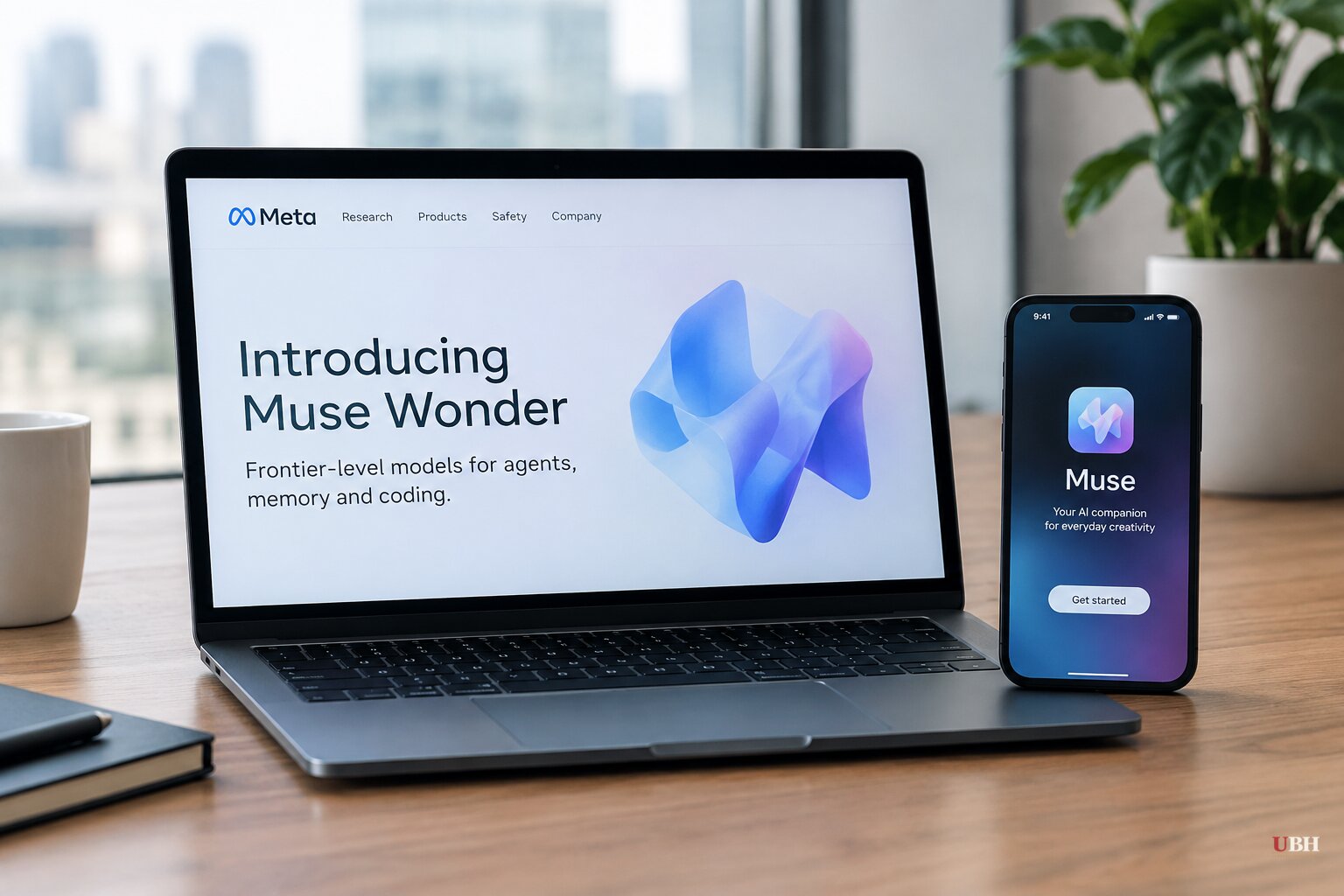
Meta introduced two new AI models on Monday, Oct. 12: Muse Wonder and Muse Wonder Full. The company calls them its most capable yet and says they compete with the best models from OpenAI, Anthropic and Google.
The access is not free. Muse app users will need a subscription of $20 or $100 a month to use Muse Wonder, according to Meta. The company is using the launch to test whether people will pay for AI beyond its core advertising business.
What Meta is selling
Muse Wonder is available today through the Meta Model API and Muse Code, the company's software-engineering agent. Meta said it will soon power more of the Muse personal assistant, rolling out first to subscribers. The company has not given a date.
Muse Wonder Full, the more powerful variant, is limited to developers who subscribe to Muse Code at $50 or $200 a month.
Alexandr Wang, who leads Meta Superintelligence Labs, said API access to Muse Wonder will cost more than the standard subscriptions because it is a "much larger model and at frontier level." He said it will still be priced "meaningfully below" leading models from OpenAI and Anthropic. Meta did not give API rates.
Wang said the model, codenamed Watermelon, was built so agents don't stall on real-world tasks like booking dinner reservations. "When you do real-world tasks, you're going to get roadblocks," he said. "We specifically tried to train the model to be able to try other approaches instead of stalling and then checking back in with the user."
The performance claims
Meta says the models bring two new features: Active Memory, which carries relevant context across conversations, and Active Focus, which keeps an agent working toward a goal, trying other approaches and recovering from errors. Meta says the agent asks for clarification when needed and checks in before doing anything important.
Meta says the largest Wonder model beats Anthropic's Claude Fable 5.1 and ranks just below Claude Opus 5.5 on the Artificial Analysis Intelligence Index. It also says the model outperforms OpenAI's GPT-6 Astra on some specialized benchmarks, including legal-document work and software building.
Those are Meta's published evaluations. Meta has not disclosed how the models were built or trained. Wang told Axios the models are "true frontier models, competitive with the best models in the world," and "particularly state of the art on personal and professional agentic work."
Meta also says both models were trained at its Prometheus data center. The release follows Muse Spark in April, Muse Spark 1.1 in July and Muse Spark 1.3 in September.
A 14-month bet, and its history
Mark Zuckerberg overhauled Meta's AI operation roughly 14 months ago. He sank billions into Meta Superintelligence Labs and hired Wang, the former Scale AI CEO, to run it. The effort has been uneven, and some researchers have not stayed long.
Meta once led in open-weight models with its Llama series. It fell behind after several disappointing Llama versions while Anthropic, OpenAI and Google kept shipping stronger systems. Wonder is the first big test of whether the rebuild closed that gap.
Meta has not said whether it will open source any Wonder model. Wang pointed to a recent open-weight release of a smaller Muse model, along with the technology to put a Muse agent on hardware.
Privacy complaints and the paywall
The Muse agent app launched last month and shot to the top of Apple's App Store. It is free, with paid plans for more usage. It runs in its own virtual machine with a browser and can work across connected apps for tasks like travel bookings and email. Meta says users control its access and approve sensitive actions.
Some users have complained on social media that the agent accessed their personal messages without authorization. Meta disputes that. Wang said there are "certainly instances users have authorized various communications or whatnot earlier in a conversation, and then may have forgotten about that." He said Meta is monitoring for agent-related incidents and educating users "to ensure that consumers can trust the product going forward."
Meta's blog post said Muse Wonder offers "our strongest safeguards to date" against cyber misuse. Those protections come only with the paid model for now.
Meta also says the Wonder family was trained to avoid sharing private information without permission and to turn down requests to assist with harmful acts. It said the models can still help developers and security teams find flaws in their own code.
What comes next
Meta said a full report with additional safety evaluations will be available soon. It has not given a date for that report or for the Muse app rollout. Whether the benchmark claims hold up will depend on independent testing, which has not been published.
The subscriber pricing is also untested. Muse's App Store ranking came from a free app, and Wonder access starts at $20 a month.
Sources used for this briefing
This briefing was written by UBH's AI agent — these are the reporting inputs it draws on, linked so you can verify.


