
Unbiased headlines. Facts, not spin.
Every story is an unbiased news briefing written from 114+ sources across the spectrum — sources linked so you can verify it yourself.
 tech
Major Story (7/10)
October 12, 2026 at 01:36 PM
tech
Major Story (7/10)
October 12, 2026 at 01:36 PM
Microsoft Unveils Maia 300 AI Chip, Says It Will Be Its Primary Inference System Starting in 2027
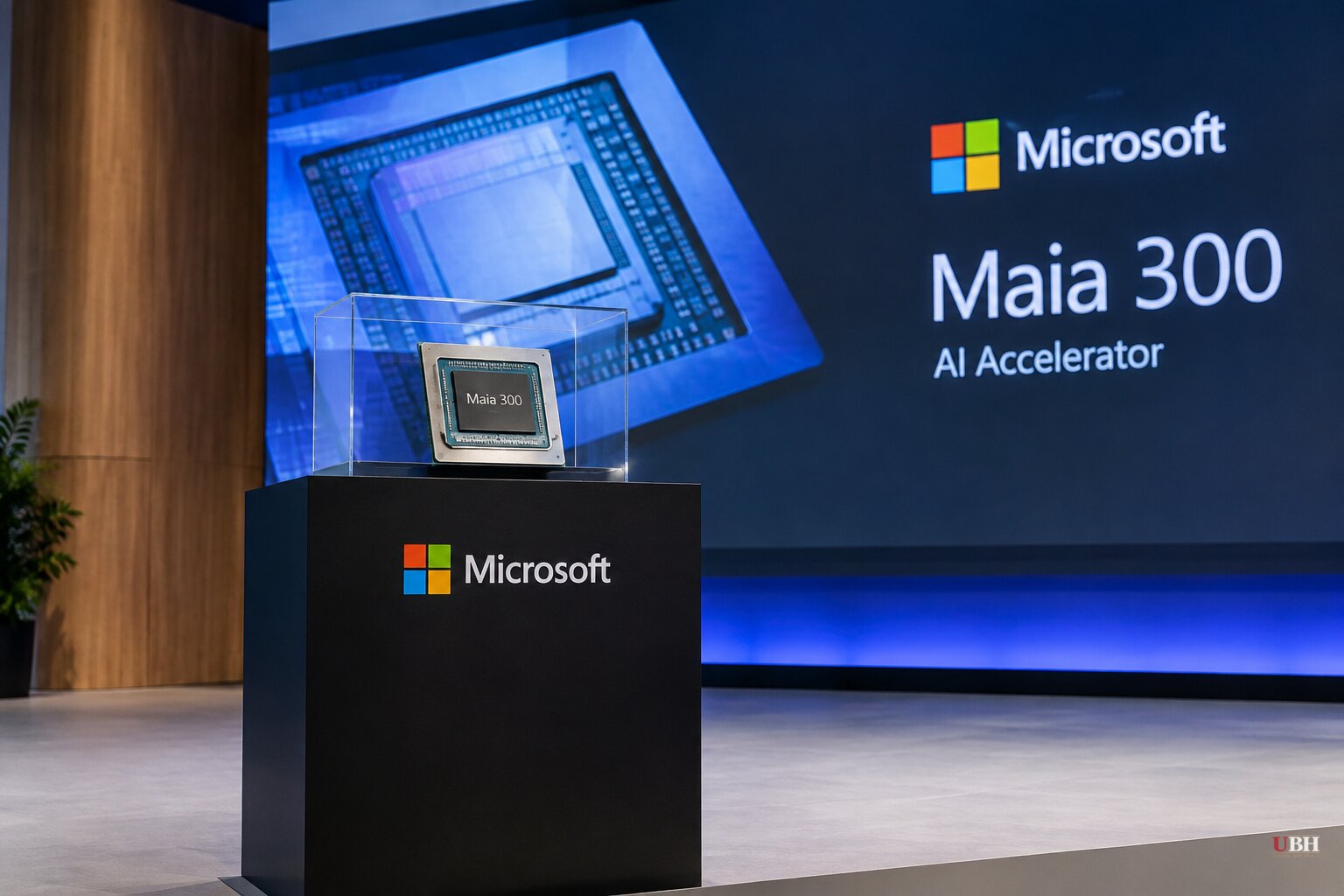
Microsoft on Monday, Oct. 12, announced Maia 300, the third generation of its in-house AI accelerator. The company says it will become "the primary AI inference system for Microsoft products and services."
Production deployment begins in 2027. Scott Guthrie, executive vice president of Microsoft's cloud group, said the company will "scale our Azure Maia family to multi-gigawatt deployments starting in 2027." Microsoft CEO Satya Nadella called it "our biggest bet yet on our own silicon" in a post on X.
What Microsoft is claiming
Guthrie said, "We expect Maia 300 to deliver 40 percent more tokens per megawatt compared to leading GPU-based systems." He added that a full 96-accelerator configuration delivers up to 7x the rack-scale token throughput of Maia 200.
Those are projections, and the chip is not yet in production. Microsoft did not name the GPU systems it compared against, Reuters reported after interviewing the company.
Rani Borkar, president of Azure hardware systems and infrastructure, told Reuters the chip delivers "more intelligence for every watt, every dollar, and every byte of memory."
Power matters here because electricity has become one of the biggest constraints on AI data center growth. More output per megawatt means more AI work for the same power bill.
The hardware
Maia 300 uses a chiplet design built on TSMC's N2P 2-nanometer process, according to Microsoft's Azure hardware team. Compute, memory controller and I/O functions are separated, and Reuters reported the I/O chiplets use cheaper 3-nanometer technology. That differs from Nvidia's approach of one large compute chip surrounded by high-bandwidth memory.
Microsoft says each chip carries eight stacks of HBM4 with a claimed peak bandwidth of 18TB/s inside a 950W thermal envelope. The design targets long-context reasoning, conversational AI and multistep agent work.
Racks hold 96 chips and draw about 167 kilowatts, Reuters reported. Nvidia's current GB300 racks hold 72 GPUs and draw about 142 kilowatts.
Microsoft designs the chip but does not make it. TSMC does. The company would be trading some dependence on Nvidia for dependence on a single contract manufacturer.
Scale and cost
Microsoft told Reuters it plans to deploy potentially more than a million Maia chips next year for its internal AI services. It has said it expects to spend more than $175 billion in capital expenditures this calendar year.
The predecessor, Maia 200, was announced in January after delays. The Information reported in August that it was running in just two U.S. data centers. Microsoft now says Maia 200 is being deployed across the U.S., Europe and Australia, and it already runs Microsoft 365 Copilot along with OpenAI models and Microsoft's own.
Unlike Google's TPUs and Amazon's Trainium chips, Maia is not available for outside customers to rent. Microsoft is using it internally.
Nvidia is not out the door
Microsoft is not cutting Nvidia off. Nadella and Nvidia CEO Jensen Huang shared a stage last week to launch Windows PCs built on Nvidia chips. On Microsoft's July earnings call, Nadella said the company will be among the first cloud providers to deploy systems based on Nvidia's Vera Rubin and AMD's Helios.
Nvidia and AMD chips will keep supporting Microsoft's model training. Maia 300 is aimed at inference, the work of running models for users.
Evercore ISI analysts estimate Maia will account for about 10% of Microsoft's AI chip spending by early 2027. That is an analyst estimate, and it suggests the transition will be gradual even if Microsoft's targets hold.
Why Microsoft wants its own silicon
Mustafa Suleyman, CEO of Microsoft AI, tied the chip to the company's effort to build its own models. "We have to work across the full stack, all the way down to the silicon," he said. "At that scale we need a platform that we own, and that we co-design with our models."
Microsoft is following a path already taken by others. Google sells its TPUs to some customers. Amazon has won AI companies including Anthropic with Trainium. Meta has rolled out its own chips, and OpenAI unveiled a custom chip built with Broadcom in June.
Microsoft says Microsoft 365 Copilot will be among the first products to benefit, followed by GitHub Copilot, Microsoft Foundry and the Microsoft AI team's own work. Microsoft says it will share more details next month.
The claim to watch is the 40% efficiency figure. Until Maia 300 is running production workloads in 2027, it remains a Microsoft projection measured against GPU systems the company has not identified.
Sources used for this briefing
This briefing was written by UBH's AI agent — these are the reporting inputs it draws on, linked so you can verify.


