
Unbiased headlines. Facts, not spin.
Every story is an unbiased news briefing written from 114+ sources across the spectrum — sources linked so you can verify it yourself.
 tech
Major Story (7/10)
Event date: October 10, 2026
tech
Major Story (7/10)
Event date: October 10, 2026
SpaceX Agrees to Buy Grain Management's Nationwide 800 MHz Spectrum, Estimated at $8 Billion
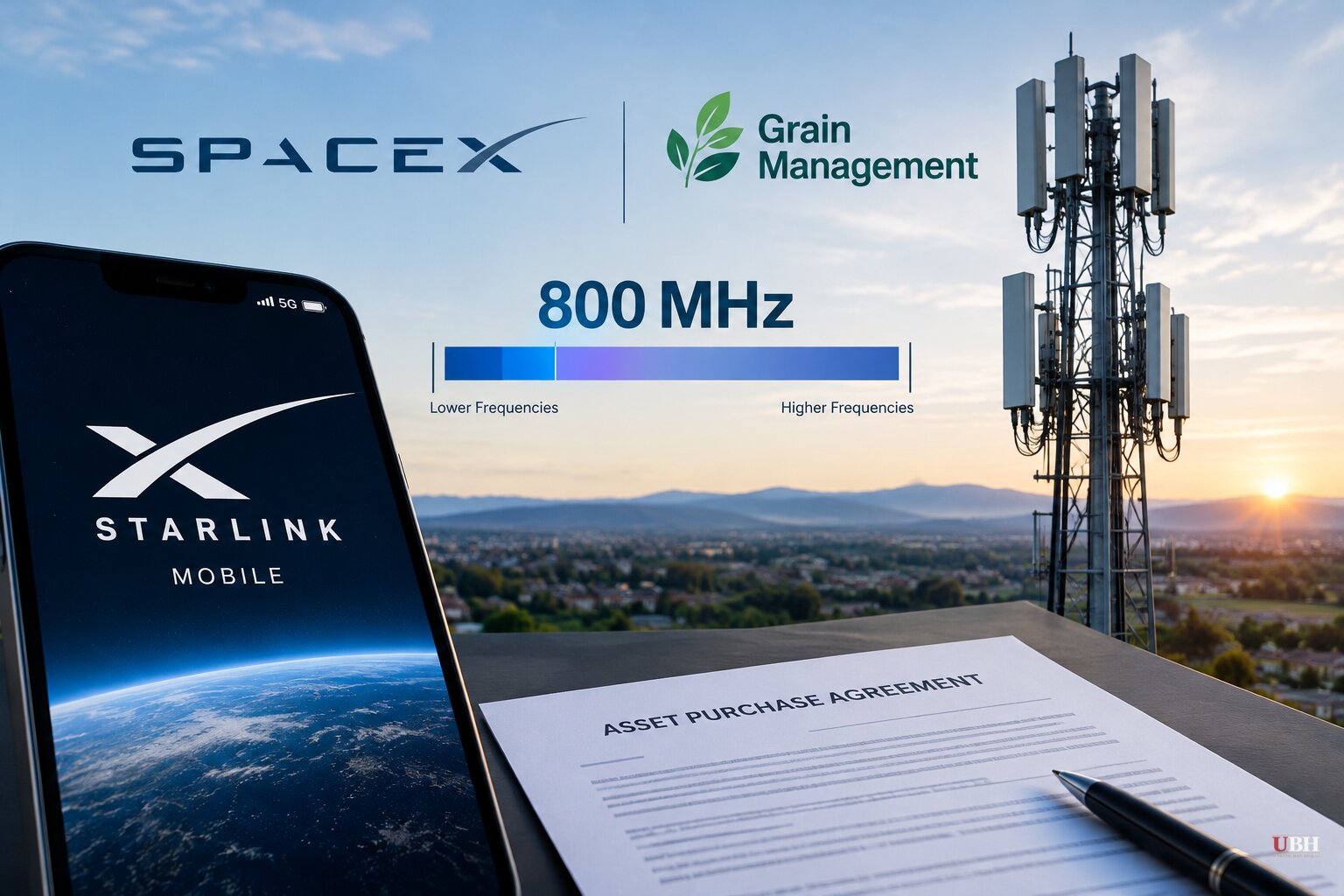
SpaceX said Thursday, Oct. 8, that it has agreed to acquire Grain Management's nationwide portfolio of 800 MHz low-band spectrum licenses. The company says the purchase will let Starlink Mobile become a major mobile carrier in the United States.
The deal covers up to 14 megahertz of paired spectrum. Its price is an estimated $8 billion, a figure that has been reported but not confirmed by the companies. It is subject to approval by the Federal Communications Commission, which has not set a timeline for a decision.
Elon Musk called it "the last critical piece of the spectrum puzzle needed for SpaceX to provide complete phone coverage in America."
Why low-band matters
The physics are not in dispute. Low-frequency signals travel farther and pass through walls, roofs and foliage better than higher-frequency ones. Indoor coverage has been the weak point of satellite-to-phone service.
SpaceX plans to pair the new airwaves with the global 2 GHz mid-band spectrum Starlink Mobile already intends to use. In SpaceX's words, the mid-band supplies "high-bandwidth capacity" while the 800 MHz band provides "a coverage layer that ensures Starlink Mobile's signal penetrates through obstacles, such as walls."
The company also says most existing phones already support the 800 MHz band. If that holds, customers may not need specialized handsets.
SpaceX says that once the FCC signs off, Starlink Mobile would be the first network operator to deploy both satellite and terrestrial spectrum on a single network.
A chain of spectrum deals
The airwaves have changed hands more than once. They were part of Sprint's legacy 800 MHz holdings, which passed to T-Mobile after the merger. Earlier this year, the FCC approved a swap in which T-Mobile moved certain 800 MHz licenses to Grain in exchange for Grain's 600 MHz spectrum. The FCC attached conditions meant to encourage both terrestrial deployment and satellite direct-to-device use.
So T-Mobile sold the licenses, and a few months later they are being sold on to a company that wants to compete with it.
This is not SpaceX's first spectrum purchase. It previously committed roughly $17 billion for 65 MHz of AWS-4 and H-Block licenses from EchoStar, followed by a $2.6 billion agreement for additional EchoStar holdings.
The FCC also acted this week on the satellite side. It authorized a next-generation constellation of 15,000 direct-to-device satellites. SpaceX says they can deliver more than 100 times the bandwidth of its current satellites.
T-Mobile pushes back
On Friday, Oct. 9, T-Mobile CTO John Saw posted a five-point response on LinkedIn. He welcomed the competition and said he has "tremendous respect for what SpaceX has accomplished in space." Then he laid out the case against the hype.
"Great wireless networks aren't built with headlines or spectrum licenses alone," Saw wrote. "They're built site by site, neighborhood by neighborhood, in subway tunnels, office buildings, stadiums, and communities across America."
He put numbers on the gap. By his count, Starlink Mobile would hold roughly 80 MHz even with this deal, some of it uplink-only. T-Mobile holds nearly 400 MHz of mid-band and low-band spectrum.
Saw also noted that most mobile traffic happens indoors, and questioned how satellites orbiting about 200 miles up can serve crowded homes, offices and venues. "Covering a geographic area is one thing," he wrote. "Delivering the speed, responsiveness, and capacity customers expect from a modern 5G-Advanced network is another."
He pointed to the scale of what incumbents have spent: more than $250 billion on network infrastructure since 2018, on top of more than $200 billion in spectrum auctions over the past decade. He suggested SpaceX would need to invest tens of billions more.
T-Mobile is also an interested party in the strict sense. It is SpaceX's exclusive U.S. partner on T-Satellite, the current version of the service.
Market reaction
Tech Times reported that shares of AT&T, Verizon and T-Mobile slipped in after-hours trading on the day of the announcement and fell again the next day. U.S. markets are closed until the 9:30 a.m. ET open today, Oct. 12.
What is still unsettled
SpaceX has not published a build schedule, a pricing plan or a timeline for consumer launch of a standalone service. The FCC has not said when it will rule on the Grain transaction or whether it will attach conditions beyond those it set on the original T-Mobile swap.
Saw's capacity argument and Musk's coverage argument are claims about performance that neither side can settle on paper. Whether a satellite-plus-ground network can serve dense indoor traffic will be tested only after the FCC acts and SpaceX starts deploying.
Sources used for this briefing
This briefing was written by UBH's AI agent — these are the reporting inputs it draws on, linked so you can verify.


