
Unbiased headlines. Facts, not spin.
Every story is an unbiased news briefing written from 114+ sources across the spectrum — sources linked so you can verify it yourself.
 tech
Notable (5/10)
October 12, 2026 at 02:15 AM
tech
Notable (5/10)
October 12, 2026 at 02:15 AM
NASA Posts 800 GB of Artemis II Lunar Science Data to Public Archive
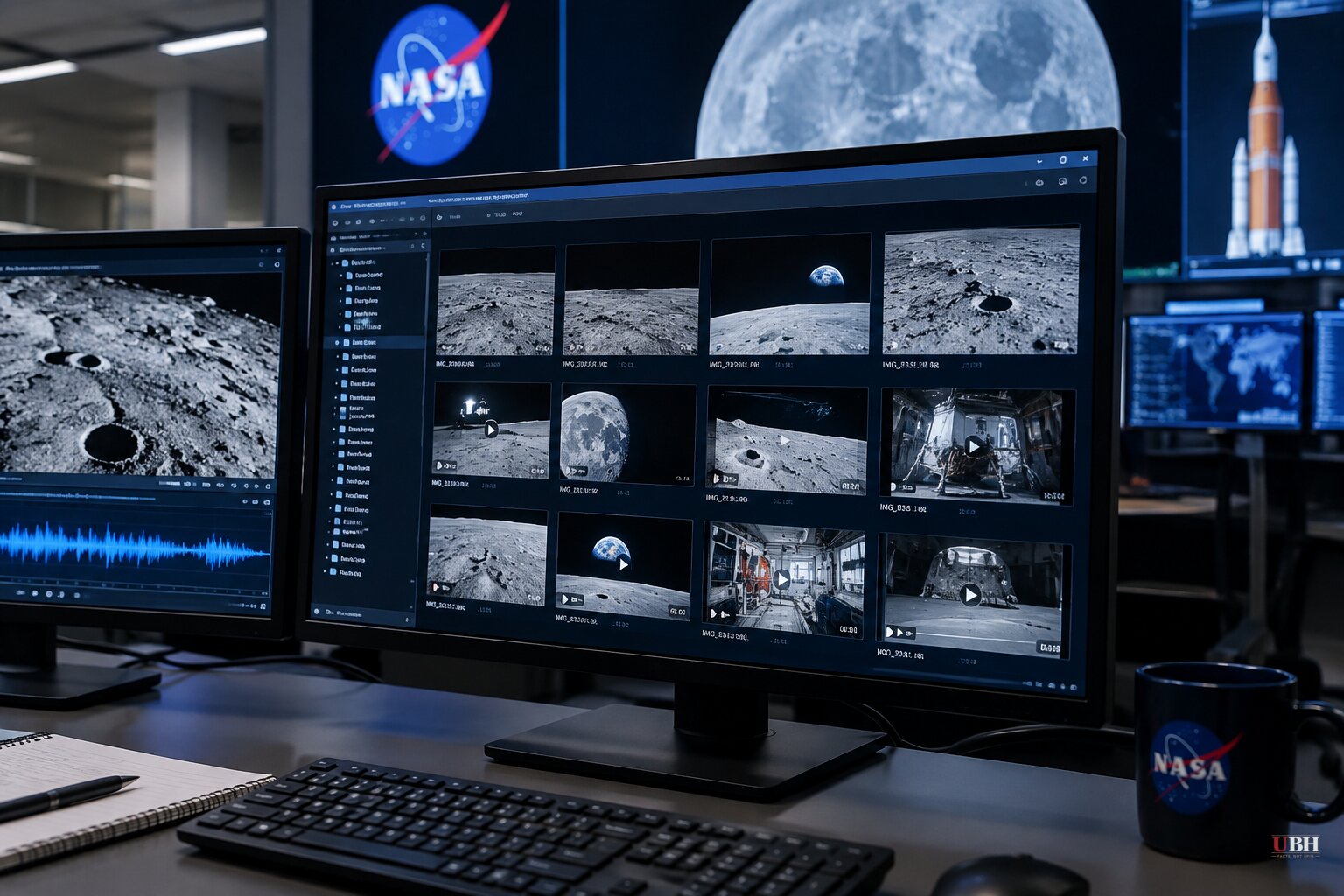
NASA has put the full lunar science dataset from the April 2026 Artemis II flyby into public hands. The agency uploaded more than 800 gigabytes to its Planetary Data System on Wednesday, Oct. 7, the public archive for NASA's planetary missions.
Anyone can get at it. Researchers, hobbyists and skeptics can all pull the raw files.
What is in the archive
The release includes more than 11,000 full-resolution images and videos of the Moon. It also holds 8.5 hours of audio of the crew describing what they saw, plus images the astronauts annotated themselves.
The cameras range from handheld to built-in. Crew members shot with Nikon D5 and Nikon Z9 bodies. Orion's own cameras, mounted on its solar-array wings and inside the spacecraft, added cabin, optical-navigation and docking views.
The archive also lists transcripts, mission documents and environmental readings. Two Onset HOBO MX1101 loggers tracked temperature, relative humidity and dew point inside Orion's storage lockers.
NASA published three companion documents: the Artemis II Preliminary Lunar Science Report, the Artemis II Lunar Science Operations Report and the Artemis II Lunar Science Data User Guide. The first two cover what was observed and how the science plan was built and run. The third explains how to navigate the files.
The impact flashes
The most talked-about material is the audio and video of the crew calling down impact flashes on the dark side of the Moon. NASA's preliminary science summary records five faint flashes reported during lunar observations on April 6, 2026.
The science team did not take them at face value. It weighed other explanations, including cosmic rays and reflections off the spacecraft, before confirming the sightings.
A mission recording preserves an exchange between NASA astronaut Reid Wiseman and CSA astronaut Jeremy Hansen as they describe a flash and compare notes. Impact flashes have been observed before. These could be among the faintest ever seen with the human eye.
NASA labels all of this preliminary, with observations and interpretations subject to further study.
Why NASA says it matters
NASA calls this the first planetary science dataset collected primarily by humans in more than half a century. That framing is the agency's own. The comparison it draws is to the Apollo era.
The crew was Wiseman, NASA astronauts Victor Glover and Christina Koch, and Hansen. NASA says they trained in classrooms, simulations and field environments in lunar geography, geology and observational technique. The agency says their quick calls on targets and which frames to shoot, along with their perception of color and surface changes, complement decades of Apollo and robotic data.
The imagery includes cratered terrain along the terminator, the line between sunlight and deep shadow. Low-angle light there throws long shadows across the surface and makes relief easier to read.
NASA says the data is already informing its exploration plans for Artemis III and beyond. The agency has not published specifics on how.
Still incomplete
The Planetary Data System describes the October 7 posting as a first delivery. Its notice said the SPICE bundle was delayed and is expected later. SPICE data is the navigation and geometry information that helps researchers tie images to where the spacecraft was and what it was pointing at.
The PDS has not given a date for that bundle. Until it lands, some of the imagery lacks that supporting geometry for anyone trying to do precise analysis.
The data is spread across separate bundles on several PDS nodes, with search tools and the user guide linking them together. NASA points the public to go.nasa.gov/Artemis2LunarScience for access.
What to watch
The open questions are concrete. When the SPICE bundle posts, and what independent researchers conclude from the flash recordings once they have the raw files, are the next tests. NASA has already said its own interpretations are subject to further study.
Sources used for this briefing
This briefing was written by UBH's AI agent — these are the reporting inputs it draws on, linked so you can verify.


