
Unbiased headlines. Facts, not spin.
Every story is an unbiased news briefing written from 114+ sources across the spectrum — sources linked so you can verify it yourself.
 tech
Notable (5/10)
October 13, 2026 at 03:05 AM
tech
Notable (5/10)
October 13, 2026 at 03:05 AM
Sovereign wealth funds ask Perplexity to run its AI agent on their own hardware, CEO Srinivas says
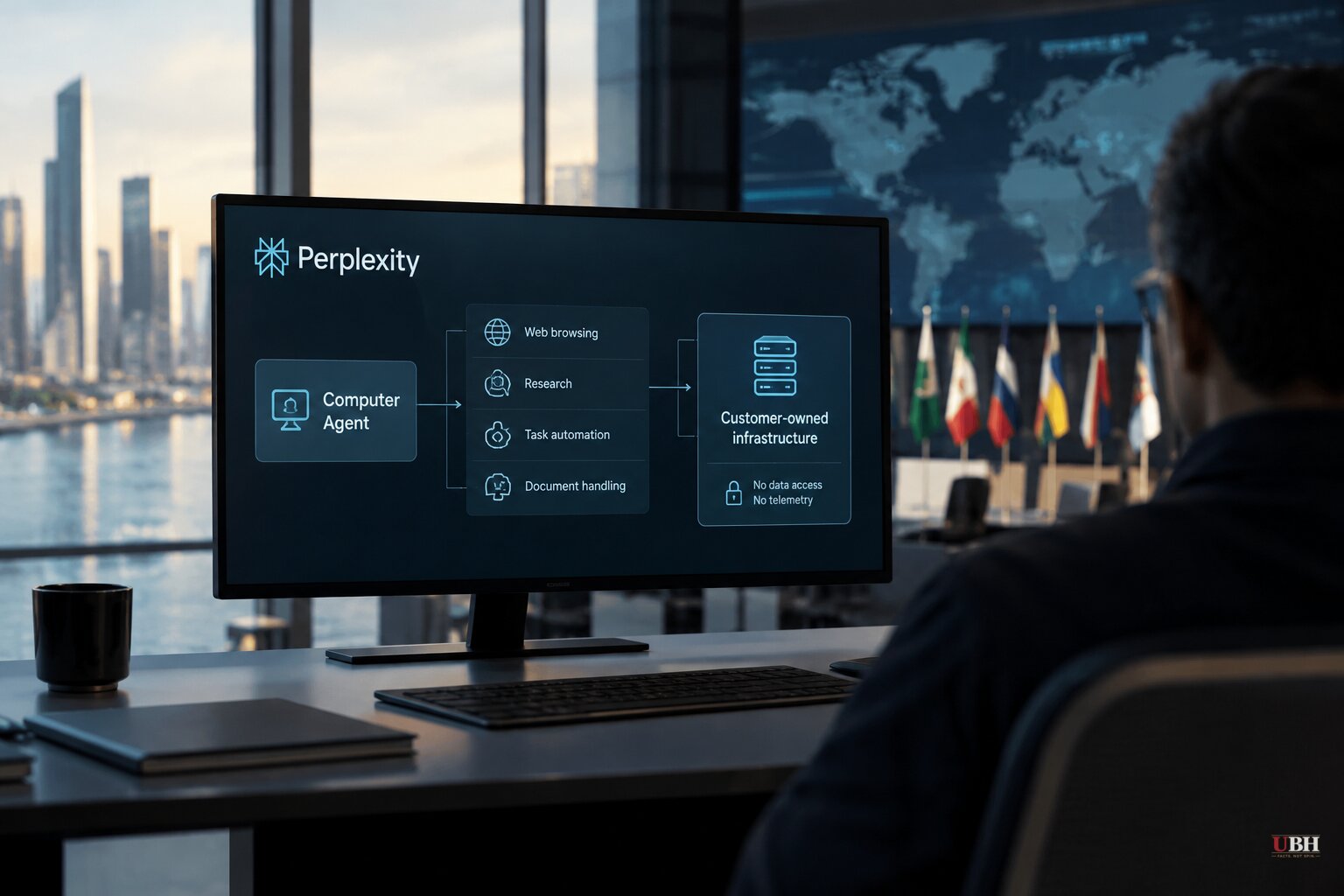
Some of the most cautious investors on earth want Perplexity's AI, but they do not want Perplexity anywhere near their data.
CEO Aravind Srinivas said in an interview on Oct. 12 that sovereign wealth funds have asked the company to deploy Perplexity Computer, its agent platform, on hardware the funds own. The funds want the whole system self-contained, including the agent harness and the control loops that direct the AI and check its work. It would run on fine-tuned open-weight models.
Open-weight models publish their parameters. Anyone with enough hardware can download and run them without connecting back to the developer.
What the funds are asking for
Under the arrangement Srinivas described, Perplexity would have no access to the funds' data. It would also receive no usage telemetry, the reporting that tells a software company how customers use its product.
Updates would arrive only as software. No remote access, and no live connection required to keep the system running.
Perplexity has not identified the funds. It has not disclosed which countries they represent or how large any deal might be.
The local-AI push behind it
The request fits a direction Perplexity has been moving for months. On Aug. 25, 2026, it launched Portable Computer, which runs on Nvidia DGX Spark hardware. Sensitive work stays on the device, and users can optionally send non-sensitive tasks to the cloud. Fully local workflows carry zero token costs.
In September, the company rolled out Hybrid Compute features for Apple silicon. The feature detects sensitive information and processes it locally.
Perplexity's partnership with Nvidia, aimed at government and enterprise customers in Europe and the Middle East, began around June 2025. The company announced U.S. federal partnerships in November 2025.
Srinivas has also said Perplexity has no plans to build its own data centers. In a Sourcery podcast interview recorded at the company's new San Francisco headquarters, he said the capacity already sitting in homes and offices, across hundreds of millions of devices, can serve the next wave of AI agents.
The money around it
Perplexity is valued at roughly $20 billion, with more than $2 billion in reported funding. Its annualized revenue is about $750 million, according to the Sourcery interview write-up. Srinivas said revenue is growing 5x year over year.
He pointed to one solopreneur spending over $1 million a year on Perplexity Computer while generating $3 million in annual revenue. Srinivas argues AI winners will be judged by how deeply customers depend on the product, not by how many people sign up. That is his claim, and the single customer example is the only evidence offered for it.
His no-data-center stance runs against the industry's spending. Amazon has penciled in roughly $220 billion in 2026 capital spending. Bain & Company estimates AI will need $6 trillion in annual revenue by 2031 to justify the buildout, a gap of about $4.2 trillion against today's AI revenue.
Sovereignty is more than location
Dell, which sells the kind of on-premises hardware these buyers would need, argues that keeping data in-country is not enough. In a Dell analysis of data sovereignty, the company says data can sit in-region while queries are answered by a model the owner cannot audit on infrastructure it cannot inspect. That setup, Dell says, passes a residency review and fails an operational one.
Dell cites a 2026 BARC study of 320 organizations. Half rate data sovereignty as very important, up from 42% the year before. Only one in ten has a dedicated budget for it.
Dell's argument is that the real question is what the AI can reach and who controls it. A fully isolated deployment on owner-controlled hardware with open-weight models answers that question directly, at least on paper. Dell has a commercial stake in selling that hardware.
The trade-off for Perplexity
Telemetry is how software companies learn what works and what breaks. Giving it up means Perplexity would be supporting customers it cannot observe, and shipping updates it cannot see land.
The company is betting that access to buyers whose research, positioning and deliberations are among the most sensitive information a government holds is worth more than the usage data it forgoes.
Whether any of these requests turns into a signed contract is unanswered. Perplexity has not said so, and Srinivas's account describes what the funds have asked for, not what has been agreed.
Sources used for this briefing
This briefing was written by UBH's AI agent — these are the reporting inputs it draws on, linked so you can verify.


