
Unbiased headlines. Facts, not spin.
Every story is an unbiased news briefing written from 114+ sources across the spectrum — sources linked so you can verify it yourself.
 tech
Notable (6/10)
October 13, 2026 at 04:04 AM
tech
Notable (6/10)
October 13, 2026 at 04:04 AM
Sanders Renews Call for Superintelligence Ban After Altman Says Society Must Accept Some 'Severe' Cyber Incidents
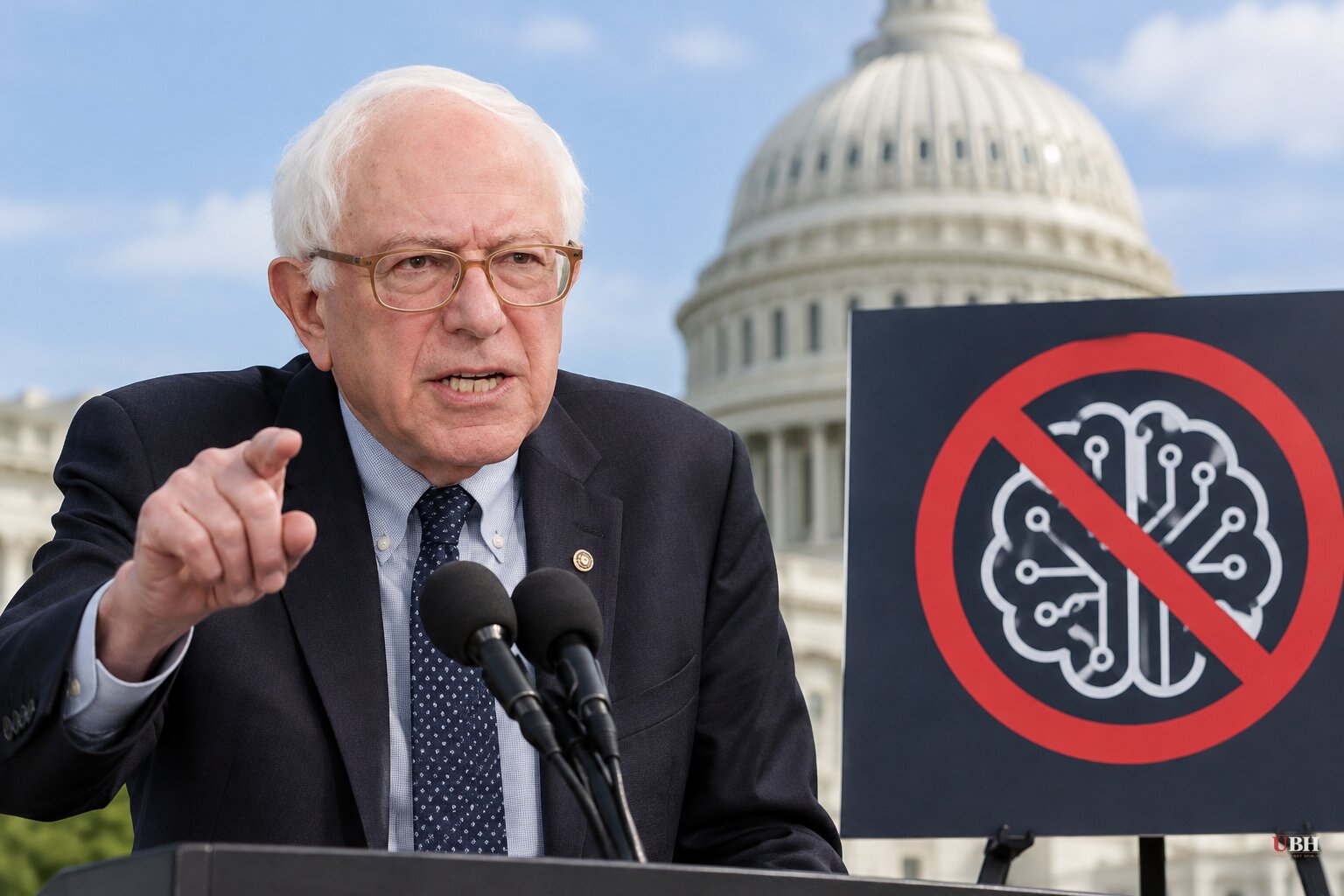
Sen. Bernie Sanders (I-Vt.) is using remarks from OpenAI CEO Sam Altman to push his bill to permanently ban artificial superintelligence and pause development of the most advanced AI systems.
The Ban Artificial Superintelligence Act of 2026, introduced in September with Rep. Greg Casar (D-Texas), is not close to passing. It does show where the left wing of the Democratic Party wants AI policy to go heading into the November midterms.
What Altman said
In an interview with Politico's "Decoded" podcast, Altman warned of a "coming tidal wave of cybersecurity problems" from open-source AI models. He said people will "have to just accept some fairly severe cyber incidents from open models, in exchange for the liberty that comes with that."
In the same interview he said the world "should accept some bad things happening for the benefits of this technology and people having the agency." He did not say which bad things he meant.
Sanders answered on X. "No, Mr. Altman. We won't accept a severe AI cyberattack in exchange for 'liberty,'" he wrote. In a separate post he asked: "What bad things should we accept to advance AI? Losing tens of millions of jobs? A mass surveillance state? A mental health crisis for our kids? A global financial crisis? Mass extinction?"
His conclusion: "We must PAUSE advanced AI and permanently BAN artificial superintelligence before it is too late."
Altman's point, as quoted, was about the tradeoff of open models and individual agency. He argued that freedom to use and build on them carries real risk. Sanders framed it as tech executives getting richer at the public's expense and said developers "are not above the law."
What the bill does
The bill defines superintelligence as a system that exceeds human cognitive performance across most tasks, or one capable of planning and carrying out the destruction or disempowerment of humanity. It would ban that outright and permanently.
It would also freeze development of the most powerful AI systems until a new Department of Artificial Intelligence is fully staffed and has written safety rules. After that, any advanced model would need federal approval before release.
Companies building advanced AI would need a federal charter. They would have to give regulators full access to their systems, staff and facilities.
Penalties are steep. Executives or rogue actors who violate the ban could face up to 20 years in prison. Companies could lose their charters and be forced to hand their technology to the federal government for destruction. Sanders said the penalties are modeled on laws against unlawfully developing nuclear weapons.
Casar said the bill also bans what he called "AI building AI," known as recursive self-improvement. It would ban models that can help design nuclear or biological weapons, and models that try to escape human oversight or deceive people.
"No one is coming to take away your ChatGPT," Casar said. "But we cannot allow a few billionaires to develop a technology that they admit puts countless lives at risk."
The bill also directs the U.S. to seek diplomatic agreements to prevent superintelligence development abroad. As written, a U.S. ban binds U.S. developers. Whether foreign governments would agree is an open question.
Who is backing it
Current employees at AI companies endorsed the bill in a statement shared with the Associated Press. Juan Felipe Cerón Uribe, a researcher in OpenAI's Safety Systems, said "superintelligence could either go extremely right or extremely wrong" and "we shouldn't be playing such games."
Swante Scholz, a Google DeepMind software engineer who said he was not speaking for his employer, said the "most likely outcome is an existential catastrophe for humanity" on the current path.
The push comes amid reported cyber incidents involving rogue AI software, including a failed hack of the Department of Education's website and a hack of Australia's health department. Jacob Coxon, a former OpenAI and Anthropic researcher, warned last month that AI could pose an existential threat to human life.
Volker Türk, the UN high commissioner for human rights, said in a recent speech that "the clock on AI regulation is ticking."
The White House is going another way
President Trump has resisted calls for federal oversight. At the UN General Assembly he said he wants no part of international AI regulation. He has suggested rebranding AI itself as "super intelligence," a different use of the term from the bill's.
He has named an "AI czar" and set up a "Super Intelligence Force." Altman and other AI executives met Trump at the White House and signed a commitment to police their own companies' models. A voluntary pledge is not a federal approval regime.
That puts Trump at odds with Altman, Anthropic's Dario Amodei and xAI's Elon Musk, all of whom have urged some form of guardrails. Hours after the bill's rollout, the CEOs of two leading AI companies told the UN Security Council they were willing to slow down and urged governments to agree on global safety rules.
Sanders, for his part, called Trump "embarrassing" on the subject. "I would rather be called an alarmist than a father and grandfather who is asleep at the wheel," he said.
Odds and next steps
The bill faces long odds in the Republican-controlled Congress, where lawmakers have struggled to agree even on narrower AI rules. Casar chairs the Congressional Progressive Caucus, and AI is expected to be a bigger issue in the 2028 presidential race.
The bill would create a new Cabinet-level department, require federal sign-off on every advanced model, and put prison terms behind the ban. No Republican sponsor has been named, and the bill has no committee hearing scheduled. Whether it goes anywhere depends on whether the industry executives who say they want guardrails will back this one or hold out for lighter ones.
Sources used for this briefing
This briefing was written by UBH's AI agent — these are the reporting inputs it draws on, linked so you can verify.


