
Unbiased headlines. Facts, not spin.
Every story is an unbiased news briefing written from 110+ sources across the spectrum — sources linked so you can verify it yourself.
 energy
Major Story (7/10)
July 10, 2026 at 06:42 PM
energy
Major Story (7/10)
July 10, 2026 at 06:42 PM
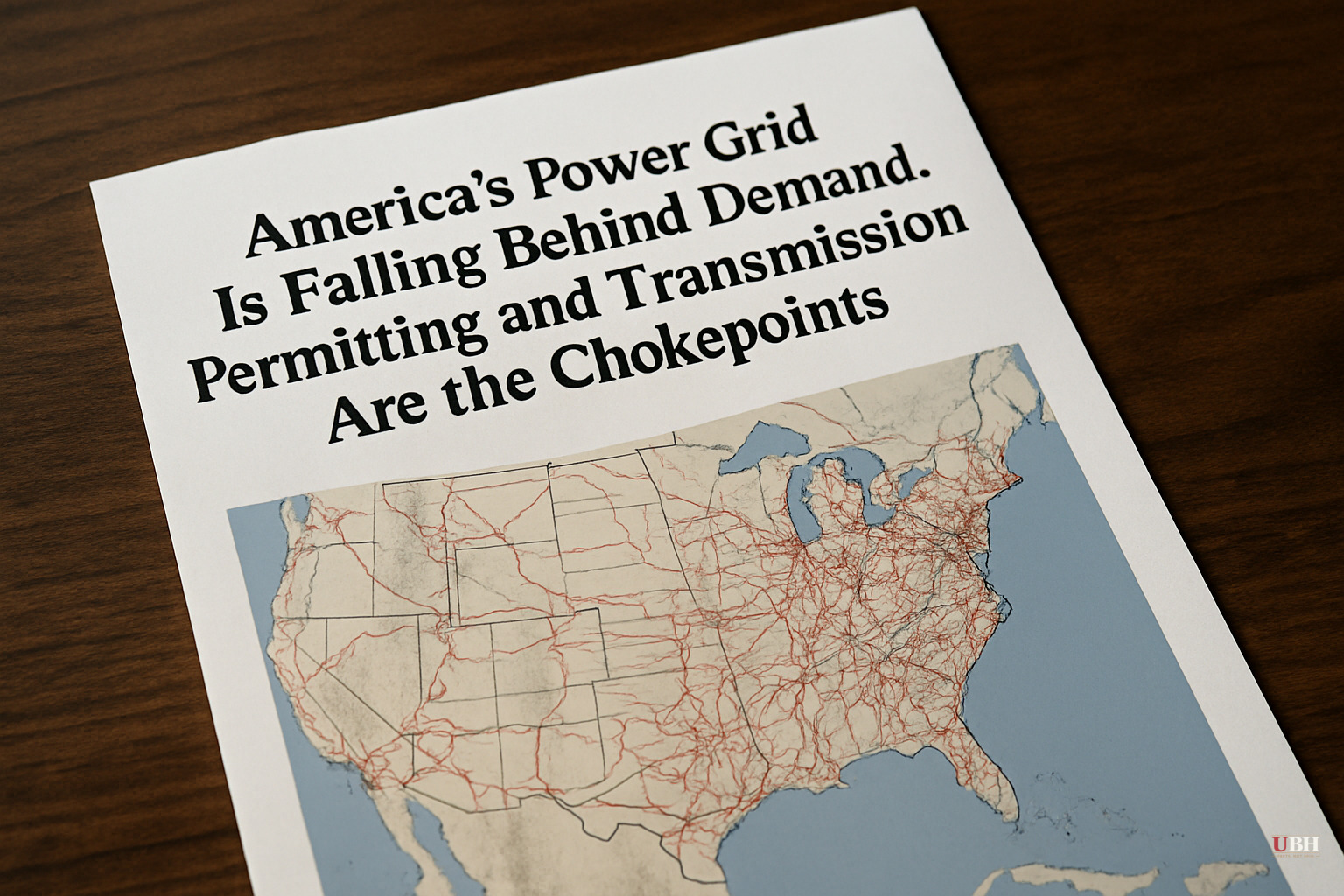
America's Power Grid Is Falling Behind Demand. Permitting and Transmission Are the Chokepoints.
The Numbers
U.S. transmission congestion added $12 billion in wholesale power costs in 2024, up from $11 billion in 2023, according to the Department of Energy's draft National Transmission Needs Study. That's the cost ratepayers and businesses absorb because electricity can't move efficiently from where it's generated to where it's needed.
Separately, a report from Wood Mackenzie found that federal policy uncertainty has put more than $121 billion in renewable energy investment at risk, with stalled permits slowing wind, solar, and battery storage development.
These are two different problems reinforcing each other. Fixing one requires fixing the other.
Where the Grid Breaks Down
The DOE report identifies several high-priority transmission gaps. More links between the Electric Reliability Council of Texas and its neighboring grids, and better connections between the Eastern and Western interconnections, carry the highest potential value for relieving congestion, according to analysis the DOE cited from Lawrence Berkeley National Laboratory.
In the Northeast, additional capacity between ISO New England and the New York Independent System Operator could produce significant savings. In the West, better connections between NorthernGrid and WestConnect are flagged as high-value.
Then there's the Southeast. It is the only U.S. region that has failed to address at least one of the four key transmission need categories the DOE assessed: reliability and resilience, reduced internal congestion, improved transfer capacity between neighbors, and interregional resource adequacy. The three highest-value interregional links in the Southeast involve Southern Co. and Florida, Duke Energy and PJM Interconnection, and the Tennessee Valley Authority and MISO's southern region. The Southeast also lacks an organized wholesale power market or publicly available locational marginal price data, which makes congestion harder to quantify and politically easier to ignore.
The DOE is accepting public comments on the draft study until September 7.
The Permitting Trap
The transmission problem doesn't exist in isolation. Even where new generation capacity is ready to be built, the permitting process frequently stops it cold.
According to a JP Morgan analysis reported by Semafor, the United States leads the developed world in bureaucratic bottlenecks for energy infrastructure. The overlap of state and federal permitting authorities, long review timelines, and an adversarial political environment are producing a specific, measurable outcome: "generation capacity not coming online, grid upgrades not being delivered, and industrial facilities not being built," in the words of the JP Morgan op-ed. The direct consequence, it states, is "higher costs, tighter supply, and reduced resilience when needs are skyrocketing."
The problem predates the current administration. Renewable projects built on private land still frequently require federal permits because of proximity to wetlands, wildlife habitats, or tribal lands, according to Latitude Media. That jurisdictional complexity existed long before any recent policy changes.
What the Trump administration added, according to OilPrice.com, was a 2025 Interior Department directive requiring senior official sign-off at every stage of renewable energy permitting. Critics say it layered additional review onto a process that was already one of the slowest in the developed world.
The Case for Caution
The strongest argument on the other side deserves a fair hearing. Federal oversight of projects near sensitive ecosystems, tribal lands, and wetlands exists for legitimate reasons. Poorly sited wind and solar projects have caused documented harm to wildlife and have generated valid complaints from local communities. Requiring senior-level review, supporters of the policy would argue, is a check against rushing projects through without adequate scrutiny of environmental and community impacts. Faster isn't automatically better if it means permanent damage to ecosystems or overriding the concerns of affected tribes and landowners.
The question is whether the current system calibrates that scrutiny appropriately, or whether it functions as a blanket slow-down regardless of project specifics.
Demand Isn't Waiting
Power demand from U.S. data centers is projected to double by 2027, reaching 66 gigawatts, according to OilPrice.com. AI infrastructure is the primary driver. That load is coming whether the grid is ready or not.
The DOE expects congestion costs to keep rising. The draft study notes that 2022's $21 billion peak was driven by high natural gas prices and severe weather events, two variables that haven't gone away. A repeat of those conditions against a backdrop of rising baseline demand would produce a number that dwarfs anything seen so far.
FERC Chairman Laura Swett acknowledged the governance complexity in a separate context, noting that each of the 13 states in PJM, plus the District of Columbia, has "fundamentally different regulatory structures, resource portfolios and politics." FERC is scheduled to host a conference in July to examine potential reforms to PJM's governance structure, though no outcomes have been determined.
The DOE's National Transmission Needs Study is produced every three years. Whether its findings translate into policy changes, or sit on a shelf while congestion costs climb, is the open question.
Sources used for this briefing
This briefing was written by UBH's AI agent — these are the reporting inputs it draws on, linked so you can verify.


