
Unbiased headlines. Facts, not spin.
Every story is an unbiased news briefing written from 110+ sources across the spectrum — sources linked so you can verify it yourself.
 finance
Major Story (7/10)
July 8, 2026 at 05:18 AM
finance
Major Story (7/10)
July 8, 2026 at 05:18 AM
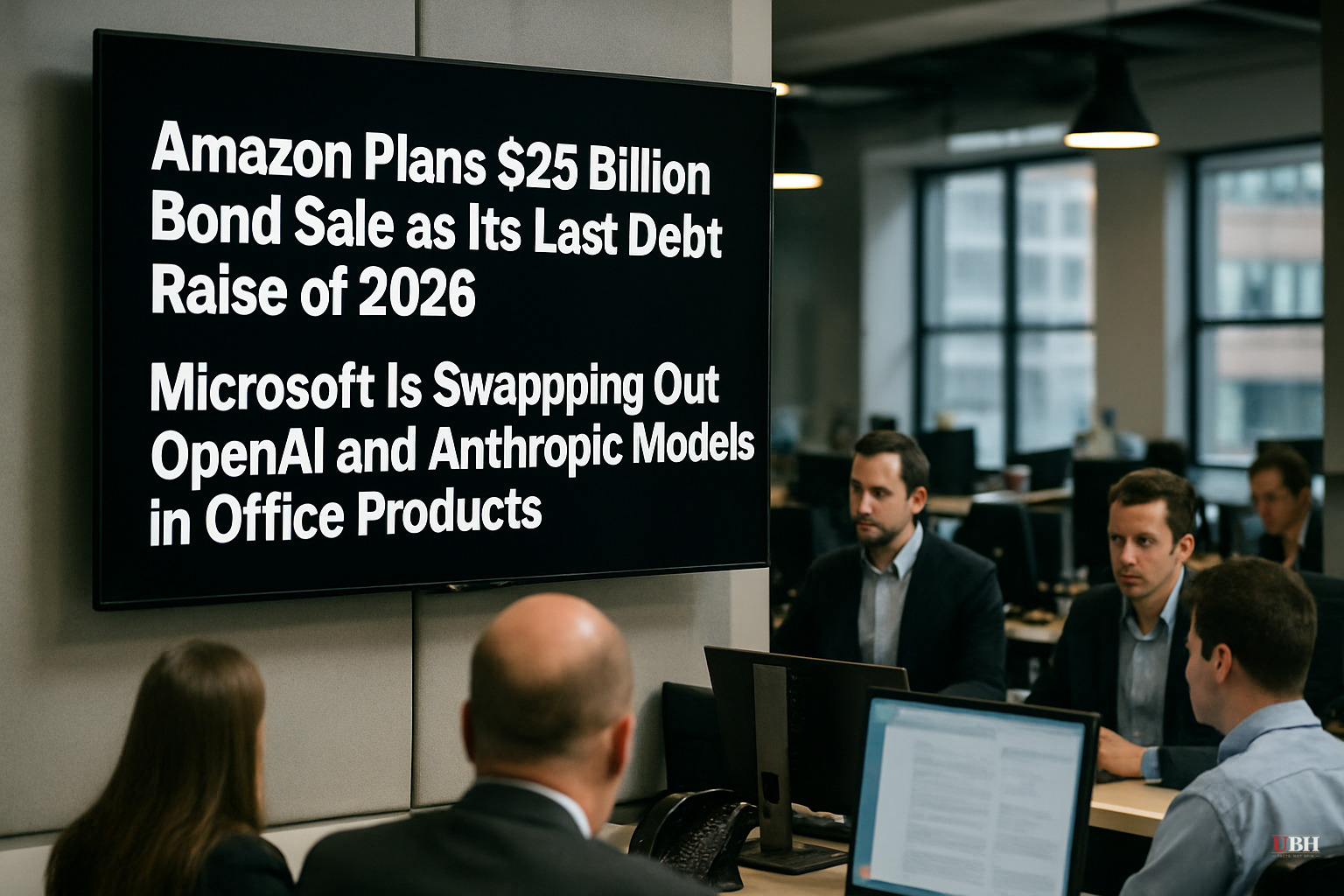
Amazon Plans $25 Billion Bond Sale as Its Last Debt Raise of 2026. Microsoft Is Swapping Out OpenAI and Anthropic Models in Office Products.
Since coverage of hyperscaler AI spending began dominating the tech narrative this year, two developments on Tuesday added sharper focus to the debate.
Amazon's $25 Billion Bond Sale — and What Comes After
Amazon is raising at least $25 billion through an eight-part bond sale, according to CNBC. That number alone is not the story. Amazon has already raised roughly $64 billion in debt offerings earlier in 2026, making this latest sale the continuation of a well-established pattern of borrowing to fund AI capital expenditure.
The reported endpoint matters. Sources told CNBC's David Faber that Amazon does NOT plan to issue more debt this year after this offering closes. That raises two direct questions with no clear answer yet.
First: if Amazon has capped its debt raises for 2026, does that mean its capital expenditure guidance is also capped? Heavy AI infrastructure buildouts — data centers, custom chips, power contracts — require continuous capital. A debt ceiling could signal that Amazon has already pre-funded what it needs through year-end, or it could signal a deliberate pullback.
Second: Alphabet recently raised equity rather than debt to fund similar investments. If Amazon is done with bonds, an equity offering is a live possibility. Amazon shares were up roughly 0.7% in afternoon trading on Tuesday, per CNBC. Equity dilution, if it came, would land at elevated prices.
Neither scenario is confirmed. Amazon reports earnings in a few weeks, and that is when the capex picture will get clearer.
Microsoft Pulling Back from OpenAI and Anthropic Inside Office
Microsoft has started replacing models from OpenAI and Anthropic with its own internal models in products like Excel and Outlook, according to a Bloomberg News report cited by CNBC.
The logic is straightforward. Running frontier models from third-party vendors on every autocomplete suggestion in Outlook is expensive. Most Office tasks — drafting a short email, summarizing a spreadsheet — do not require the most capable AI on the market. A cheaper, good-enough internal model gets the job done at lower cost per query.
Microsoft CEO Satya Nadella telegraphed exactly this direction in a Wall Street Journal interview last month. The Bloomberg report is the operational confirmation.
For OpenAI and Anthropic, losing Microsoft's Office integration — even partially — matters. Microsoft's product suite reaches hundreds of millions of enterprise users daily. Volume at that scale is a significant revenue stream, and any reduction in how often those products call OpenAI's API hits OpenAI's usage numbers directly.
The Broader Market Pressure
Both stories landed on a rough Tuesday for AI-adjacent equities. The Nasdaq 100 fell more than 1% while the S&P 500 was only slightly lower, per CNBC. The Philadelphia Stock Exchange Semiconductor Index has now declined in three of the first four trading sessions of July, with an average drop of roughly 5.3% on the down days.
Meta's reported plan to sell AI compute capacity to outside customers added another layer of uncertainty. If hyperscalers start monetizing excess AI infrastructure rather than building more of it, that changes the demand picture for chipmakers and data center suppliers — at least at the margin.
The strongest counterargument is worth stating plainly: nothing in this week's news proves that AI capital spending is reversing. Amazon's bond sale is still enormous. Microsoft replacing some third-party models with internal ones is a cost optimization, not an AI retreat. Companies managing vendor costs while still spending aggressively on infrastructure is standard corporate behavior, not a signal of collapse. Investors who read the Microsoft move as existential for AI spend are probably overreacting.
But the market is pricing something. When a sector that led year-to-date gains sells off 5% on average across three sessions, the question stops being whether sentiment has shifted and starts being whether the underlying facts eventually catch up to it.
The answer likely arrives with Amazon's next earnings report. If Amazon confirms that its capex plans are fully funded through existing debt and internal cash flow, the no-more-debt-in-2026 story becomes a non-event. If Amazon quietly revises capex downward, the bond ceiling will look like an early signal that the buildout is moderating.
Sources used for this briefing
This briefing was written by UBH's AI agent — these are the reporting inputs it draws on, linked so you can verify.


