
Unbiased headlines. Facts, not spin.
Every story is an unbiased news briefing written from 110+ sources across the spectrum — sources linked so you can verify it yourself.
 finance
Major Story (7/10)
July 8, 2026 at 09:29 AM
finance
Major Story (7/10)
July 8, 2026 at 09:29 AM
AI Hardware Stocks Fell Tuesday as Megacaps Rebounded. The Debate Over Who Wins the AI Race Just Got Louder.
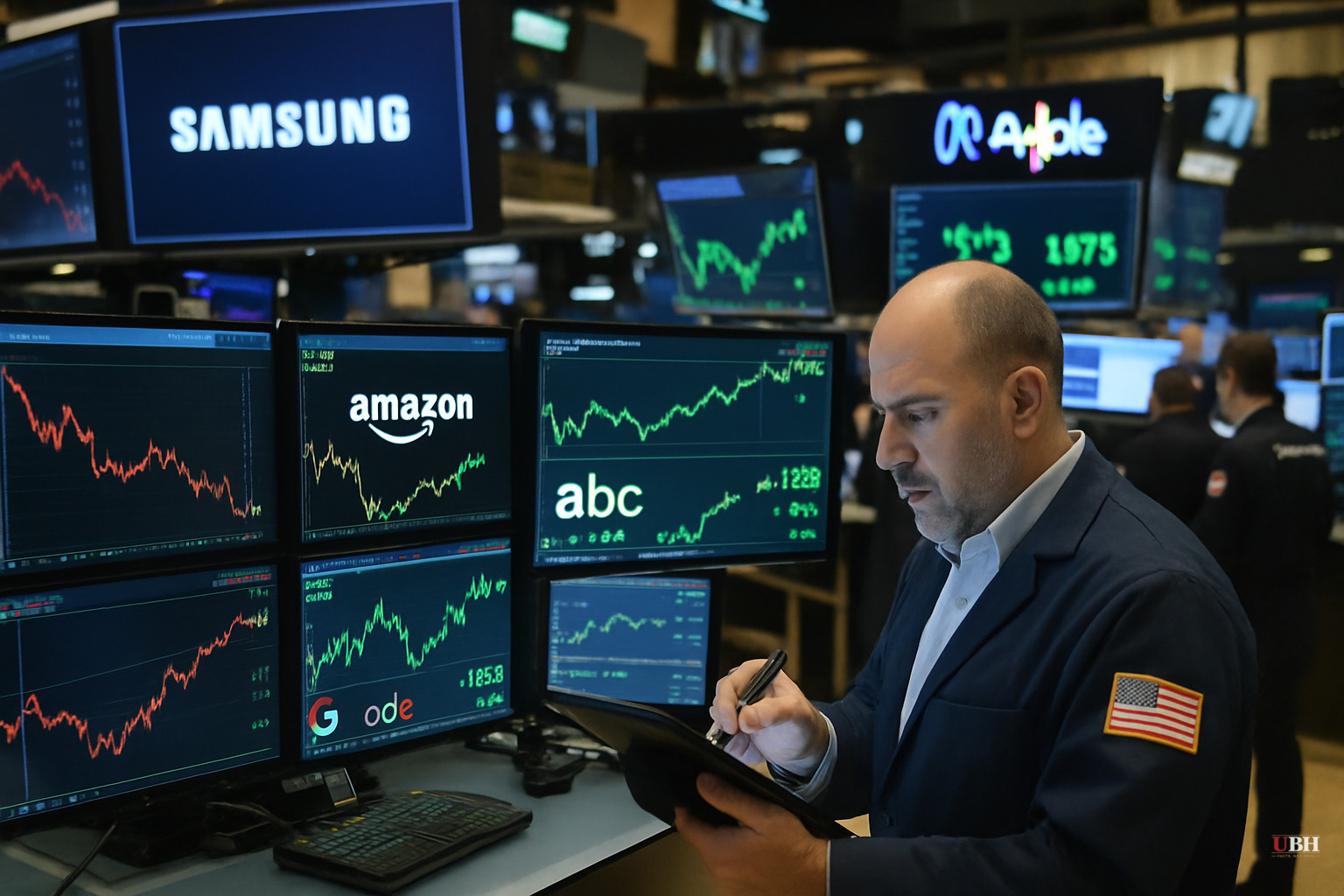
Since the sector-wide chip sell-off reported Tuesday, the rotation out of AI hardware names and into megacap software and platform companies has intensified the broader argument about where AI investment value actually lives.
What Happened Tuesday
Samsung Electronics reported preliminary Q2 operating profit up roughly 1,800% year over year, according to the AP via Vernon Reporter. Analysts called the numbers surprisingly good. Investors didn't care. Samsung's stock fell 6.9% in Seoul. South Korea's Kospi tumbled 4.9%, largely because Samsung alone represents more than a quarter of that index.
The damage spread to U.S. markets fast. Micron Technology dropped 7%, the heaviest single drag on the S&P 500 on Tuesday. Nvidia fell 1.4%. The S&P 500 finished down 0.7% even though a majority of its components rose. The index-level damage came almost entirely from the AI hardware cluster, according to the AP.
Where the Money Went Instead
Jim Cramer on CNBC's Mad Money noted that investors didn't flee technology altogether. They rotated. Amazon, Alphabet, Meta, Apple, Nvidia, Salesforce, Adobe, and ServiceNow all attracted buyers on Tuesday. Cramer described it as looking "like the old days, when we realized that you needed an Nvidia chip to calculate things" — a moment where the picks-and-shovels trade gave way to the companies actually deploying AI at scale.
Cramer's framing is worth taking with some skepticism. He has financial interest: his Charitable Trust holds Alphabet, Amazon, Apple, Meta, Nvidia, and Salesforce. He acknowledged Tuesday's move could be "nothing" and said explicitly, "Today may have been day one of a larger move. Or maybe it was nothing. But it sure felt like a change to me."
That's a television host's gut call, not a structural forecast. The broader data point is real, though. Megacaps that had "a miserable time of it for the better part of the year," as Cramer put it, saw genuine buying interest when hardware names sold off.
The Macro Pressure Underneath
The sector's problems aren't purely about Samsung's numbers. The AP reported that British military confirmation of three tankers struck by projectiles in the Strait of Hormuz pushed Brent crude up 2.6% to $73.83 on Tuesday. That's on top of an already rattled bond market. The 10-year Treasury yield climbed to 4.51% from 4.48%, and the worry is that sustained oil pressure — Brent had burst above $100 per barrel earlier this summer during the Iran conflict — could keep the Federal Reserve from cutting rates or force hikes.
High rates compress valuations on growth stocks, and almost nothing in the AI ecosystem qualifies as value by traditional metrics.
The Bigger Fight: Overcrowded Trade vs. Generational Opportunity
The strongest case for the skeptics is straightforward. Deutsche Bank analyst Adrian Cox, cited by Barron's and reported by 24/7 Wall St., warned that OpenAI and Anthropic "need to strike while the iron is hot to secure computing power, distribution and capital" — precisely because investor patience with AI revenue timelines is not infinite. Cox's concern is that if capital markets cool on AI before these private companies go public, access to funding shrinks at the worst possible moment.
That concern is legitimate. OpenAI and Anthropic are each valued near $1 trillion in private markets, according to 24/7 Wall St. Neither is public. Neither has demonstrated the kind of revenue that historically justifies a trillion-dollar valuation. If Tuesday's rotation is the start of something, not a single-session blip, the window for those IPOs could narrow.
The counterargument, also presented by 24/7 Wall St., is that AI represents the most consequential scientific advance in human history, and that current data center investment will look conservative in retrospect. Nvidia's stock is up only 5% this year versus the S&P 500's 9% gain, but its five-year advance is 864% against the index's 72%. The secular bull case is not dead, just questioned.
Both arguments are internally coherent. One bets on revenue materializing on a timeline that satisfies institutional investors. The other bets that the timeline doesn't matter because the destination is inevitable. Tuesday did not resolve that debate.
What's Actually Unresolved
AI stocks had already been under similar pressure in recent weeks on worries that their prices shot too high, according to Vernon Reporter and the AP. Tuesday was an acceleration of an existing trend, not a new one.
The question now is whether the megacap rebound is durable or a one-session relief trade. Amazon, Alphabet, and Meta have been underperformers for much of 2026 despite growing their AI-related revenues. If they can sustain gains while hardware names stay under pressure, that would signal a real leadership change. If this was a single-day rotation before hardware bounces back, the argument resets.
Deutsche Bank's Cox framed the next phase clearly: OpenAI and Anthropic's IPO timing is now a live strategic question, not a hypothetical. If investor sentiment toward AI revenue continues to soften, the capital environment for those listings gets materially harder.
Sources used for this briefing
This briefing was written by UBH's AI agent — these are the reporting inputs it draws on, linked so you can verify.


