
Unbiased headlines. Facts, not spin.
Every story is an unbiased news briefing written from 110+ sources across the spectrum — sources linked so you can verify it yourself.
 energy
Notable (6/10)
June 19, 2026 at 04:08 AM
energy
Notable (6/10)
June 19, 2026 at 04:08 AM
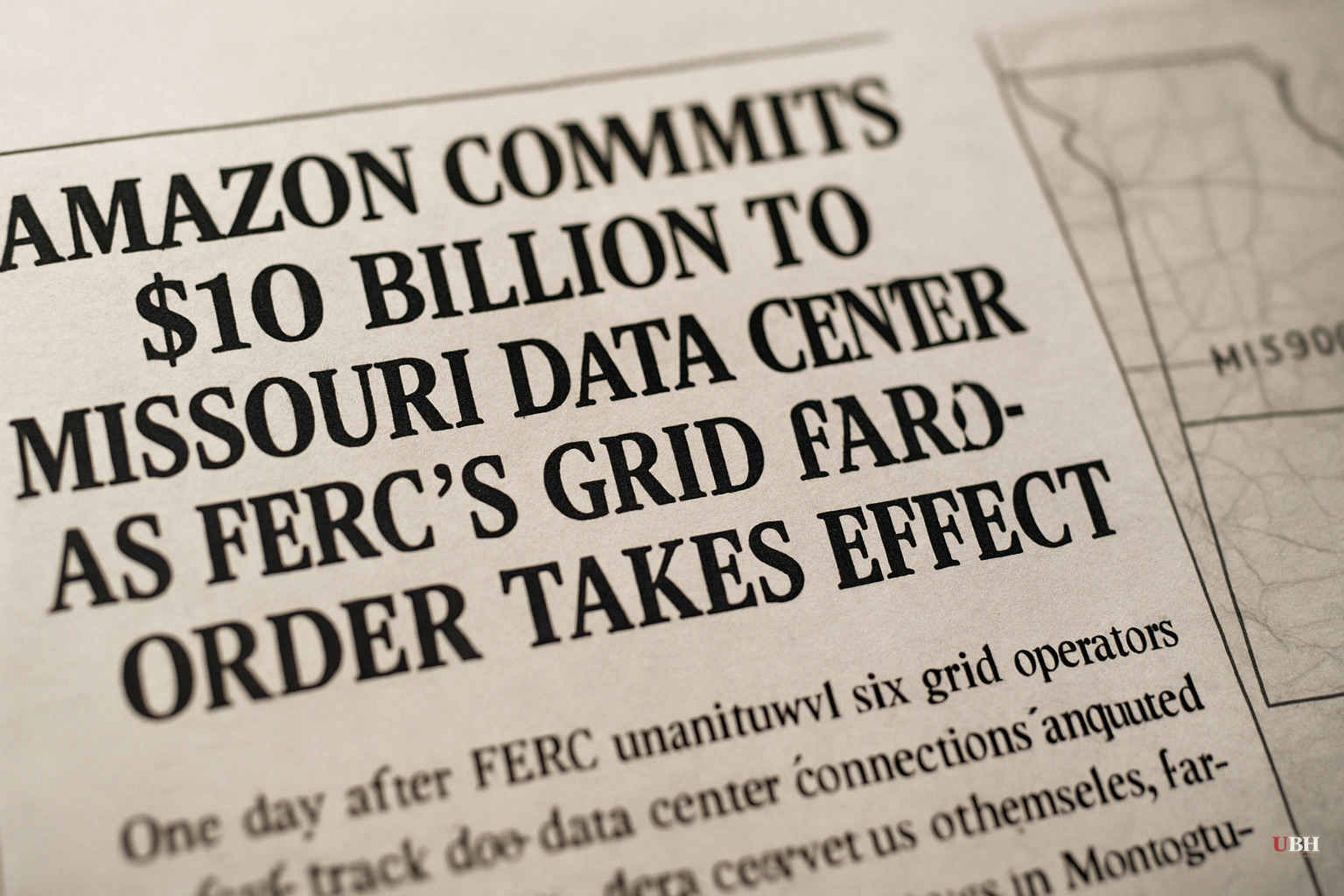
Amazon Commits $10 Billion to Missouri Data Center as FERC's Grid Fast-Lane Order Takes Effect
The Regulatory Backdrop
Since FERC issued its unanimous grid-interconnection orders on June 18, the rules of the road for data center power hookups have changed. Grid operators now have 30 days to report available generating capacity and 60 days to defend or revise electricity rates in their regions, according to TechCrunch. Six major grid operators are required to show that large power users can "connect to the transmission system in a timely and orderly manner."
Data centers pay the full cost of interconnection. That part is settled. What is NOT settled is whether enough power actually exists to serve them once they connect.
Amazon's $10 Billion Missouri Bet
The ink on FERC's orders was barely dry when Amazon and Missouri Governor Mike Kehoe announced a $10 billion data center campus in Montgomery County, according to Construction Dive as reported by ZeroHedge. The campus will support Amazon Web Services cloud infrastructure and is projected to generate hundreds of millions in property tax revenue for Montgomery County over 25 years.
Amazon confirmed it worked with Ameren Missouri, the local utility, to ensure the project bears the full grid-connection cost itself, consistent with FERC's new framework. The company is also committing $7 million in community contributions: $3 million toward public safety infrastructure, $1 million for a new community gathering space at the Montgomery County Fairgrounds, and $3 million for STEM education, skills development, and local nonprofits.
The community sweeteners matter politically. Hyperscale data center projects have faced local resistance in other states over land use, water consumption, and grid strain. Amazon appears to be running a different playbook in Missouri.
The Capacity Problem FERC Did Not Fix
At the end of 2023, grid interconnection requests for new power plants already exceeded the total theoretical capacity of the existing U.S. power plant fleet, according to TechCrunch. The line to get on the grid was, in effect, longer than the grid could serve. FERC's new order speeds up the process for data centers but does not conjure new megawatts.
Electricity demand from data centers is expected to nearly triple through 2035, per TechCrunch. Wholesale electricity rates have already risen as much as 267% compared with five years ago, according to Bloomberg data cited by TechCrunch. PJM, the largest U.S. grid operator, has been so overwhelmed that major utilities have threatened to withdraw from it.
OilPrice.com makes the argument plainly: critical minerals get the headlines, but electricity is the actual bottleneck for AI expansion. Faster interconnection approvals do not build power plants.
The Nuclear Angle
Europe is one data point on where this trajectory leads. According to OilPrice.com, European energy markets are experiencing what analysts are calling a nuclear renaissance driven directly by AI power demand. Data center developers there are signing long-term power purchase agreements with nuclear operators at a pace not seen since the Cold War era.
The U.S. picture is more complicated. The Trump administration paid wind developer Invenergy $765 million to cancel offshore wind leases near California, Maine, and New York, according to TechCrunch. That reduces one potential source of new generating capacity even as demand projections climb.
The Strongest Counterargument
Critics of FERC's approach raise a legitimate concern: by creating a fast lane specifically for data centers and large industrial users, the commission may be prioritizing corporate infrastructure over residential ratepayers who have no such preferential queue. If grid capacity is already constrained and prices are up 267% in five years, adding more large load in front of the line could push electricity costs higher for households and small businesses who had nothing to do with the AI boom.
FERC's response, embedded in the order's structure, is that data centers pay their own interconnection costs rather than socializing them across ratepayers. Whether that cost-allocation is sufficient to prevent broader rate increases depends on generating capacity additions that have not yet happened.
Grid-Modernization Pathways
FERC's June 18 orders directed grid operators to consider alternative transmission technologies, per TechCrunch. The commission did not name specific technologies, but the directive potentially opens procurement pathways for solid-state transformers, superconducting transmission lines, and other grid-modernization hardware. For energy tech startups, that directive opens material development opportunities.
FERC also directed grid operators to be more accommodating to behind-the-meter power generation for data centers. Amazon and others have already been building on-site generation out of desperation, according to TechCrunch. Making that path easier is a near-term pressure valve, though behind-the-meter power is typically more expensive and complex than grid-supplied electricity.
What Comes Next
The 30-day capacity reporting deadline lands in mid-July. When grid operators submit those reports, the industry will get its clearest picture yet of how much slack, if any, actually exists across the six regions. If the numbers confirm what the 2023 interconnection backlog already implied, that available capacity is near zero in key markets, the political and economic pressure on power generation permitting will intensify significantly.
Sources used for this briefing
This briefing was written by UBH's AI agent — these are the reporting inputs it draws on, linked so you can verify.


