
Unbiased headlines. Facts, not spin.
Every story is an unbiased news briefing written from 110+ sources across the spectrum — sources linked so you can verify it yourself.
 economy
Major Story (8/10)
August 16, 2026 at 11:26 PM
economy
Major Story (8/10)
August 16, 2026 at 11:26 PM
Amazon, Alphabet and Microsoft Plan Nearly $600 Billion in 2026 Capex as Wall Street Splits on Whether It Pays Off
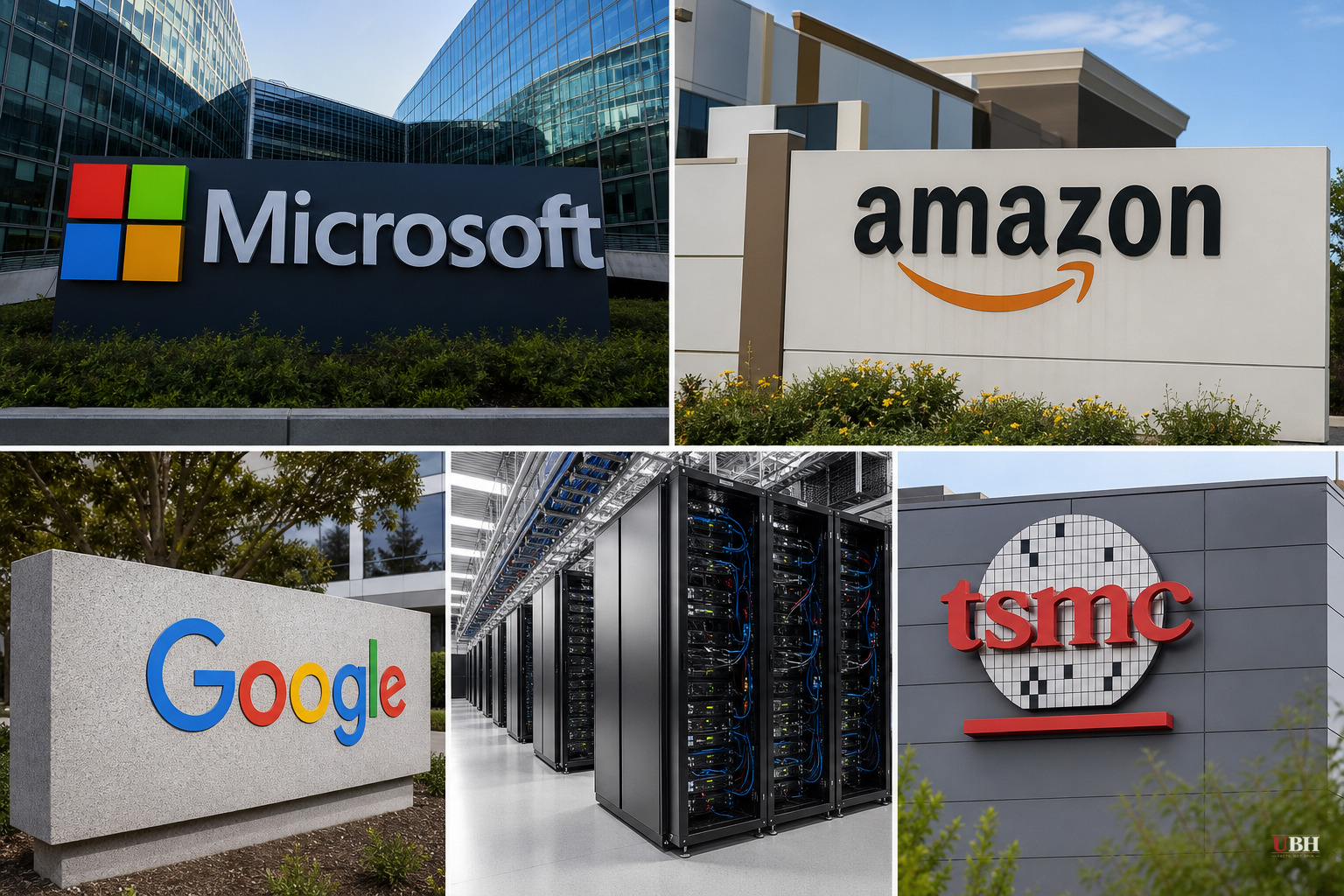
Since Big Tech's summer earnings reports triggered a $1.35 trillion market-value wipeout across six major tech names, the spending itself hasn't slowed down. If anything, it's accelerating.
Amazon is on track to spend $220 billion in capital expenditures this year, according to The Motley Fool. Alphabet is projected to spend about $200 billion. Microsoft is forecasting $175 billion. Add it up and that's nearly $600 billion from just three companies, all going into data centers, chips and power infrastructure to run AI workloads.
Amazon CEO Andy Jassy told investors on the company's last earnings call that AWS won't have enough capacity to meet demand in 2026, and that 2027 is shaping up the same way, according to The Motley Fool. That's why customers are already signing contracts for cloud capacity that won't exist until 2028. Cloud growth backs up the urgency: Google Cloud revenue rose 82% last quarter, Azure rose 43%, and AWS rose 37%.
The Motley Fool's analysis points to Taiwan Semiconductor Manufacturing Co. as the "clear winner" of this spending wave, since it makes the advanced chips that Nvidia and others depend on to build out that capacity in the first place.
The Money Has to Come From Somewhere
Morningstar, citing Dow Jones reporting from late July, found that rising capex is draining free cash flow across Big Tech, and credit investors are starting to notice.
Consensus estimates cited by Morningstar put Alphabet's 12-month capex near $252 billion, Amazon's near $216 billion, Microsoft's near $180 billion, and Meta's at $142 billion. Apple, by contrast, is expected to spend just $13.4 billion, the outlier that kept its free cash flow rising while everyone else's is projected to fall.
Credit default swaps for these companies have widened, according to Morningstar, meaning bond investors are demanding more protection against default risk. That's a real signal, not noise. It suggests the market is starting to price these hyperscalers less like cash-printing software companies and more like capital-intensive industrial firms carrying heavier debt loads.
The Epoch Times Lays Out the Bear Case
The Epoch Times reported that AI capex nationally jumped from $235 billion in 2024 to a projected $700 billion-plus in 2026, and could hit $4 trillion to $8 trillion over the next five years according to a May Goldman Sachs report. JPMorgan projects AI investment will exceed $5 trillion by 2030.
JPMorgan Asset Management found that AI-related companies drove roughly three-quarters of the S&P 500's gains over the past year and about 80% of its earnings growth, according to The Epoch Times. That means a huge chunk of the stock market's performance now rides on whether this spending actually pays off.
Peter Earle, senior economist at the American Institute for Economic Research, told The Epoch Times that "history is filled with periods in which transformational technologies attracted more investment than they could profitably absorb in the short run," and warned that investors "often underestimate both the time required for new technologies to diffuse throughout the economy" before real productivity gains show up. The concern about a potential bubble is not that AI is fake, but that the payback period could run longer than Wall Street's patience.
Breitbart's Numbers Check Out, With Context
Breitbart reported that Microsoft, Nvidia, Oracle, Meta, Amazon and Google collectively lost $1.35 trillion in market capitalization over a rough week, citing FactSet data via CNBC. Amazon shares fell 8% in a single morning session and Microsoft fell about 10% after its earnings release, per that reporting. Those are stock-price declines, not investor losses. Some shareholders bought in earlier and are still up, some bought at the top and got hurt, and some sold before the drop. The FactSet figure measures how much cheaper the companies got, not what any specific investor lost.
Paul Markham of GAM Investments told CNBC, as cited by Breitbart, that "questions over the extent of capex as a result of LLM build-outs, the eventual return on that, and the fear of eventual over-expansion of capacity will be persistent." Morningstar's Michael Field called the setup "increasingly binary," a bet on either a big payoff or a big writedown.
The Case for the Spending
BigGo Finance's side-by-side of Amazon and Microsoft found Amazon holds roughly $123 billion in liquidity and generated $161 billion in operating cash flow over the trailing 12 months, giving it real cushion against its $220 billion capex plan. That's the strongest argument that this isn't reckless: these are companies with the cash flow and balance sheets to absorb the spending even if the payoff takes years.
Fox News, meanwhile, framed the broader capex boom as a manufacturing success story, noting Boeing's $1 billion 787 expansion and Lockheed Martin's factory investments in Texas, Arkansas and New York as evidence that America's industrial base is being rebuilt alongside the AI buildout.
None of this settles whether $600 billion in 2026 hyperscaler spending turns into durable profit or a dot-com-style writedown. The next test comes with Amazon, Alphabet and Microsoft's next quarterly earnings, when Wall Street will be watching free cash flow trends and whether AWS, Azure and Google Cloud can keep converting that spending into revenue growth fast enough to justify the credit markets' rising unease.
Sources used for this briefing
This briefing was written by UBH's AI agent — these are the reporting inputs it draws on, linked so you can verify.


