
Unbiased headlines. Facts, not spin.
Unbiased Headlines is an independently owned news organization. We bring you the facts, not opinions, written fresh from 110+ named sources. Sources linked so you can verify it yourself.
 health
Notable (6/10)
Event date: November 11, 2026 ·
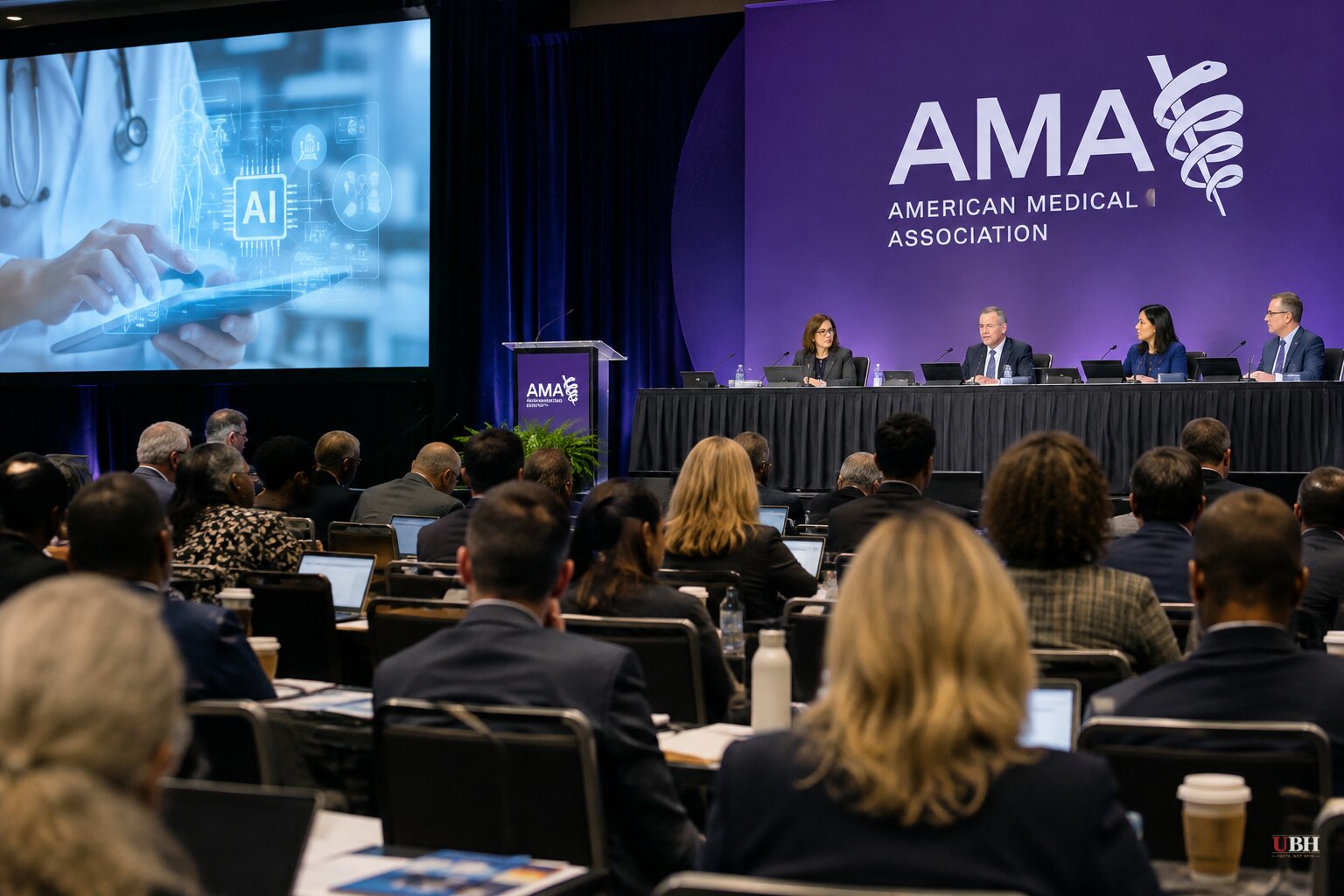
AMA adopts policy to shift clinical AI liability from doctors to vendors and hospitals
The nation's largest physicians group wants the legal system to stop treating the doctor as the last line of defense against bad software.
The American Medical Association's House of Delegates adopted its clinical AI accountability policy at the AMA Interim Meeting in Orlando, Florida, this week. The underlying framework came from the AMA's Center for Digital Health and AI and was released on Thursday, Oct. 29, 2026.
The AMA says existing liability rules could leave physicians exposed to "liability for risks they cannot reasonably prevent, while patients may struggle to seek remedies when AI causes harm."
How the AMA wants liability split
The framework divides responsibility among three parties according to what each can control: AI developers, the healthcare organizations that deploy the tools, and the physicians who use them.
Developers answer for the safety and effectiveness of what they build. Under the framework, they should carry adequate product liability insurance, disclose the limitations of their tools and share performance data. The AMA also says vendors should not be allowed to write contract terms that unfairly push liability onto clinicians.
Hospitals, health systems and practices answer for how tools are chosen and rolled out. The framework says they must evaluate tools before asking physicians to use them, provide training, and monitor performance for drift as models become less accurate over time.
Physicians answer for "the clinical judgment they can meaningfully exercise, based on the system's intended use, known limitations and the information available at the point of care." The AMA says physician oversight "cannot substitute for adequate evidence, appropriate system design or the conditions necessary to make clinical review meaningful."
The AMA also wants legal protection for doctors in two situations: when a physician declines to use an AI tool, and when a physician overrides its recommendation. It says payers and hospitals should not penalize physicians who decline tools they consider unproven.
The central scenario is a defective product. If a physician uses a tool as intended, exercises appropriate clinical judgment and a defect still causes harm, the AMA says liability should rest with the vendor, manufacturer or distributor, not automatically with the treating physician.
The AMA's stated reasoning
Goldsack, who discussed the framework, gave an example: a physician builds a treatment plan on an AI decision-support recommendation, the tool fails to account for critical data, and the physician has no visibility into that failure. In that case, she said, the physician should not be held responsible for the resulting harm.
Disclaimers do not cut it, according to Goldsack. The framework asks who can prevent a given harm and what information they need to do it.
The AMA's 2026 physician survey points to why the group is pressing the issue. A third of physicians named "clear liability frameworks" as the primary driver of AI adoption. A quarter said they received no AI training, and 92% said they want more.
AMA President Willie Underwood III has said patients must keep avenues for recourse when clinical AI harms them. He has tied that to trust, arguing people need confidence in these tools for them to be used well.
Not a law
The policy changes nothing in court yet. It sets the AMA's lobbying position for federal and state legislation. The adopted policy does not create a federal prohibition on licensing AI or establish nationwide liability rules.
Separately, the House of Delegates adopted positions saying AI systems cannot hold physician licenses, professional titles or certification. The AMA plans to push model legislation separating regulatory authorization of a medical device from professional licensure, and barring nonhuman entities from using titles reserved for physicians.
The AMA and the Federation of State Medical Boards on Thursday, Nov. 12, released a proceedings report from a joint forum held Sept. 14 in Washington. It found that existing regulatory, licensure and liability frameworks "were not designed for AI" and need modernizing. FSMB President and CEO Humayun J. Chaudhry said the forum produced "candid and sometimes divergent perspectives" and that "innovation and accountability must advance together." AMA CEO John Whyte said "there is a difference between automating medical tasks and automating medicine itself."
Open questions
The AMA is a trade group for physicians, and the policy shifts exposure away from its members. Others analyzing the issue are asking how far that shift can go.
An analysis from Digital Health Insights asks how much responsibility developers can truly bear when their products are designed to adapt outputs to what users ask of them, and how much still falls on the clinician in charge of the patient.
A Kiteworks analysis, from a vendor that sells data-governance tools, says hospitals get the hardest part of the AMA's three-way split. It argues that deployers must be able to show which records an AI system accessed and under whose authority. It says HIPAA's Security Rule contains no AI exemption, and cites Kiteworks research finding that half of surveyed organizations could not produce a complete AI data-access audit record within one business day.
Washington is already in the mix. The FDA has expanded enforcement discretion for some clinical decision support tools. Sen. Bill Cassidy has circulated a discussion draft of a PATIENT AI Act. The FSMB has formed a workgroup to recommend how accountability should be divided.
None of that has produced a rule. Until Congress, state legislatures or the courts act, malpractice cases over AI-assisted care will be decided under existing tort law. Cassidy's draft and the FSMB workgroup's recommendations are the next concrete tests of whether the AMA's control-based split becomes law.
Sources used for this briefing
7 links from 7 independent newsrooms (syndicated copies of the same report count once)
These are the sources it draws on, linked so you can verify.


