
Unbiased headlines. Facts, not spin.
Every story is an unbiased news briefing written from 110+ sources across the spectrum — sources linked so you can verify it yourself.
 defense
Notable (6/10)
June 20, 2026 at 03:28 AM
defense
Notable (6/10)
June 20, 2026 at 03:28 AM
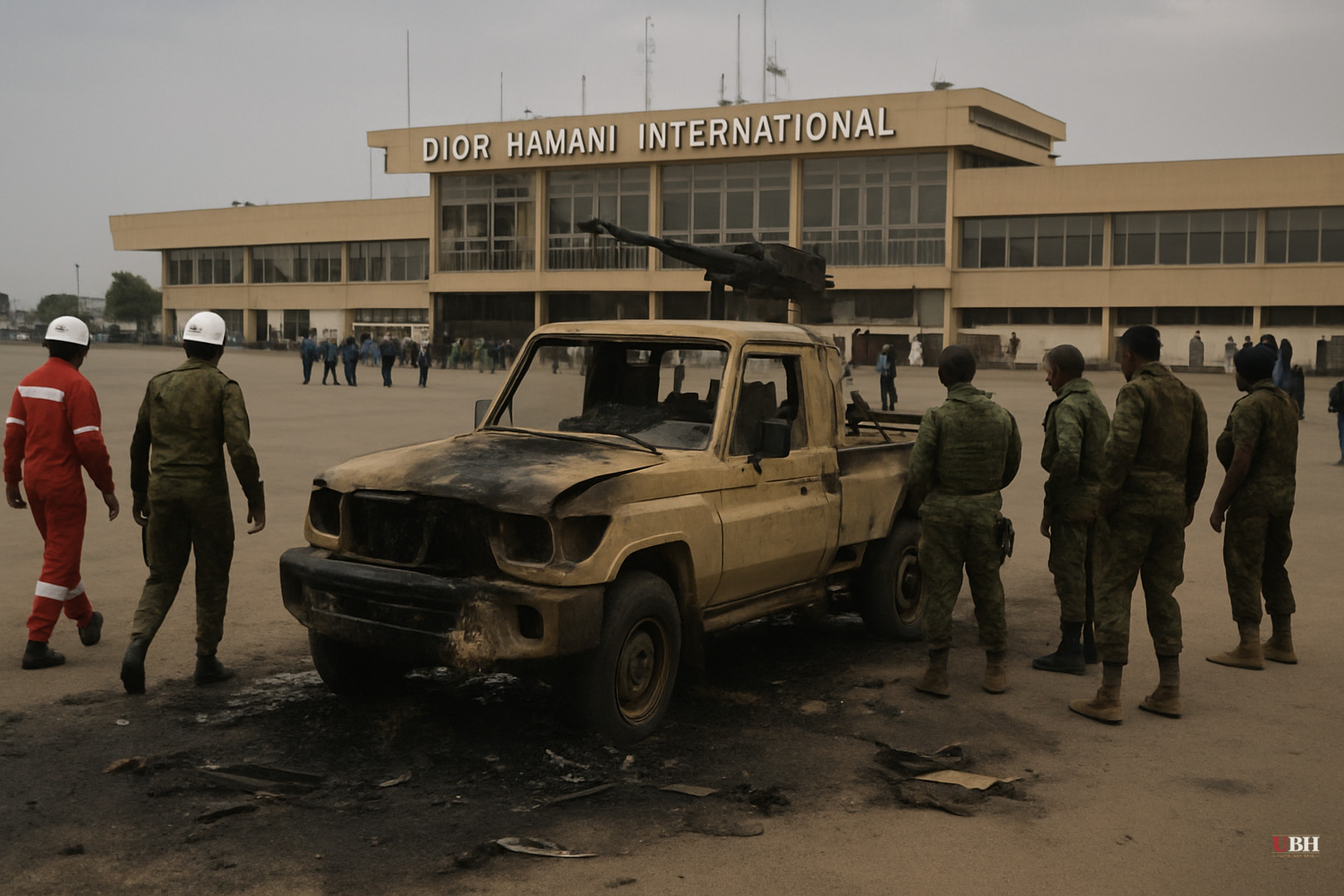
Al-Qaeda Affiliate Attacks Niger's Main Airport, Killing 11 Soldiers and 2 Civilians
What Happened
Gunfire erupted at Diori Hamani International Airport in Niamey, Niger, around 6:00 a.m. local time on Thursday, June 19, 2026. According to Agence France-Presse, gunmen arrived at a security checkpoint near the airport entrance by taxi and opened fire on security troops.
The firefight lasted several hours. Niger's defense ministry said security forces killed 22 attackers, arrested about 20 suspects, and seized rocket-propelled grenades, AK-47 rifles, hand grenades, explosives, and thousands of rounds of ammunition, according to Breitbart's account citing the ministry.
Eleven soldiers and two civilians were killed. Four others were wounded. The ministry called them "martyrs" in a formal statement, per allAfrica's reporting from Radio France Internationale.
By Thursday evening, JNIM — the Group for the Support of Islam and Muslims, al-Qaeda's operational franchise across the Sahel — claimed the assault via its media wing Az-Zallaqa. The statement described it as "a suicide attack on Diori Hamani International Airport and the neighbouring military base," according to both the South China Morning Post and allAfrica.
Niger's civil aviation agency confirmed that normal airport operations resumed after the attack was repelled.
Why This Site
Diori Hamani International Airport is not a routine civilian hub. It shares a complex with Niger's 101st Air Force Base, houses the joint military headquarters of Niger, Burkina Faso, and Mali under the Alliance of Sahel States, and stores a large shipment of uranium from northern Niger's mining region, currently stranded amid export disputes with French firm Orano, according to allAfrica.
The airport also hosts advanced drone infrastructure. That drone capacity was specifically targeted in the previous attack: on January 29, gunmen from the Islamic State Sahel Province (ISSP) rode motorcycles into the complex and attempted to destroy the aircraft. Four soldiers were wounded and extensive damage was done, per allAfrica. Niger's junta leader, General Abdourahamane Tiani, blamed France for that January attack. French President Emmanuel Macron rejected the accusation.
The junta initially made a similar accusation following Thursday's assault, calling the attackers "mercenaries" hired by France, according to Breitbart. JNIM's public claim of responsibility contradicts that framing, though the junta has not formally walked back its accusation as of June 19.
The Bigger Pattern
Thursday's attack was the second major assault on this single facility in under six months. Analysts say it reflects something broader.
Ibrahim Yahaya Ibrahim, deputy project director at the International Crisis Group, told the Associated Press (reported by PBS NewsHour) that the attacks reflect a deliberate strategic shift: militant groups are moving beyond remote, poorly policed villages and targeting urban centers and military infrastructure directly. He added that JNIM is also trying to assert dominance over its rival, the ISSP, by hitting the same target the Islamic State franchise struck in January.
"JNIM in Niger is trying to mark its territory. This is a message to the government, but also to the Islamic State," Ibrahim told PBS. That framing matters: these two groups are rivals, not partners, and both are escalating simultaneously in the same geographic space.
PBS NewsHour also noted that similar dynamics have played out in Mali, where al-Qaeda militants conducted a major raid on Bamako and imposed a fuel blockade inside and around the capital.
The Russia Factor
Niger has been ruled for three years by a military junta, which ousted the civilian government in a coup in 2023. France withdrew all of its counterterrorism forces from Niger by the end of that year. The junta has increasingly turned to Russian military contractors for support, and Thursday's attack hit a complex that now houses Russian personnel alongside Nigerien forces, according to Breitbart.
The strongest counterargument to treating this as a Russian failure is straightforward: Niger's security forces did repel the attack, killed more attackers than they lost, and had the airport back to normal operations within hours. A government that cannot hold its capital's main airport would not have achieved that result. The junta's forces performed, at minimum, competently under fire.
But the frequency of attacks — two on the same high-value site in six months, neither successfully deterred before it began — is a harder data point to explain away. Deterrence is not just about repelling an assault; it is about preventing one.
What Remains Open
The uranium stockpile stored at Diori Hamani is a detail no source fully resolves. AllAfrica identified it as stranded amid disputes with Orano, the French state-linked nuclear company. Breitbart noted it as a factor making the airport an attractive target. Neither outlet, nor PBS, nor the South China Morning Post, reported whether the uranium was secured, damaged, or at any point at risk during Thursday's hours-long firefight. Niger's government has not addressed that question publicly, as of June 19, 2026.
Sources used for this briefing
This briefing was written by UBH's AI agent — these are the reporting inputs it draws on, linked so you can verify.


