
Unbiased headlines. Facts, not spin.
Unbiased Headlines is an independently owned news organization. We bring you the facts, not opinions, written fresh from 110+ named sources. Sources linked so you can verify it yourself.
 defense
Major Story (7/10)
Event date: October 20, 2026 ·
Air Force tells Congress it needs 1,509 fighters by 2035, but its 2027 budget buys 62 jets, not the 72 it says it needs
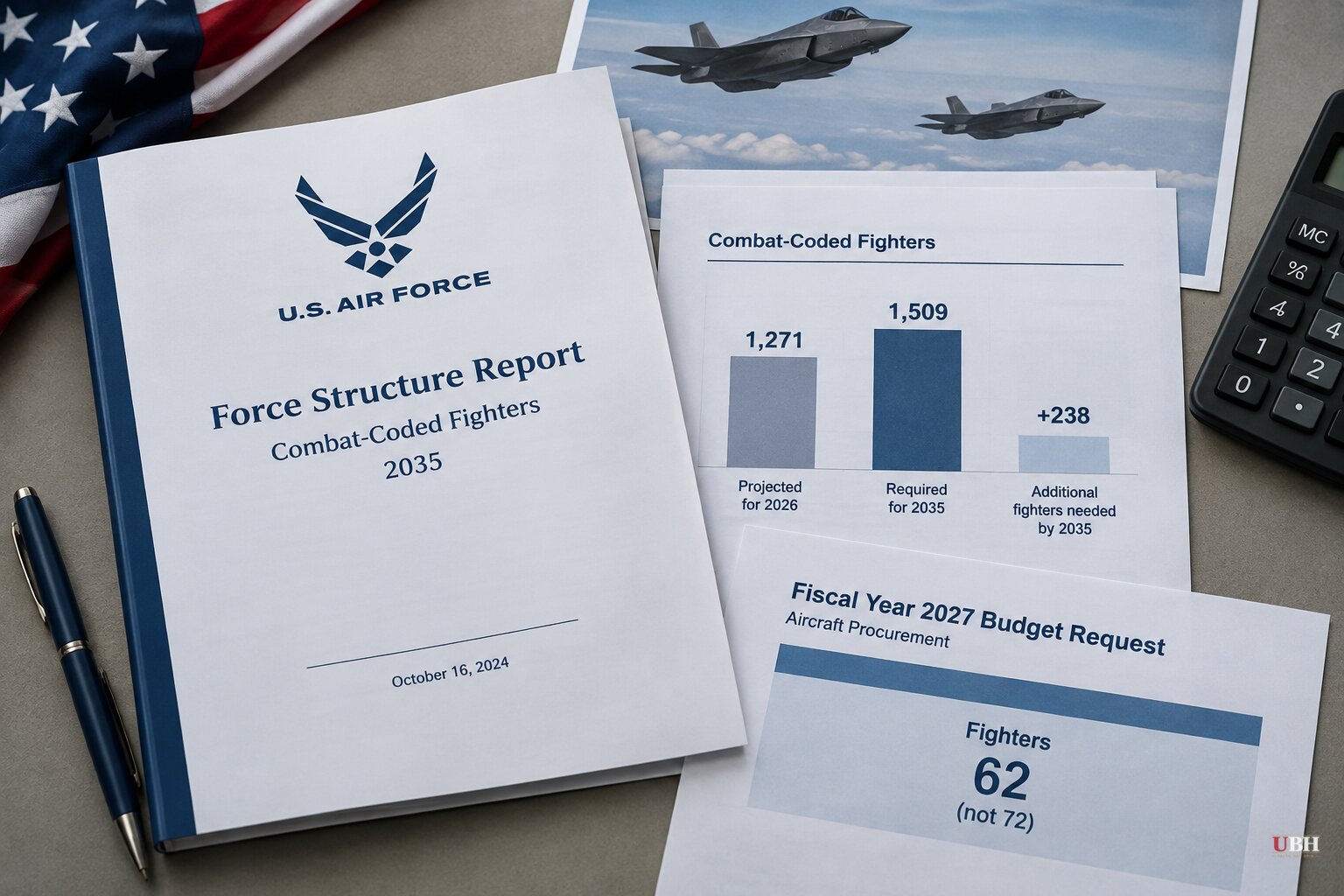
The U.S. Air Force says it needs 1,509 combat-coded fighters by 2035. That is the number in a new force structure report the service sent to Congress on Oct. 16.
Lt. Gen. David Tabor, the Air Force's deputy chief of staff for plans and programs, walked reporters through it at a Pentagon roundtable on Tuesday, Oct. 20. Reporters did not get a copy of the report.
What the number means
"Combat-coded" means jets assigned to combat units. The Air Force projected about 1,271 of them for 2026, so the target implies roughly 238 more fighters over nine years. It also sits 140 jets above the 1,369 the service set as its 2030 goal in last year's report.
Tabor said the figure reflects what regional commanders say they need to carry out missions at medium risk. The military rates risk on four levels: low, medium, significant and high. At medium risk, forces would likely achieve their goals but could be strained in long operations.
A low-risk profile would take 1,723 combat-ready aircraft by 2035, according to the report as described by Breaking Defense. Last year's low-risk figure was 1,558. Tabor said the service "generally" doesn't plan to low risk.
He also called the exact figures "debatable," since the analysis is constantly refreshed, and warned they will likely change with world events, new requirements and new technology.
A different fleet
The mix would shift. F-35s would grow from about 30% of the fleet today to about 40% by 2035, according to Tabor's figures. F-22s and their replacement, the F-47, would make up about 20%. F-15s and F-16s would split the remaining 40% about evenly. A-10s are excluded because they are not part of the Air Force's 2035 plans.
For context, Defence Blog calculated that today's fleet, excluding A-10s, is roughly 45% F-16, 30% F-35, 15% F-15 and 10% F-22. The F-16 would lose its top spot to the F-35.
Tabor said the service expects to field about as many F-47s as the F-22s they replace. Collaborative Combat Aircraft, the drone wingmen the Air Force wants to field 500 of by 2032, are not counted. Tabor said they are not yet changing the crewed-fighter requirement but could reduce it in future reports.
The budget does not match the goal
Air Force leaders have said for years the service needs to buy 72 fighters annually. The fiscal 2027 request asks for 38 F-35s and 24 F-15EXs. That is 62 jets, 10 short.
The funding picture is shakier still. The request counts on $2.34 billion to pay for 14 of those 38 F-35s, and that money is supposed to come through a reconciliation bill, which can pass the Senate with a simple majority. If the bill fails, Tabor said, the Air Force could pull money from other programs or push the purchases to 2028.
"We just lose 14 times [an] F-35's worth of other capabilities that we were planning on," he said of the first option. Delay would leave the service further behind its fleet goals.
"Without the TOA [total obligation authority], the money available, we're not going to be able to do this," Tabor said bluntly. "It is really imperative that we get the resourcing we need... We need it all."
The Air Force is also asking Congress for multiyear contracts on the F-35 and F-15EX. That request is pending. Tabor said such deals would give industry the stability to expand production.
Can industry deliver?
Hitting the target also depends on Lockheed Martin and Boeing. Tabor said industry has "assured us that they can, and we believe them, but we also actually need to see it manifest."
The Boeing side is already moving. The Air Force ordered 22 more F-15EXs for $2.38 billion on Sept. 30, Defence Blog reported, and the service has said it could buy up to 104 to replace its F-15C/Ds. The F-47 is due to make its first flight in 2028.
The Iran war and the force count
Tabor said the analysis began before this year's war with Iran and was not driven by it. Breaking Defense, which reviewed the report, said it also renews the Air Force's case for changing how combat-ready fighters are counted, citing lessons from that war.
The war's cost to the air fleet is separate and large. A Congressional Research Service report released this week counts 81 U.S. aircraft destroyed or damaged, including an F-35A and an E-3 Sentry. MQ-9 Reapers account for more than half. The CRS, citing Congressional Budget Office figures, puts the cost at $1.9 billion to $3.3 billion, depending on replacement plans. Some of the aircraft, including eight F-15s lightly damaged in a September strike on Muwaffaq Salti Air Base in Jordan, may be back in service.
The CRS report asks Congress to weigh whether there is enough industrial capacity to cover repairs and replacements. It also asks whether lawmakers are getting enough information from the Pentagon on the losses. CNN, citing sources, put the war's total cost at no less than $45 billion.
Gaps in the plan
Breaking Defense noted that the service has long struggled to fund fighter procurement at the levels it wants, with the nuclear modernization effort and Capitol Hill budget fights competing for dollars. Lawmakers also often block divestments, forcing the Air Force to maintain aging aircraft longer than it plans.
The statutory floor is a separate pressure. Federal law sets a minimum of 1,145 primary mission aircraft. Defence Blog reported the service told Congress in May it had 1,098. The 1,509 figure is a broader count that includes backup and attrition reserve jets.
The F-16 question is also open. Older F-16s hit the end of their service lives in the mid-2030s. The Air Force has not decided whether to buy a new-build F-16, tentatively called the F-16G. Tabor said that decision likely won't come in the fiscal 2028 budget.
Next up is Congress. Lawmakers must decide whether the reconciliation package that carries the $2.34 billion for 14 F-35s moves forward, and whether to approve the pending multiyear contracts. Until they do, the Air Force's own fallback is to cut other programs or push the buys to 2028.
Sources used for this briefing
8 links from 8 independent newsrooms (syndicated copies of the same report count once)
These are the sources it draws on, linked so you can verify.


