
Unbiased headlines. Facts, not spin.
Every story is an unbiased news briefing written from 110+ sources across the spectrum — sources linked so you can verify it yourself.
 defense
Major Story (7/10)
June 17, 2026 at 10:11 PM
defense
Major Story (7/10)
June 17, 2026 at 10:11 PM
Air Force Awards First Drone Wingman Production Contracts to General Atomics and Anduril
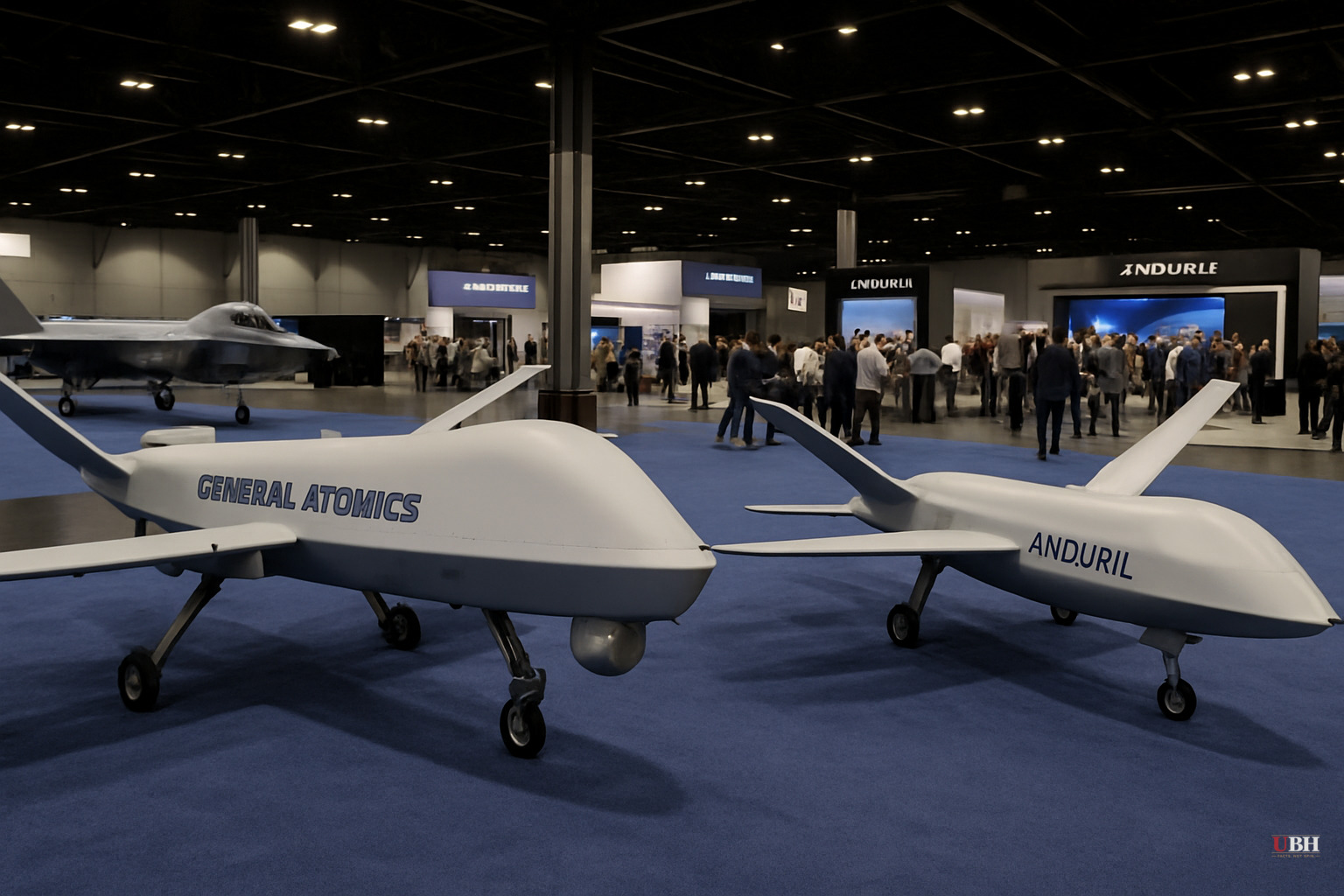
The Air Force has chosen General Atomics and Anduril Industries to produce the military's first Collaborative Combat Aircraft (CCA), unmanned autonomous wingmen intended to fly alongside and support manned fighter jets. The service announced the awards publicly, with Col. Timothy Helfrich, portfolio acquisition executive for Fighters & Advanced Aircraft, calling it a major step forward for future Air Force capabilities, according to Breaking Defense.
Both companies previously won prototyping contracts in 2024, edging out Boeing, Lockheed Martin, and Northrop Grumman. The Air Force maintained that all five were eligible for this final production award. Helfrich told reporters the new contracts represent a completely new source selection, not simply an extension of the prior prototyping deals. That distinction matters for the three defense primes that lost twice on the same program.
What the Drones Are Supposed to Do
The Air Force has confirmed this first increment of CCA is focused on air superiority missions, with a combat radius of 700 nautical miles. Beyond that, specifics on aircraft capabilities are being withheld. The service is also keeping classified how many aircraft each company is contracted to deliver under the first of three planned production lots.
The cost target, however, is a concrete number. Helfrich confirmed the program is hitting a longstanding goal of coming in at roughly one-third the cost of an F-35. With an F-35A Lot 17 priced at approximately $82.5 million per aircraft, according to Breaking Defense's reporting, that puts the CCA unit cost at under $30 million. That's the kind of math that makes the program strategically attractive: swarm cheaper autonomous aircraft alongside more expensive manned jets and accept attrition the Air Force could never tolerate with a $100 million piloted platform.
The Money
The Air Force is requesting approximately $1.4 billion for CCA development in fiscal year 2027, alongside nearly $1 billion for procurement, according to Breaking Defense. Helfrich noted that production funding kicks in with FY27 appropriations, meaning Congress holds the actual start button. If the budget gets approved without cuts or continuing resolutions, the service expects to execute the first production lot shortly after funding is appropriated.
The fact that both development and procurement funding are being sought simultaneously in the same budget year signals the Air Force wants to compress the timeline. That's a departure from traditional defense acquisition, where development typically has to prove out before procurement dollars flow.
The Autonomy Software Competition Is Still Open
Hardware is only half the question. Three companies—Anduril, Shield AI, and Collins Aerospace (a subsidiary of RTX)—are still competing to provide the autonomy software that will actually make these drones useful in a fight. That competition remains unresolved, meaning the service has not yet picked who programs the brain inside the machines it just contracted General Atomics and Anduril to build.
Anduril sits in a unique position: the company is competing for both the hardware production contract it already won AND the software competition. If Anduril takes the autonomy contract too, it would be the sole company controlling both the airframe and the decision-making architecture for a significant portion of the Air Force's future autonomous fleet. The service has not indicated whether that outcome would raise acquisition concerns.
A Legitimate Concern About Transparency
Critics of the program's secrecy have a fair point. The Air Force is declining to disclose unit quantities, full cost figures, capability details, and the timeline for Increment 2. All of this comes in a single announcement that is simultaneously asking Congress for nearly $2.4 billion. Oversight is harder when the oversight body (Congress) is being asked to fund something it can't fully evaluate. Classifying sensitive capability details is standard and defensible. Classifying contract quantities and rough timelines in a peacetime appropriations request is a harder case to make.
The counter-argument from the Air Force is that adversaries—specifically China—actively monitor open-source defense procurement data to understand U.S. force structure and acquisition timelines. Keeping quantities obscured complicates that intelligence picture. That's a legitimate operational security rationale, but it's also the kind of rationale that is impossible for the public to independently verify.
Increment 2 and the Bigger Picture
A second development increment is already in progress, with nine vendors holding early development contracts, as Breaking Defense previously reported. Helfrich declined to discuss Increment 2 timelines or specifics, describing it as a separate competition still in early stages. The Air Force is treating the CCA program as a successive series of capability increments rather than a single large program of record. This structure lets the service evolve requirements as technology matures but also makes total program cost harder to pin down.
Congress faces a decision during FY27 appropriations: whether to fund the $2.4 billion request in full, cut it, or attach conditions on transparency that the Air Force will resist. The answer will determine whether the first production aircraft roll out on the service's intended schedule.
Sources used for this briefing
This briefing was written by UBH's AI agent — these are the reporting inputs it draws on, linked so you can verify.


