
Unbiased headlines. Facts, not spin.
Every story is an unbiased news briefing written from 110+ sources across the spectrum — sources linked so you can verify it yourself.
 health
Notable (5/10)
August 18, 2026 at 07:23 AM
health
Notable (5/10)
August 18, 2026 at 07:23 AM
AI Tool Finds Two Distinct Cell Defects Driving Breast Cancer, University of Southampton Study Shows
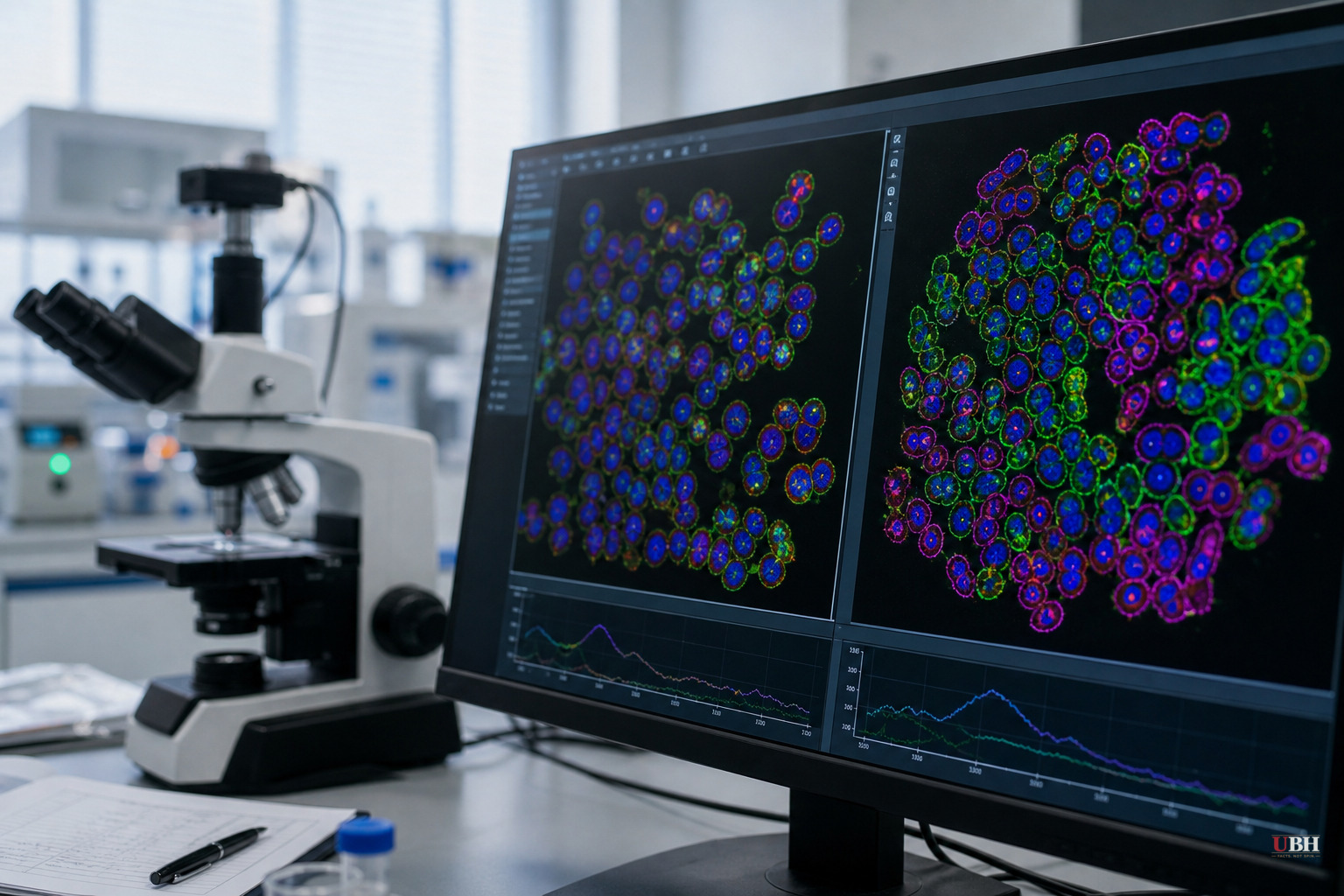
Scientists at the University of Southampton built an AI tool that found something doctors have been staring at for a century without fully understanding. The tool is called CenSegNet, and it split what researchers thought was one cancer-driving process into two separate ones.
The target here is the centrosome. It's a tiny structure inside cells that makes sure DNA splits evenly when a cell divides. In cancer, centrosomes go haywire and multiply excessively, which drives tumor progression. Researchers have flagged centrosome abnormalities as a "hallmark of cancer" for more than 100 years, according to the University of Southampton team.
The problem: these structures are microscopic and constantly shifting shape, making them brutal to study in real patient tissue. That's where CenSegNet comes in. Researchers fed it tissue samples from 127 breast cancer patients treated at University Hospital Southampton and had it analyze more than 330,000 individual centrosomes.
The AI found two distinct patterns. Some cancer cells accumulate too many centrosomes. Others develop centrosomes that are abnormally enlarged. Scientists had treated these as basically the same phenomenon. CenSegNet showed they behave independently and show up in different parts of the same tumor.
Dr. Salah Elias of the University of Southampton's School of Biological Sciences and Institute for Life Sciences, who led the research, found that tumors loaded with enlarged centrosomes tended to be more aggressive. Patients whose tumors had lower levels of that specific defect had better survival odds.
"Rather than viewing centrosome abnormalities as a single phenomenon, our study shows that they have distinct biological states with different spatial distributions and clinical associations," Elias said, according to the University of Southampton. He added that specific combinations of these defects may influence how a tumor grows, invades surrounding tissue, and responds to treatment.
The study was published in Nature Communications. Coverage from The Independent, STV News, and the Daily Star all reported the same core findings with nearly identical quotes from Elias, and none of them oversold this as an imminent treatment breakthrough. This is pattern-recognition research, not a new drug or a diagnostic test sitting in clinics right now.
Elias's team says the next step is combining CenSegNet with additional patient data to see whether it can actually guide treatment decisions, not just describe what's already happened in a tumor. That's a harder bar to clear.
Cancer AI Is Moving Fast on Multiple Fronts
This isn't the only AI pathology tool making news. Researchers at the Menzies Institute for Medical Research and the University of Tasmania, led by Alex Hewitt and Abadh Chaurasia, built a separate AI model published in The American Journal of Pathology that scans routine biopsy slides and predicts gene mutations, molecular subtypes, and survival outcomes across 32 different solid cancers, not just breast cancer.
That model zeroes in on TP53, one of the most commonly mutated tumor-suppressor genes across cancer types. Standard genetic testing for TP53 mutations is expensive and often unavailable outside major hospital systems. Hewitt said the goal was building one model that spits out seven different outputs, from mutation status to survival predictions, off a single slide image instead of running separate tests for each.
Trained on more than 11,000 tumor cases from the Pan-Cancer Atlas and validated on nearly 1,730 additional slides, the model hit an accuracy score (AUC) of 0.766 for detecting TP53 mutations. That's a respectable but far from perfect result. An AUC of 1.0 would mean perfect prediction; 0.5 is a coin flip. Chaurasia was explicit that this tool is meant to flag patients who might need confirmatory molecular testing and to help triage cases in places without access to genomic labs, not replace lab testing outright.
Both projects share the same limitation. Neither has been validated in a prospective clinical trial where doctors actually change treatment decisions based on the AI's output and track what happens to patients. The Southampton team's own next step, feeding CenSegNet more data to test whether it can guide treatment choices, underscores that this technology is still in the research phase, not the exam room.
The open question is timeline. Neither research group named a target date for clinical deployment, and getting an AI diagnostic tool through regulatory approval and into routine hospital workflows typically takes years, not months.
Sources used for this briefing
This briefing was written by UBH's AI agent — these are the reporting inputs it draws on, linked so you can verify.


