
Unbiased headlines. Facts, not spin.
Unbiased Headlines is an independently owned news organization. We bring you the facts, not opinions, written fresh from 110+ named sources. Sources linked so you can verify it yourself.
 finance
Major Story (7/10)
Event date: November 8, 2026 ·
AI Stock Rout Pushes Investors Into Defensive Sectors as December Fed Rate Hike Is Fully Priced In
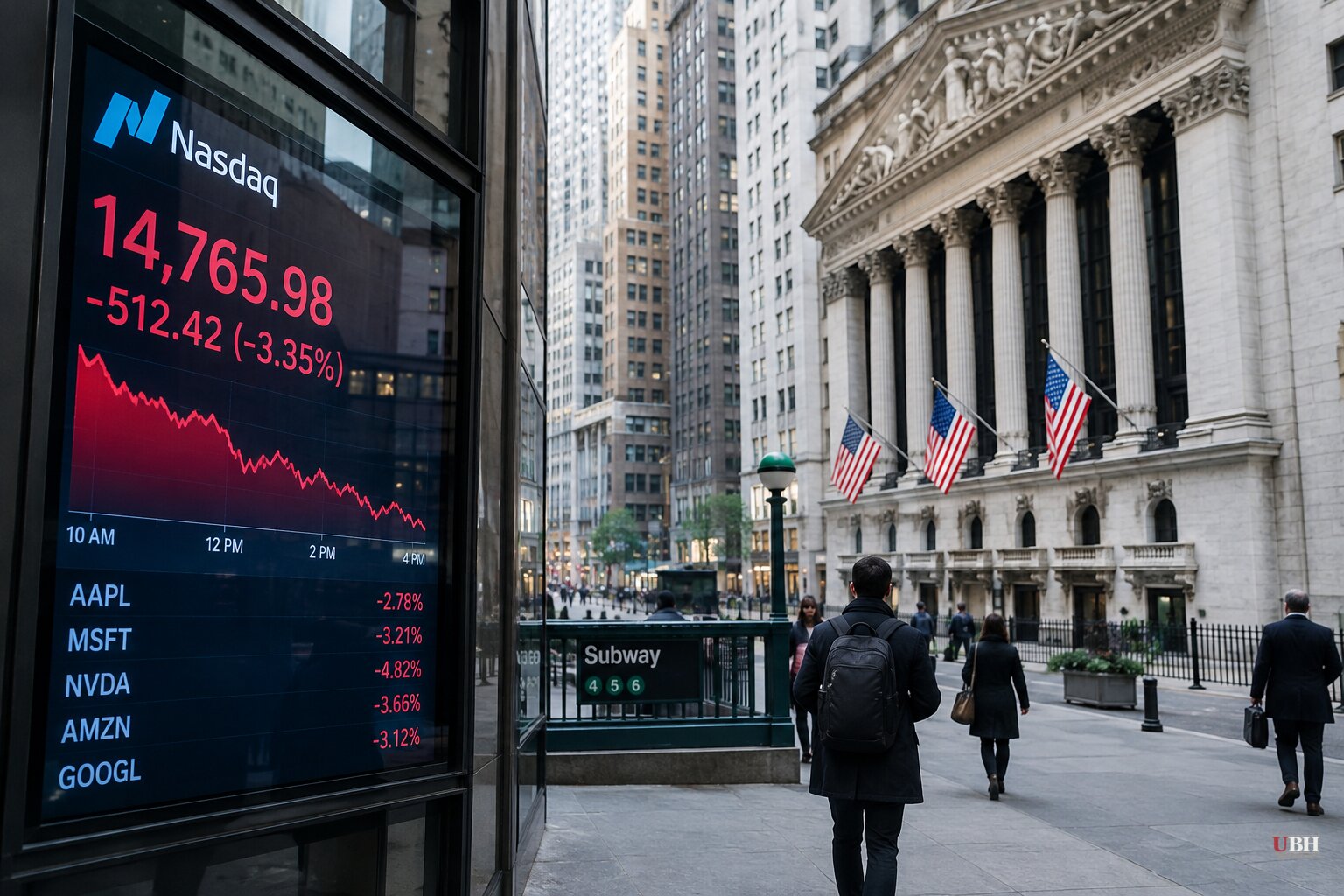
The AI trade took the hardest hit of the year on Thursday, Nov. 5, and money is still moving out of it. The Nasdaq fell 5.52% that day and closed in correction, more than 10% below its Oct. 6 record. Roughly $2.5 trillion in market value disappeared.
The Nasdaq 100 dropped 6.36%, its worst day since March 2020. The S&P 500 and Dow had their worst sessions since April 2025, when President Trump unveiled his global tariffs. The Dow shed 1,833 points, erasing the 1,569-point post-midterm rally it had posted a day earlier.
Chipmakers took the worst of it
Nvidia fell 9.3% and gave back all of its 2026 gains. A closely watched chip index dropped 12.3%, its worst day in about six and a half years. Tesla fell 11% and SpaceX 9%.
Neocloud firms that rent out computing power fell hard too. CoreWeave dropped roughly 10% and Nebius about 15%. CoreWeave is down 76% from its June 2025 peak. Nebius is down 58% from its June 2026 high.
The damage spread overseas. South Korea's Kospi fell almost 9% at the open on Friday, Nov. 6, triggering a 20-minute trading halt.
Earnings misses made it worse. Qualcomm missed estimates on Wednesday and said higher memory chip costs are hurting sales.
Why it happened is disputed
CNN tied the sell-off to fears that Democratic midterm wins could slow the AI buildout. Its focus was Texas, where Google, Meta, Oracle and OpenAI are pouring money into data centers. Governor-elect Gina Hinojosa, a Democrat, campaigned on a temporary data center moratorium and on eliminating certain tax incentives for companies building them.
Other analysts point somewhere else. Schroders analysts told clients that investors "grew increasingly sceptical of technology sector valuations and questioned the long-term funding plans for the massive AI build-out."
Citi's Beata Manthey wrote that "earning revisions have decelerated and AI sentiment has plunged." She made the case in a note explaining Citi's decision to downgrade a host of U.S. and global tech stocks.
The two explanations are not mutually exclusive. Nothing in the numbers separates them.
The rotation into staples and healthcare
The MSCI consumer staples index rose 10.6% in October, its biggest monthly gain in nearly 30 years. The global healthcare index gained 9.8%, the second-best month of the century. Only April 2020, at 12.4%, was better.
The MSCI global technology index has fallen more than 13% since the start of October.
Walmart is up more than 15% since the Nasdaq's Oct. 6 peak. Coca-Cola is up more than 10%. In Europe, the Swiss Market Index rose 8.4% over the past month on gains in Roche and Novartis. Germany's Dax gained 5.1% and the FTSE 100 1.5%. Diageo is up 13% and Reckitt 8.1%. Unilever is up 4.1%.
Citi analysts called the rotation "violent." They said the outperformance could carry into the more cyclical parts of the market next year.
A rebound, then a hot inflation print
U.S. stocks recovered last week. T. Rowe Price's weekly update says the S&P 500 gained more than 2.5% and the Russell 2000 added 1.32%. AI names led early on encouraging earnings commentary from CoreWeave, strong revenue growth at Taiwan Semiconductor Manufacturing, and updates on Anthropic's anticipated initial public offering.
The gains narrowed late in the week. T. Rowe Price says Nvidia shares came under pressure after reports about the personal conduct of cofounder and CEO Jensen Huang, culminating in his resignation on Thursday, Nov. 12. The firm says that weighed on AI-linked stocks more broadly. The specifics of the reports are not laid out in its update.
The larger pressure came from inflation. The Bureau of Labor Statistics reported that October consumer prices rose 0.4% from September, above the 0.3% consensus estimate. Core CPI, which strips out food and energy, rose 0.3% against an expected 0.2%.
Fed Governor Christopher Waller said a 50-basis-point hike could be appropriate. As of Friday afternoon, CME FedWatch data showed a December hike fully priced in, with roughly a 10% chance of the larger 50-basis-point move.
Oil added to the uncertainty. Prices fell early in the week on signs of restraint between the U.S. and Iran, then rebounded after President Trump said on Thursday the U.S. no longer needs a deal with Iran.
The money is still chasing AI
Demand for AI exposure has not vanished. Wedbush Fund Advisers says its U.S.-listed Dan IVES Wedbush AI Revolution ETF passed $1 billion in assets in under five months. Wedbush and HANetf launched a European version on Nov. 11, holding 30 AI-linked companies.
Markets are closed for the weekend. The next test is the Fed's December meeting, where traders expect the first rate increase on the table. Whether tech's valuations can hold against higher rates is the question that decides what comes after it.
Sources used for this briefing
5 links from 5 independent newsrooms (syndicated copies of the same report count once)
These are the sources it draws on, linked so you can verify.


