
Unbiased headlines. Facts, not spin.
Unbiased Headlines is an independently owned news organization. We bring you the facts, not opinions, written fresh from 110+ named sources. Sources linked so you can verify it yourself.
 finance
Major Story (8/10)
finance
Major Story (8/10)
AI Selloff Costs Global Stock-Picking Hedge Funds 2.9% in a Week, Asia Managers Down 6.8% in October
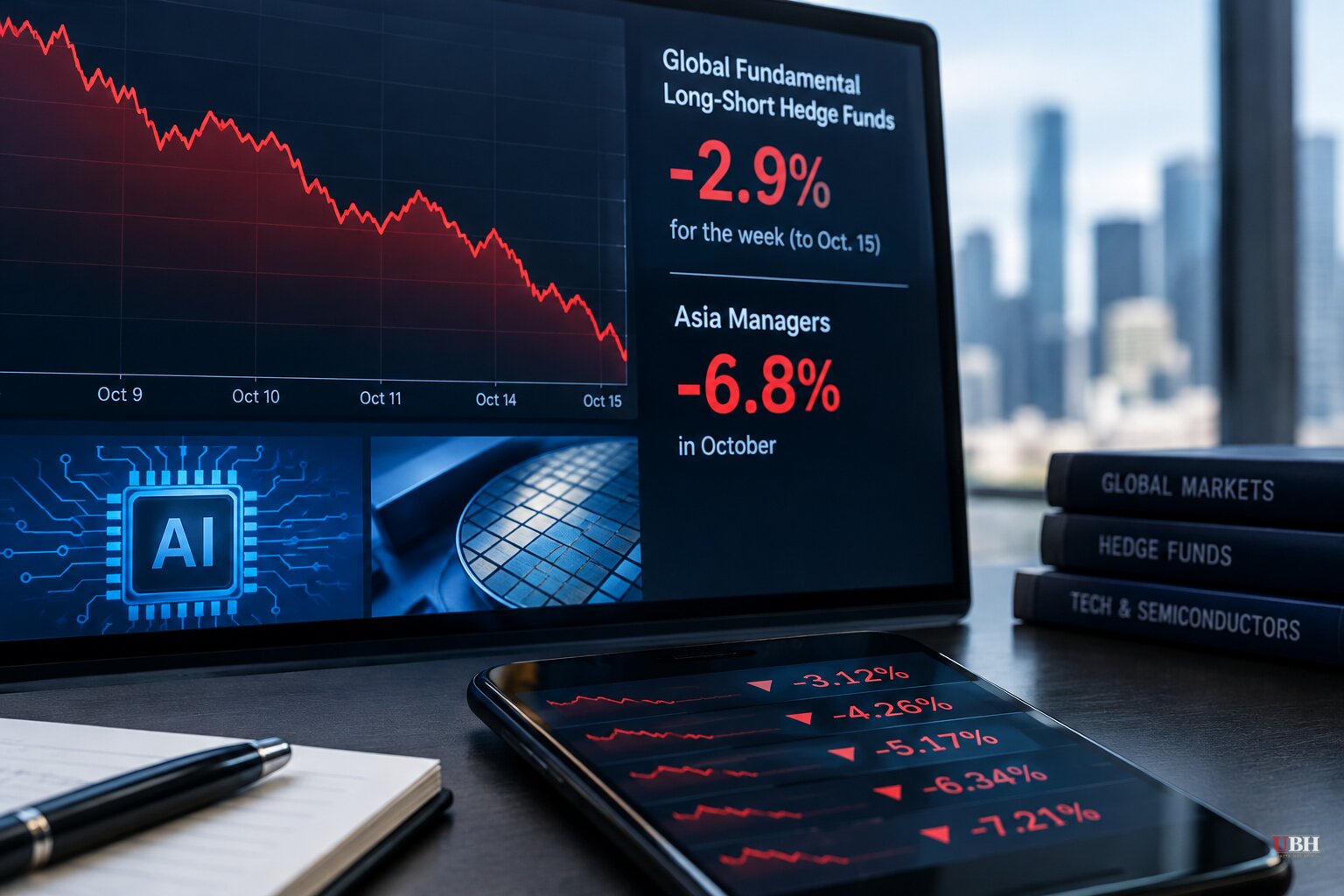
Since the AI trade began cracking on Oct. 14 after a hot U.S. inflation reading, the damage has moved from chip stocks into hedge fund returns. Goldman Sachs prime brokerage data now put numbers on it.
Global fundamental long-short funds, the stock pickers, lost money every single day this week. They were down 2.9% for the week through Oct. 15, according to Goldman. They are still up 14.3% for the year.
Asia managers took the worst of it
Asia-focused stock pickers lost 2.6% in a single session this week. Tech-focused funds fell 2.0%. Global systematic long-short managers and multi-strategy funds each slid roughly 1%.
For the first half of October, Asia-focused stock pickers are down 6.8%. That erased more than half of the gains from their late-June peak, when they were up more than 40% for the year, Goldman said.
Goldman also flagged a rare pattern. From COVID through the end of 2025, all three broad hedge fund strategies never fell more than 80 basis points on the same day. That has now happened three times this year: Feb. 4, July 28 and Oct. 15, per the bank. Goldman's note also describes quant strategies posting their weakest showing since August.
Positioning data in the same note show hedge funds were net sellers of global AI equities from Oct. 8 to Oct. 14. That wiped out net purchases built up going back to 2025. Net leverage across strategies fell to historically low levels.
Where the selling landed
South Korea's KOSPI tumbled 8% on Thursday, Oct. 15, to close at a six-month low. It has dropped 18% over five sessions, though it is still up almost 30% for the year. Taiwan stocks lost more than 3%. A record $9.3 billion in foreign outflow from Taiwan has also been reported.
In the U.S., the Nasdaq Composite and S&P 500 had their worst day since July on Wednesday, Oct. 14. CoreWeave sank 15.5% and Oracle fell 8.8% that day.
Thursday's close was calmer on the headline indexes. The S&P 500 rose 0.33%, the Dow gained 556 points, or 1.08%, and the Nasdaq finished up 0.08% after being down as much as 1.4%. Money rotated into health care, consumer discretionary and materials, and into Treasuries. Yields dropped sharply.
Chips did not get that relief. The semiconductor index fell 0.88% for a seventh straight losing day, after swinging as much as 4.4% lower during the session. It is down roughly 20% from its June peak.
The inflation trigger
Producer prices posted their sharpest monthly gain since 2022. Core producer inflation, which strips out food and energy, rose 0.7%, above estimates. The reading raised expectations of further Fed rate hikes. Higher borrowing costs bite hardest on AI infrastructure, which needs enormous capital to build.
Neil Wilson, a strategist at Saxo, listed the pressures in a note: AI buildout worries, bubbly valuations, lower-than-expected earnings growth at leading U.S. frontier labs, Chinese competition, inflation and rates. He said signs of slowing revenue growth at Anthropic and OpenAI added to the concern. Anthropic told investors ahead of its planned IPO that sales grew 45% to $17 billion last quarter, he noted.
TSMC CEO C.C. Wei told analysts Thursday that rising component prices and macroeconomic uncertainty were challenging demand in some segments. TSMC shares closed 2% lower despite strong earnings.
The counterargument from money managers
Not everyone reads this as a broken thesis. Hendi Susanto, a portfolio manager at Gabelli Funds, said in a note that the problem is not fundamentals. "It is the expectations that are fragile," he said.
Susanto said the AI infrastructure buildout will continue into the new year, with demand still high for accelerators, chipmaking equipment, memory and networking. "Companies don't commit billions to new fabs unless they see the orders coming," he said.
Adam Turnquist, chief cross-asset strategist at LPL Financial, made a similar point about Korea. Enthusiasm for the broader AI investment cycle remains intact, he said. But Korea's concentrated exposure to memory makes it more vulnerable to competitive threats, positioning unwinds and shifts in the memory cycle.
The semiconductor index is still up 61% this year despite falling almost 10% in the past week.
What decides the next leg
Susanto said investors want proof that AI spending will persist through 2027 and beyond. Anthropic's IPO is planned but has no announced date. The next hard evidence will come from the inflation and rate path, and from whether chip stocks can end their seven-day losing streak.
Sources used for this briefing
7 links from 7 independent newsrooms (syndicated copies of the same report count once)
These are the sources it draws on, linked so you can verify.


