
Unbiased headlines. Facts, not spin.
Every story is an unbiased news briefing written from 110+ sources across the spectrum — sources linked so you can verify it yourself.
 energy
Major Story (7/10)
July 5, 2026 at 11:42 PM
energy
Major Story (7/10)
July 5, 2026 at 11:42 PM
AI Power Demand Is Reshaping Texas and Global Energy Markets. Here Is What the Numbers Actually Show.
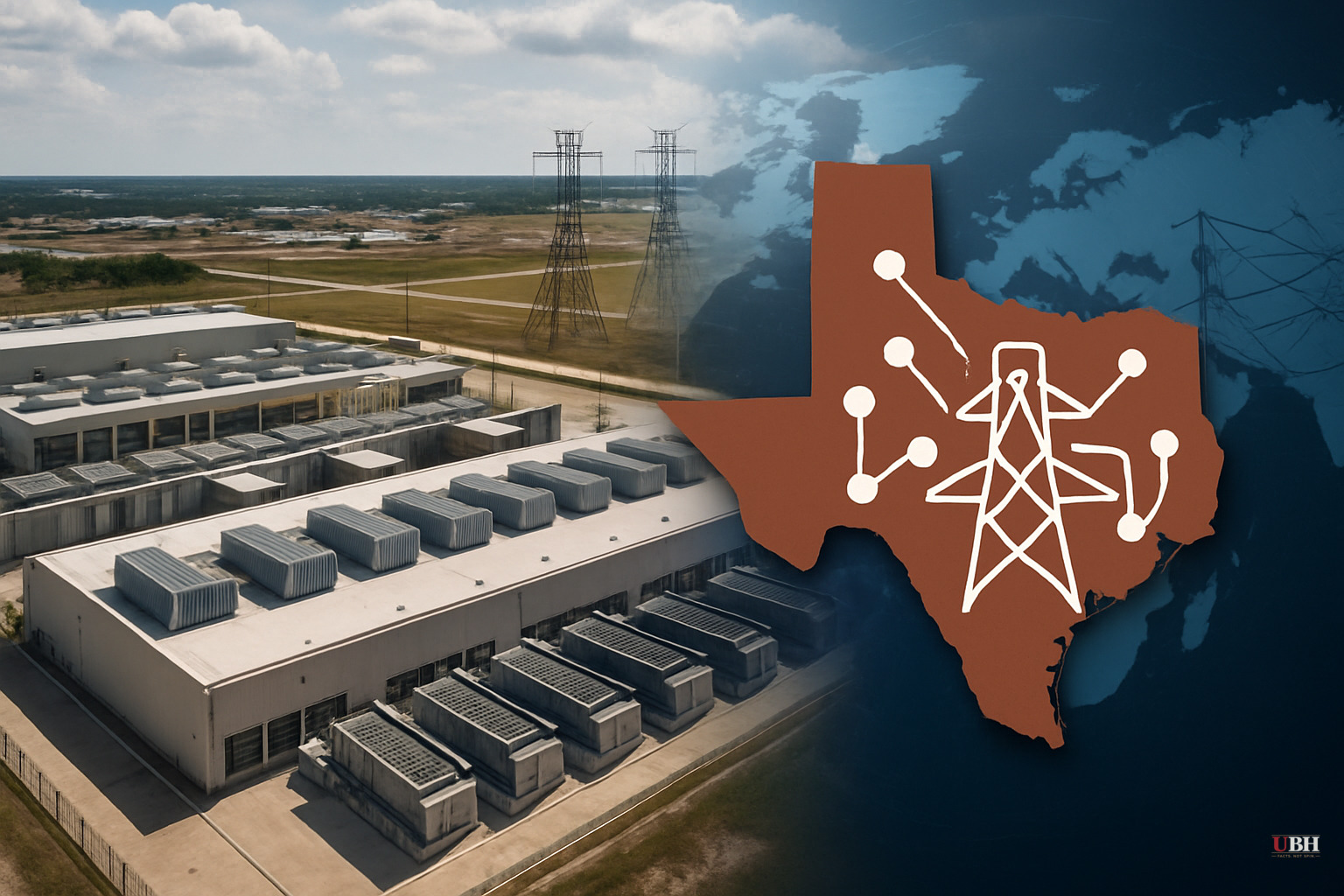
Since our prior coverage of the Archbald, Pennsylvania data center fights, a local battle that illustrates a much larger supply crunch is playing out at grid scale across the country and beyond.
The Number That Explains Everything
Goldman Sachs research projects global data center power demand could rise 165% by the end of this decade compared to 2023 levels. That is not a rounding error. That is roughly doubling the electricity appetite of an industry that already consumes more power than many mid-sized nations.
Utilities are currently quoting two- to four-year wait times just to complete feasibility studies, according to OilPrice.com. That is before permits, construction, or a single server rack gets installed.
Google's Indiana situation illustrates how bad it has gotten. The company set aside $1 billion to build a data center there, then had to reverse course over concerns that a local planning commission would kill the project. A trillion-dollar company, stopped cold by a county vote.
Texas Is the Epicenter
ERCOT, which operates most of Texas's power grid, now projects the state's electricity demand could approach 368 gigawatts by 2032, according to OilPrice.com. Analysts have framed that figure plainly: it is roughly equivalent to bolting another entire Houston metro area onto the grid.
Nationally, data center investment is projected to hit approximately $500 billion in 2026 alone, and Texas is capturing an outsized share. Nearly 20 projects are underway or planned in the Austin area alone.
The cranes are visible before you land at Abilene, Amarillo, or Midland. Turbine halls sit half-built, pipeline right-of-way freshly trenched, fenced-off scrubland that a year ago was mesquite and cotton.
Why Companies Are Bypassing the Grid Entirely
ERCOT's interconnection queue runs three years or longer. Nobody building a billion-dollar AI campus waits three years. So they are not waiting.
Chevron, ExxonMobil, and Diamondback Energy have all announced plans to build dedicated gas-fired power plants tied directly to data centers, bypassing the public queue altogether. This is a structural shift in how industrial power gets built in America.
Texas regulators are not naive about the speculation. The Public Utility Commission of Texas approved what it calls "Batch Zero": a one-time centralized review requiring developers to put down $50,000 per megawatt and prove they have actually leased or bought the land before ERCOT will study their connection request. That filter is designed to strip out paper projects from real ones.
Vistra: The Most Direct Texas Bet
Irving-based Vistra is the largest competitive generator in Texas, running roughly 44 gigawatts of natural gas, nuclear, coal, solar, and battery capacity. Close to a third of every electron consumed by Texas retail customers touches its books at some point, according to OilPrice.com.
Vistra has spent the past year converting fleet capacity into long-term contracts rather than leaving it exposed to ERCOT's notoriously volatile spot market. It signed 20-year power purchase agreements with Meta covering more than 2,600 megawatts of nuclear output, reached a separate 20-year, 1,200-megawatt nuclear supply deal tied to its Comanche Peak plant near Fort Worth, and closed a $4.7 billion acquisition of Cogentrix's gas fleet, adding 5.5 gigawatts of dispatchable capacity in constrained markets outside Texas. Management says it is in active talks with data center developers at multiple sites.
The Case for Concern
The strongest pushback on this build-out is legitimate and deserves a straight hearing. Critics argue that ERCOT demand projections are historically unreliable, that speculative land grabs have inflated the numbers, and that concentrating this much industrial load on a grid that famously failed during Winter Storm Uri in February 2021 is asking for a catastrophic repeat. If AI demand surges onto a Texas grid that cannot handle a cold snap, the consequences are not theoretical. They fall on hospitals, nursing homes, and ordinary households, not on the hyperscalers.
Texas regulators acknowledge the inflation problem, which is precisely why Batch Zero exists. Whether that single filter is sufficient to prevent a reliability crisis as hundreds of gigawatts of new industrial demand come online is a genuinely open question. ERCOT's own 368-gigawatt projection by 2032 is a forecast, not a guarantee, and forecasts at that scale carry enormous uncertainty.
The Broader Constraint
Beyond Texas, the global pattern is the same. The companies that secured long-term, low-cost power early—whether through hydro rights in Norway, nuclear agreements in Finland, or grid-secured sites in rural North Dakota—hold a structural advantage that latecomers cannot buy their way out of quickly. Utilities quoting four-year feasibility timelines are not being obstructionist. They are describing real physical and permitting constraints.
The unresolved question heading into the second half of 2026 is whether grid buildout and power generation can keep pace with AI infrastructure commitments that have already been made, or whether a significant portion of that $500 billion in projected 2026 data center investment ends up waiting years for electrons that have not yet been generated.
Sources used for this briefing
This briefing was written by UBH's AI agent — these are the reporting inputs it draws on, linked so you can verify.


