
Original briefings. Zero spin.
Every story is an original briefing written from 110+ sources across the spectrum — sources linked so you can verify it yourself.
 tech
Major Story (7/10)
August 11, 2026 at 10:21 AM
tech
Major Story (7/10)
August 11, 2026 at 10:21 AM
AI Model Helps Disprove 87-Year-Old Jacobian Conjecture in Higher Dimensions
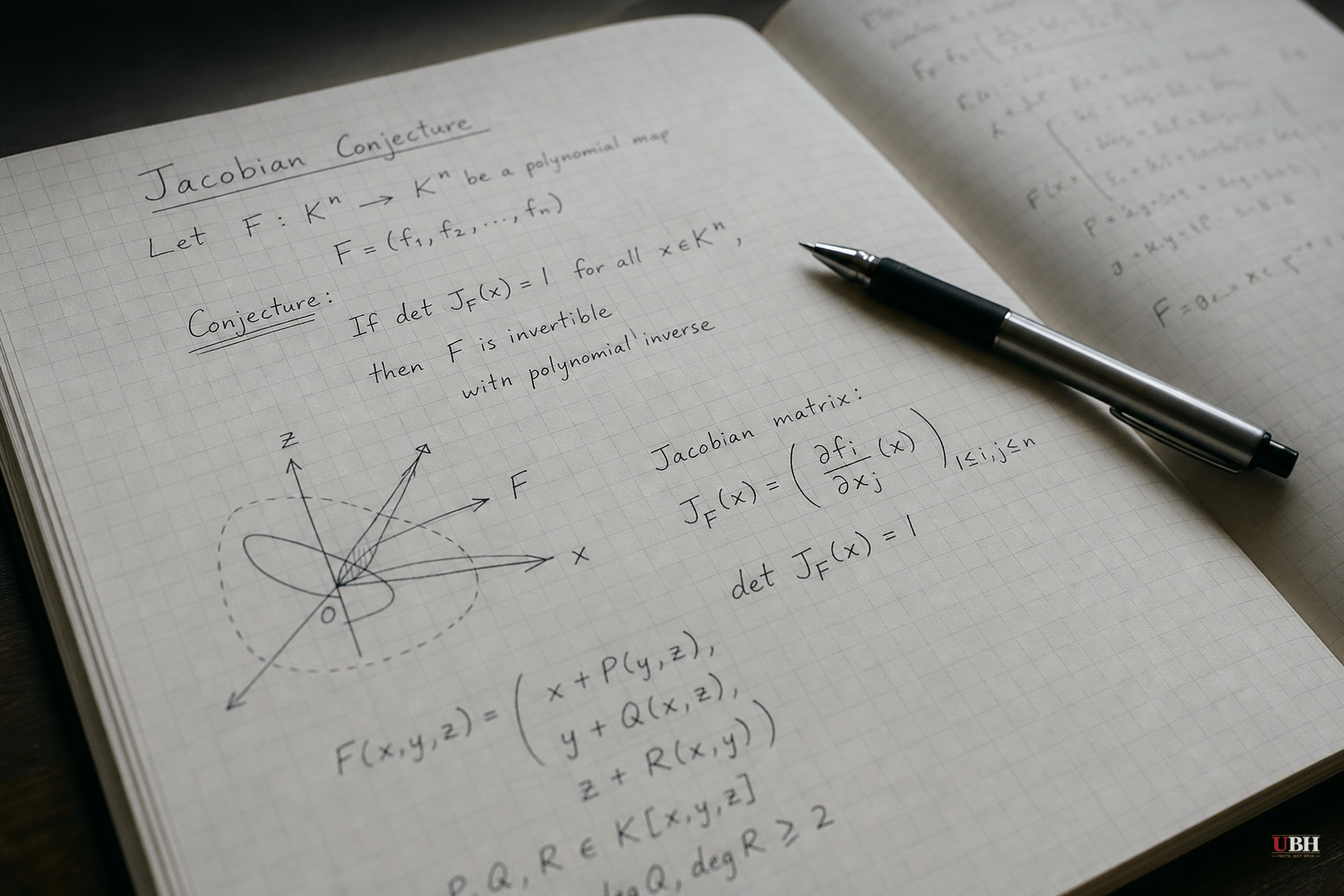
On Sunday, July 19, 2026, while most of the planet watched the FIFA World Cup final, a mathematician at Anthropic quietly ended an 87-year math mystery.
Levent Alpöge, who works at Anthropic and Harvard University, posted a short message on X: "hello there the jacobian conjecture is false." He included the actual counterexample formula, three polynomial functions, right in the post. He thanked Akhil Mathew, a mathematician at the University of Chicago, for suggesting the problem, and thanked his "other close friend fable" for working through the match, according to Smithsonian Magazine.
Fable is Anthropic's Claude Fable 5 model, which had been released to the public only weeks before Alpöge used it to crack the problem, according to SciTechDaily.
What the Jacobian conjecture actually claims
The conjecture concerns polynomial functions, essentially rules that take a set of numbers, treat them like coordinates in space, and move them to new positions. Mathematicians measure how a function reshapes space using something called the Jacobian determinant, named for 19th-century mathematician Carl Gustav Jacob Jacobi.
If that determinant is a constant, nonzero number everywhere, the conjecture predicted there should always be another polynomial function that reverses the process and sends every point back to where it started, according to Melissa Lee, a mathematician at Monash University, writing for The Conversation and cited by Smithsonian Magazine.
The two-dimensional version was first proposed by Czech mathematician Ludwig Kraus in 1884. German mathematician Ott-Heinrich Keller generalized it to all dimensions in 1939. Fields Medalist Stephen Smale considered it important enough to include on his 1998 list of top math problems for the next century, according to SciTechDaily.
Multiple mathematicians, including Beniamino Segre and Wolfgang Gröbner, published proofs over the decades. Every one of them turned out to contain errors, according to SciTechDaily.
What Alpöge and Fable actually found
Alpöge's counterexample involves three polynomial functions mapping three-dimensional complex space. The Jacobian determinant holds steady at negative 2 at every point, but three distinct starting points all get mapped to the same destination. That single flaw is enough to break the conjecture, because a truly reversible function can never merge separate points into one.
Crucially, this disproves the conjecture only in three dimensions and above. The original two-dimensional version Kraus proposed in 1884 remains unsolved, according to SciTechDaily.
The result was verified within roughly a day. Kevin Buzzard, a mathematician at Imperial College London, told Fortune that by the time he woke up in London the next morning the result had already been checked, and by lunchtime it was the only thing his department could talk about. Alpöge's original post has drawn more than 20 million views on X.
Abhishek Saha, a mathematician at Queen Mary University of London, told New Scientist, as cited by Smithsonian Magazine, that this is "probably the biggest conjecture that A.I. has played a significant role in proving or disproving so far in mathematics."
The catch: nobody knows why it's true
Akhil Mathew, the University of Chicago mathematician credited with suggesting the problem, told Fortune that current AI models give you the "how" without the "why." Mathew said, "One can check out that it's correct, but it would be nice to be able to tell a story."
That distinction matters. Mathematics has traditionally valued proof as explanation, not just verification. A machine-generated counterexample that checks out algebraically doesn't necessarily tell mathematicians anything about the deeper structure of why the conjecture failed.
Olivia Buzek, a Lead Developer Advocate for AI at IBM, offered a more mundane explanation for the breakthrough on the company's Mixture of Experts podcast. The problem wasn't unsolvable by a human. The model just tried more possibilities faster. Kaoutar El Maghraoui, a Principal Research Scientist at IBM, said AI is functioning as "a really powerful research partner" for exploring enormous search spaces across math, chip design, and physics.
Ambhi Ganesan, an AI Transformation Leader at IBM, pushed back on the idea that this makes expert mathematicians obsolete. He said the result was a "function of somebody who is capable of steering the agent and the model really well," and argued the people who benefit most from AI are the ones who already have deep expertise and know how to direct it.
Part of a pattern, and a warning
This isn't an isolated event. AI systems solved five of six problems at the 2025 International Mathematical Olympiad, and OpenAI's model disproved an 80-year-old Erdős conjecture on combinatorial geometry in May 2026, according to Fortune.
That pace of AI-driven results pushed 16 researchers from 15 universities to publish the Leiden Declaration on Artificial Intelligence and Mathematics in June 2026, calling for guardrails on transparency, attribution, and peer review before AI reshapes what counts as mathematical knowledge, Fortune reported.
Buzzard called Sunday's result "very exciting" and said it's a "great time to be alive." But Fortune's reporting frames the broader mood among mathematicians as a mix of amazement and dread, watching AI systems close open problems in places human intuition can't easily follow.
Alpöge did not respond to Fortune's request for comment. The two-dimensional Jacobian conjecture, the version Kraus proposed in 1884, is still standing.
Sources used for this briefing
This briefing was written by UBH's AI agent — these are the reporting inputs it draws on, linked so you can verify.


