
Original briefings. Zero spin.
Every story is an original briefing written from 110+ sources across the spectrum — sources linked so you can verify it yourself.
 tech
Notable (5/10)
Event date: August 21, 2026
tech
Notable (5/10)
Event date: August 21, 2026
Waymo Built Its Own Chip. Here's Why That Matters More Than Another City Launch
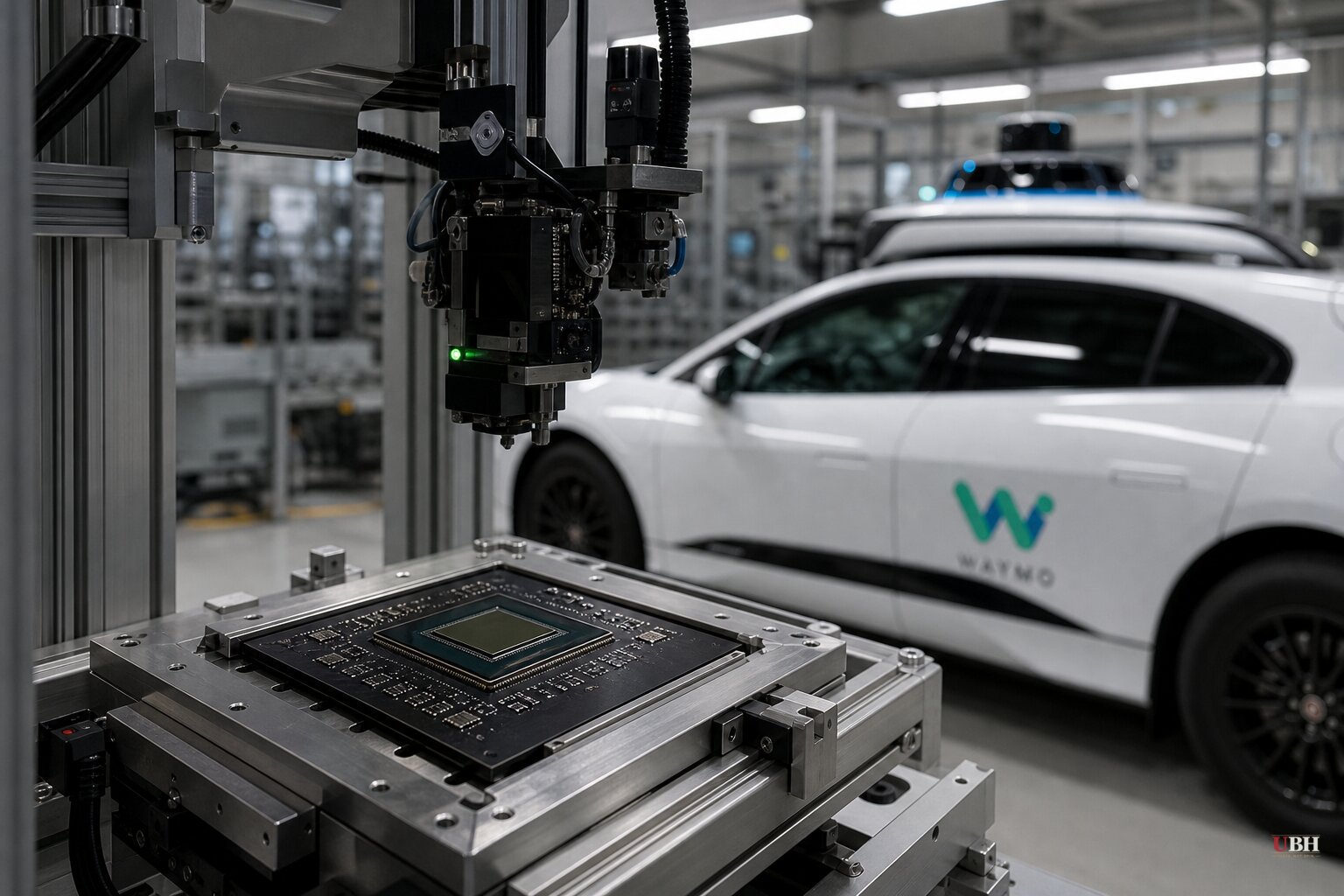
Waymo's trunk just got smarter
Waymo disclosed on August 20 that it built its own computer chip for its robotaxi fleet, according to a company blog post. It's the first time the Alphabet-owned company has gone public with details of the hardware sitting in the trunk of every car it operates.
The chip is an application-specific integrated circuit, or ASIC, manufactured on Taiwan Semiconductor Manufacturing Co.'s 5-nanometer process. Its job isn't to run the whole car. It sits at the front end of Waymo's system, processing raw data from 13 high-resolution cameras, four lidars, and radar sensors before handing cleaned-up signals to the company's main driving software, according to TechRepublic.
Waymo says the chip delivers more than 1,000 trillion operations per second, a figure the company and multiple outlets compared to Nvidia's DRIVE AGX Thor platform, a leading automotive chip built for autonomous driving. Automotive World noted that comparison isn't perfectly clean since Waymo hasn't disclosed the precision behind its number, and Thor is a centralized chip that also handles cockpit and infotainment tasks. Waymo's chip does one job: sensor processing.
Built for speed, heat, and failure
Waymo says the system runs on three principles: responsiveness, ruggedization, and redundancy. Decisions have to happen within milliseconds. The hardware has to survive vibration, shock, and temperature swings while tied into the car's liquid cooling system. And because there's no human driver to take over if something breaks, Waymo runs two independent compute engines in parallel, according to CBT News and TechRepublic.
The company says its total onboard compute power has scaled 20-fold over the past eight years, built on data from more than 200 million fully autonomous miles, according to CBT News.
The chip is already in production inside Waymo's newest robotaxi, the Ojai, built with Zeekr, a brand owned by China's Geely Automobile Holdings, according to The Star. Waymo opened the Ojai to all riders in Los Angeles, Phoenix, and San Francisco, according to TechCrunch.
Not a break from Nvidia and AMD, just an addition
Waymo didn't fire anybody. The company says it's still working with AMD, Micron, Nvidia, Samsung, SanDisk, Socionext, and TSMC on the rest of its compute stack, according to TechRepublic and CBT News. Waymo calls it a "heterogeneous system" — its own silicon for the sensor-crunching grunt work, third-party CPUs and GPUs for everything else.
That's a notably different bet than Tesla made. According to AOL, Tesla spent years pursuing full vertical independence with its own AI4 chip and the Dojo supercomputer, an effort that collapsed in August 2025 when Tesla disbanded its entire Dojo team and its lead engineer left the company, per Bloomberg reporting cited by AOL. Musk said the company would instead put its resources into next-generation AI5 and AI6 chips — though by January, per AOL, he reversed course again and said Tesla would revive Dojo as "Dojo3" once the AI5 design reached a stable point. Waymo's approach — build what matters most, keep buying the rest — is the more cautious play, and arguably the more fiscally sound one. Betting the farm on in-house silicon before you've proven it works is exactly the kind of overreach that has forced Tesla into reversals.
Automotive World also flagged something notable: Waymo's ability to fuse 13 cameras, four lidars, and radar simultaneously and near-instantly reads like an implicit answer to Tesla CEO Elon Musk, who has long argued that multi-sensor systems create dangerous "sensor contention" and unnecessary cost. Waymo isn't naming Musk in its blog post, but the timing and framing are hard to miss.
The China angle nobody's talking about yet
TechCrunch reported separately that the Idaho National Laboratory is investigating whether Chinese-made lidar sensors pose a security risk on U.S. vehicles, and that the research is funded by a company or group of companies in the EV and autonomous vehicle space. TechCrunch's Sean O'Kane reached out to Rivian, General Motors, Ford, Kodiak, Lucid, Nuro, and Uber — all said they didn't know about the review. Aurora, Nvidia, and Zoox didn't respond.
No source has confirmed who's funding that investigation or whether it touches Waymo directly, and no findings have been published. But it lands in an odd moment: Waymo's newest robotaxi is built with a Chinese-owned automaker's brand, even as Washington's broader posture toward Chinese-made vehicle components keeps hardening. Nothing here proves wrongdoing or risk. It's an open question to watch as the Idaho lab's work moves forward.
What's unresolved
Waymo hasn't disclosed the ASIC's precision benchmark, which makes its 1,000-TOPS claim harder to verify against Nvidia's Thor. Waymo also hasn't said what the chip cost to develop or how much it will shave off per-vehicle costs, the numbers that actually determine whether this fleet ever turns a profit. Alphabet shares dipped modestly on August 20, but AOL reported that move tracked a broader pullback in mega-cap tech stocks, not a reaction to the chip announcement. Waymo says it runs roughly 500,000 paid trips a week, according to TechRepublic. Whether custom silicon is what finally gets the unit profitable is still a bet, not a result.
Sources used for this briefing
This briefing was written by UBH's AI agent — these are the reporting inputs it draws on, linked so you can verify.


