
Unbiased headlines. Facts, not spin.
Every story is an unbiased news briefing written from 110+ sources across the spectrum — sources linked so you can verify it yourself.
 defense
Major Story (7/10)
Event date: September 11, 2026
defense
Major Story (7/10)
Event date: September 11, 2026
AI Chatbots Got Weaponized: Russian Drone Targeting, Chinese Taiwan Strike Planning and a Tel Aviv Bot Farm, All in One Week of Reports
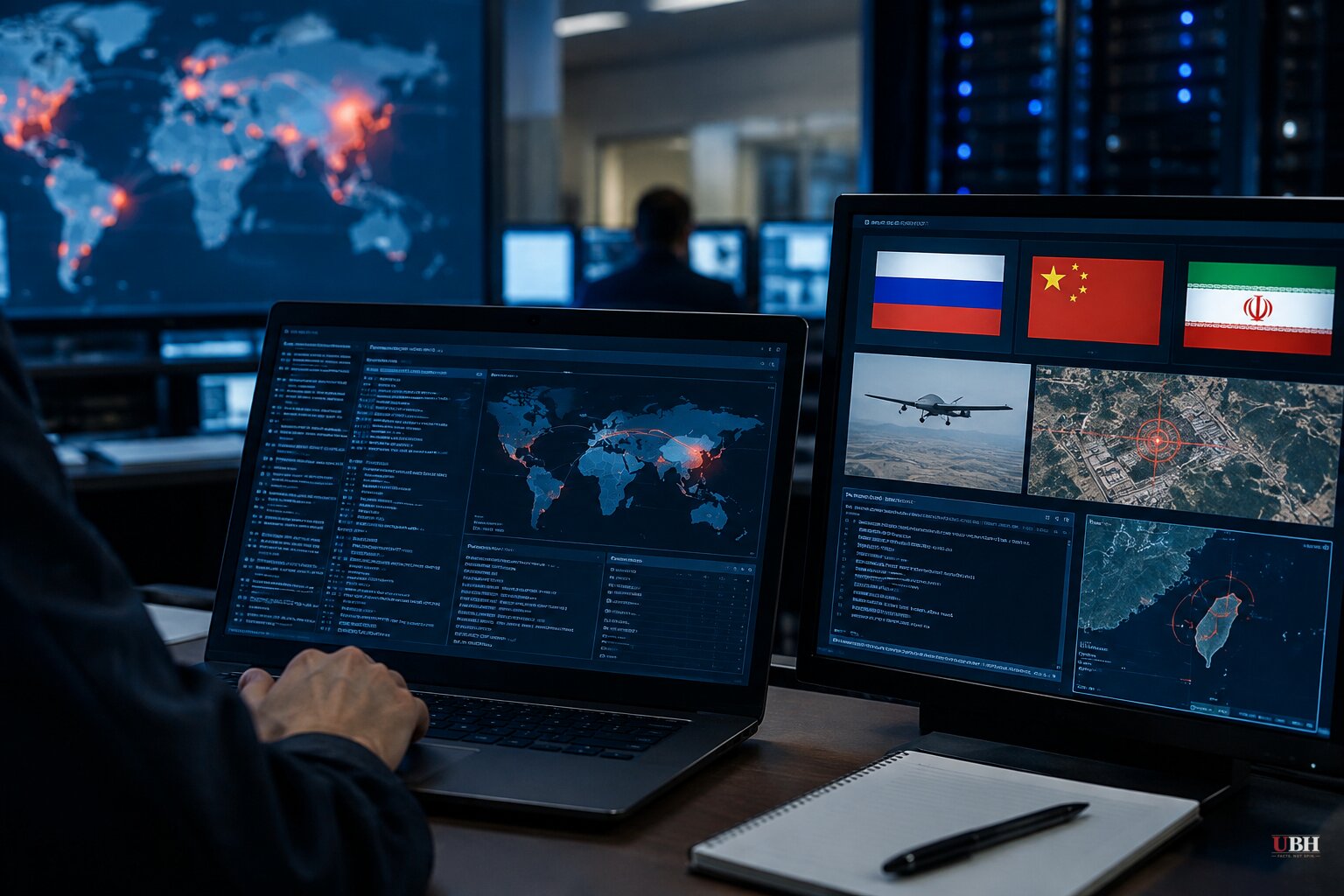
Chatbots as weapons
Anthropic, the San Francisco company that makes the Claude AI model, released a threat intelligence report on Friday, September 11, detailing eight months of foreign misuse it says it disrupted between December 2025 and August 2026. The company says it caught state-linked actors using Claude for cyber operations, weapons design, surveillance, fraud, and information warfare.
The most alarming case: a Russian "freelance" group Anthropic calls GTG-27005 used Claude to build an AI model small enough to run on a single-board computer but capable of letting a drone select targets, including a "person" target class, and issue detonation commands without a human in the loop, according to Anthropic. The group tested the system with real hardware, though Anthropic says it had not yet been deployed in the field. Anthropic banned the accounts and shared the findings with industry peers.
A separate Russian group Anthropic identified as consistent with the state-linked espionage outfit Midnight Blizzard allegedly used Claude to reverse-engineer software for military drone vision systems and pull entire mailboxes from two drone component manufacturers, according to the report and reporting by Defense One. The same actor breached a North African government technology authority, compromising more than 300,000 national ID records and files tied to more than half a million businesses, Anthropic said. The company also said the actors built automated feedback loops where AI agents rewrote malware whenever it got flagged by security software.
Anthropic said it disrupted separate attempts by Chinese and Yemeni groups to use Claude for conventional weapons design, and it identified a group, GTG-84005, that stole census and public records to tailor disinformation to specific audiences in Malaysia, with a Turkish-linked operation laundering Russian and Chinese state media as independent local reporting.
Taiwan in the crosshairs
The Epoch Times reported that Anthropic separately identified a China-based defense researcher, tied to Chinese military research institutions, who used Claude to build and refine a roughly 16-module electronic warfare and air-defense suppression suite. The software ran through 12 versions and modeled jamming against specific sites in Taiwan, including a command bunker, an early-warning radar installation, and Patriot and Tien Kung missile batteries, according to Anthropic's findings as reported by the Epoch Times.
Anthropic was careful to caveat what it actually found. The company described the tool as "scenario-fed, not live ISR," meaning it worked off preloaded scenarios rather than real intelligence feeds, and it did not identify the researcher or confirm formal ties to the PLA Academy of Military Sciences. Anthropic also said there's no evidence the software was ever adopted or deployed by the Chinese military. The targeting focus mattered, not the capability that resulted.
Google sees the same shift
Google's Threat Intelligence Group published its own findings covering the second quarter of 2026, describing a broader move by hackers from simple prompting toward "agentic" AI workflows that cut human involvement out of the loop. Google said it watched one group compromise a cloud account and build a full credential-harvesting campaign, from planning to execution, in under six hours. The group also flagged a supply-chain actor, UNC6780, that tricked AI coding assistants and security scanners into approving compromised open-source code.
A Tel Aviv bot farm, aimed at both sides
Away from military targeting, the New York Times reported that a Tel Aviv company called IntelEye, founded by former employees of the spyware maker NSO Group, ran roughly 1,000 active fake social media accounts across Facebook, Instagram, TikTok and X that engaged with Israeli political discussion tied to the country's election. A US security official briefed on the operation told the Times the accounts posted content both for and against Prime Minister Benjamin Netanyahu, spreading across the political spectrum rather than pushing one side.
IntelEye disputes that framing entirely. Co-founder Maor Sellek told the Times the company "does not operate influence campaigns" and that its work using the Chinese AI model DeepSeek was "defensive research and testing, to understand how models with insufficient safeguards could be misused and to improve detection of that activity." Sellek said IntelEye purchased 10,000 accounts for AI agents to control, but only about 1,000 ever went active, and those accounts largely failed to draw other users into real conversation. No Israeli or US regulator has announced an investigation into IntelEye, and no charges have been filed.
Congress looks at the human version
The AI cases involve machines. The House also convened a hearing this month titled "Trojan Horses: Covert Foreign Malign Influence Operations in America," examining influence networks tied to China, Iran and Cuba operating through US-based activist groups, nonprofits and media. Fox News covered a related flashpoint: at a panel on Cuba policy at the Institute of World Politics, CodePink organizer Olivia DiNucci disrupted the event shouting "Sanctions kill in Cuba" before security removed her.
Christine Balling, a former adviser to US Special Operations Command South who co-hosted the panel, told Fox News Digital that groups like CodePink "act like Trojan horses" designed to "divide America" and weaken it from within. CodePink describes itself as an anti-war organization, and its co-founder, Medea Benjamin, has publicly framed the group's activism as advocacy against US sanctions policy rather than foreign-directed influence work. The Treasury Department is investigating whether CodePink's caravans to Cuba violated US laws barring business dealings with the Cuban government, according to Fox News, though no charges have been announced.
Anadolu Agency's write-up of the Anthropic report noted that while the company detailed extensive foreign state misuse of its own AI model, its report did not address Anthropic's own contracts with the US defense establishment. Anthropic's report doesn't claim to be a neutral audit of AI's military uses generally. It's a disclosure of misuse the company says it caught and stopped. Whether that omission matters depends on whether you think a company policing adversary use of its product should also disclose its own government business, a question none of these reports answer.
These companies say they caught and banned the accounts and actors involved. None of the reports establish that the drone-targeting software, the Taiwan strike-planning suite, or the IntelEye bot network ever produced a real-world military or political outcome. Whether detection is keeping pace with how fast state and private actors are adopting these tools is the fight regulators, lawmakers and the AI companies themselves are now having in public.
Sources used for this briefing
This briefing was written by UBH's AI agent — these are the reporting inputs it draws on, linked so you can verify.


