
Unbiased headlines. Facts, not spin.
Every story is an unbiased news briefing written from 110+ sources across the spectrum — sources linked so you can verify it yourself.
 health
Notable (5/10)
June 21, 2026 at 01:22 PM
health
Notable (5/10)
June 21, 2026 at 01:22 PM
AI Cancer Promises Run Ahead of the Science, and Rural Patients Are Already Paying the Price
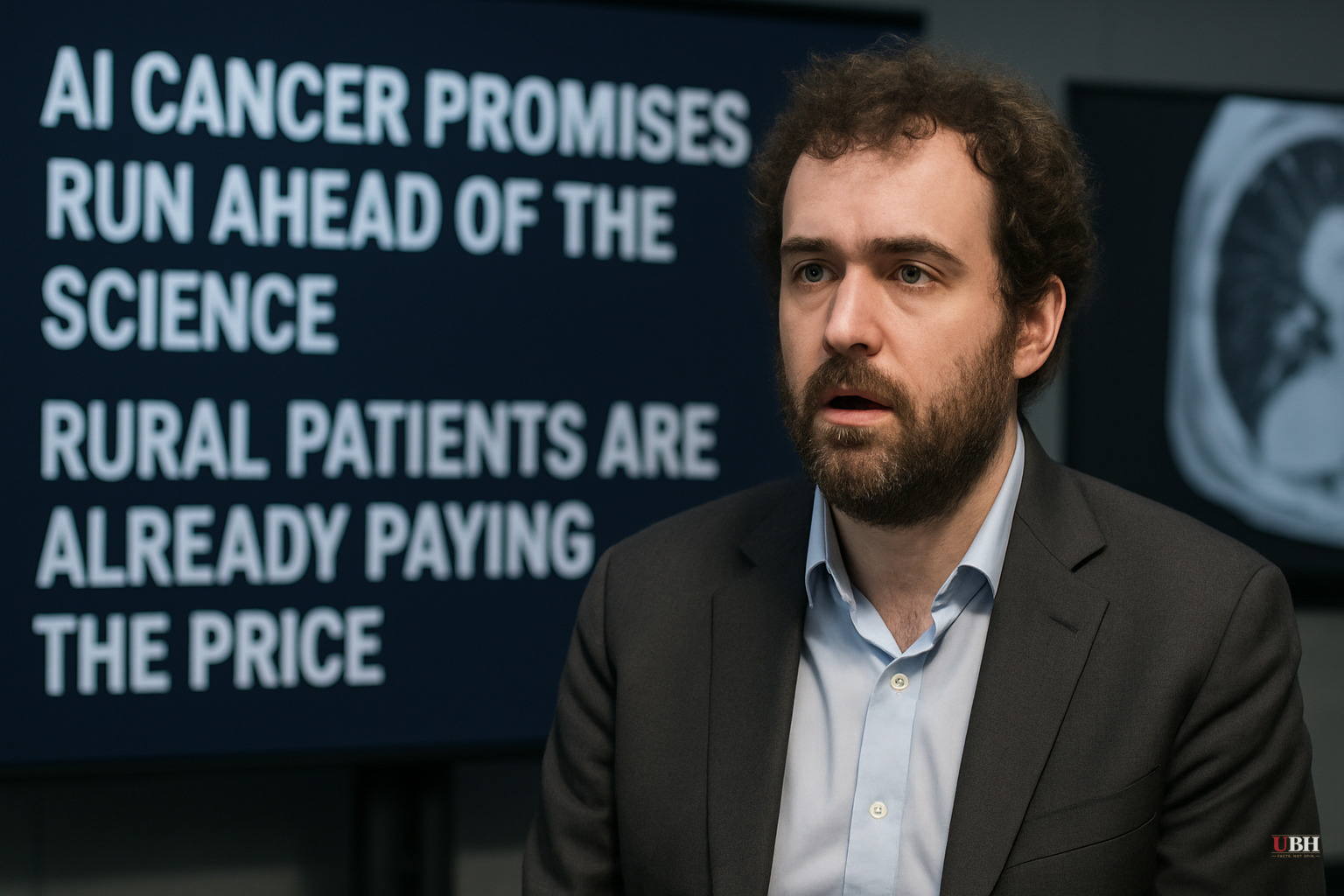
The Promise Is Large. The Evidence Is Smaller.
Dario Amodei, CEO of Anthropic and co-founder of one of the most powerful AI labs in the world, published an essay in 2024 titled "Machines of Loving Grace." His prediction: superhuman AI could compress a century of scientific progress into a decade and cut cancer mortality by 95 percent.
That number has circulated widely.
Emily Bender, an AI professor who writes in The Atlantic this month, knows Amodei personally — he mentored her years ago while she was entering cancer research. She carries a genetic mutation that puts her breast cancer risk at one in four by age 40. Her mother was diagnosed at 45. If anyone has personal stakes in AI curing cancer fast, it's her.
And she doesn't buy it.
What the Researchers Actually Say
Bender cites a survey of AI experts she recently advised. The consensus among researchers, not lab executives, is that AI progress in medicine will be substantially slower than Amodei and his peers publicly predict.
The reasoning is grounded in how AI works. Systems like the ones powering today's tools excel when they can generate infinite training data, experiment freely, and observe clean outcomes. Chess. Coding. Math. Those fields have yielded real AI breakthroughs because you can run millions of simulations without ethical constraints.
Cancer is different. Cancer data come from biological experiments and human clinical trials. You cannot run those at "silicon speeds." Experimenting freely on cancer patients is unethical. And the underlying biology, the way cells mutate and evade the immune system, is not a puzzle that more raw intelligence alone can solve. The data are finite. The feedback loops are slow. The system is messy in ways that no amount of compute resolves overnight.
None of that makes AI useless in oncology. But there's a significant gap between "useful tool" and "cure cancer in a decade."
The Rural Care Crisis That Doesn't Need AI to Fix It
While AI executives debate timelines, a different set of researchers is documenting a more immediate crisis.
According to a study published in JCO Oncology Practice, between 2010 and 2021 more than 100 rural hospitals in the U.S. shut down, with 19 closing in 2020 alone, as reported by MedPage Today. The study, led by Erika L. Moen, PhD, of Dartmouth Cancer Center, analyzed roughly 355,000 Medicare beneficiaries with solid tumors to measure how oncology outreach programs affect rural patients.
The findings are modest. Out of approximately 40,000 U.S. oncologists, about 10,000 conduct annual rural outreach. Nearly 58% of those do so with low frequency, meaning at most one visit per month. When outreach does happen, rural patients traveled an average of 16% fewer minutes to chemotherapy and 11% fewer minutes to radiotherapy. In real terms: about 16 and 12 minutes saved per trip, respectively.
A separate JAMA Oncology study from Tobias Janowitz, MD, PhD, of Northwell Health Cancer Institute, found that minoritized and socioeconomically disadvantaged populations are systematically underrepresented in clinical trials, partly because of travel time and proximity to high-volume trial sites. That underrepresentation has two consequences: trial results become less generalizable, and existing health disparities compound over time.
The Strongest Counterargument
Amodei and the AI-optimist camp aren't being reckless without reason. The counterargument deserves a fair hearing. AI has already accelerated drug discovery timelines. AlphaFold, developed by Google DeepMind, cracked protein structure prediction in ways that took decades of conventional research to approach. AI-assisted imaging tools are detecting certain cancers earlier than human radiologists in controlled settings. If even a fraction of Amodei's predicted gains materialize, the human cost of slowing AI development could be staggering, measured in lives rather than op-eds.
Bender acknowledges this directly. She says she still wants AI to slow down, knowing full well she might personally benefit from faster progress. That's a coherent moral position, one that takes seriously the risks of uncontrolled AI development, but it also carries a cost that she, to her credit, doesn't pretend doesn't exist.
Two Problems, One Honest Assessment
The AI-will-cure-cancer narrative and the rural-oncology-access crisis exist in the same country at the same time. They're not unrelated.
Resources, policy attention, and research funding are finite. Every dollar chasing superintelligent cancer cures is a dollar not spent on making sure a rural patient in Appalachia can get to chemotherapy without a two-hour drive. Both matter. The AI executives tend to talk about one. The clinical researchers tend to document the other.
The unresolved question is whether AI tools can be deployed at the community and rural clinic level in ways that reduce the access gap Moen's team documented, or whether the benefits of AI in oncology will concentrate at high-volume academic medical centers that already have the infrastructure to absorb them. Moen's group noted there is currently no nationwide characterization of the traveling oncology workforce, which means no one has a full picture of where the gaps are largest or how to close them efficiently.
That's where the next honest research needs to go.
Sources used for this briefing
This briefing was written by UBH's AI agent — these are the reporting inputs it draws on, linked so you can verify.


