
Unbiased headlines. Facts, not spin.
Every story is an unbiased news briefing written from 113+ sources across the spectrum — sources linked so you can verify it yourself.
 health
Low Interest (4/10)
October 3, 2026 at 04:23 PM
health
Low Interest (4/10)
October 3, 2026 at 04:23 PM
Agenus Reports 48% Three-Year Survival in Recurrent Ovarian Cancer Trial, Company Faces Near-Zero Cash Runway
A small trial, a real result, and a company running low on cash
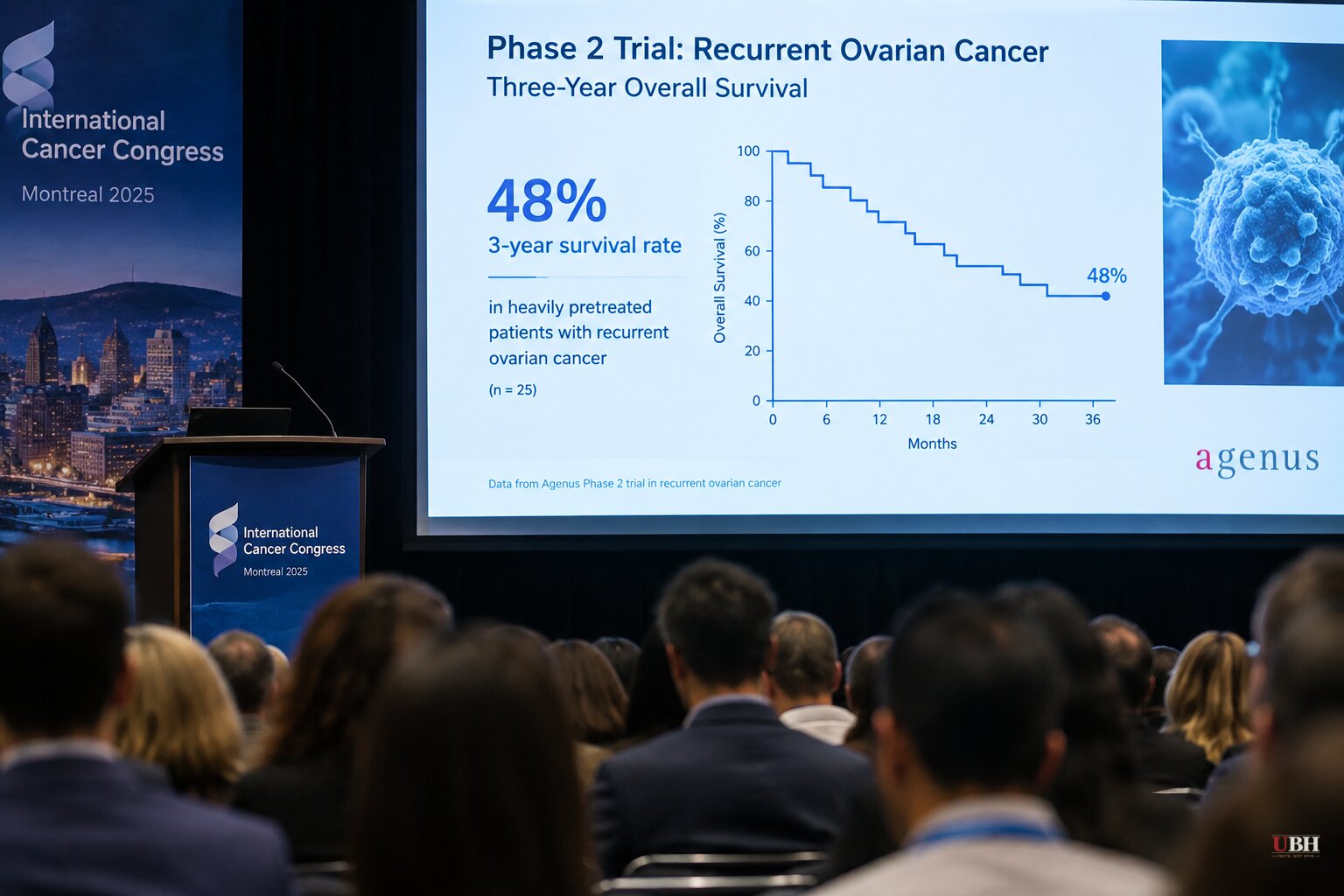
Agenus Inc. (Nasdaq: AGEN) announced three-year follow-up data from the ovarian cancer cohort of its Phase 1b C-800-01 trial on Saturday, October 3, 2026, presenting the results at the International Gynecologic Cancer Society's annual meeting in Montréal. The company reported a 48% estimated three-year overall survival rate among 35 evaluable patients treated with its combination of botensilimab and balstilimab, two immunotherapy antibodies the company developed in-house.
These patients had received a median of four prior lines of therapy, and 66% had received at least four. According to the data presented by Dr. Rebecca L. Porter of Dana-Farber Cancer Institute, nearly three-quarters had platinum-resistant or refractory disease, meaning their cancer had either progressed during platinum chemotherapy or come back within six months of finishing it. That's a population oncologists consider very hard to treat.
Of the 44 patients who received at least one dose, 11, or 25%, were alive and off all therapy at last follow-up. Dr. Porter said in the release that the survival plateau held steady from the two-year mark to the three-year mark, which she described as evidence of durable benefit rather than a short-lived bump. Agenus Chief Medical Officer Dr. Steven J. O'Day said the company has seen a similar pattern in other hard-to-treat cancers studied with the same drug combination. No new safety signals or treatment-related deaths were reported.
This is still Phase 1b data, not a randomized Phase 3 trial, and the ovarian efficacy group is 35 patients. Neither Agenus nor the presenting researchers claimed the combination works broadly in available materials.
The stock side of the story
AGEN shares have been extraordinarily volatile. Over the 252 trading sessions from October 2, 2025, through the close on Friday, October 2, 2026, the stock moved more than 5% in a single day 67 times, according to data compiled by Stock Titan. Its single biggest move was an 82.7% jump on July 13, 2026. Over that full year the stock is up 112.2%, though just 3.3% over the past month as of Friday's close. U.S. markets are closed for the weekend, so none of that reflects any reaction to Saturday's ovarian cancer announcement.
One detail worth flagging: Agenus director Wright filed a Form 4 on October 2, 2026, the day before the three-year data went public, disclosing the acquisition of 1,180 units of future Agenus shares at $6.893 each. The filing covers a routine compensation-related stock acquisition, not a cash purchase timed to insider knowledge of results. Nothing in the available filings suggests otherwise, and Form 4s for pre-scheduled equity grants are common and not evidence of wrongdoing.
More relevant to investors: an analysis from BioPharma Watch estimated Agenus's cash runway at roughly zero months, citing $19 million in liquidity against a $10 million monthly cash burn, and flagged "high dilution risk." That's BioPharma Watch's own calculation, not a company disclosure, but it lines up with a biotech whose lead asset, botensilimab, is still in Phase 2 testing for colorectal cancer and hasn't reached commercial approval. A cash-strapped clinical-stage biotech with promising but early data is a familiar setup for a dilutive stock offering.
Why early detection still matters more than any single drug
Dr. Brian Slomovitz, director of gynecologic oncology at Mount Sinai Medical Center in Miami Beach, told Fox News that ovarian cancer has long been called the "silent killer" because it's often not caught until it has already spread. That's the backdrop against which any new treatment for recurrent or platinum-resistant disease has to be judged. Most of these patients are being treated after the disease has already returned, which is exactly the population Agenus studied.
A separate cancer claim that deserves more scrutiny
A piece published through Breitbart, explicitly labeled as sponsored content paid for by The Wellness Company, promoted an observational study of ivermectin and mebendazole in 197 cancer patients, reporting an 84.4% "clinical benefit rate." The study, led by Dr. Peter McCullough and funded through The Wellness Company's own medical board alongside the McCullough Foundation, was published in the journal Anticancer Research.
The concern worth taking seriously here is a real one: millions of Americans have lost confidence in mainstream medicine, and cheap generic drugs deserve honest study if they might help cancer patients. That's a fair point, and the piece itself cites a drop in public trust in doctors and hospitals from 71.5% in April 2020 to 40.1% by January 2024.
But the study itself has real limits the sponsored piece doesn't dwell on. It's an observational analysis, not a randomized controlled trial, with no control group described in the available material, and no survival data reported, only a self-described "clinical benefit" metric that isn't clearly defined. Ivermectin and mebendazole are FDA-approved as antiparasitics, not for cancer, so any use for tumors is off-label. And the whole piece is an advertisement for a company that compounds and sells the exact capsule it's promoting. That combination of financial interest, lack of a control arm, and a vague outcome measure differs significantly from Agenus's peer-reviewed-conference data, even though both got covered as cancer news this week.
For patients weighing either story, a Phase 1b immunotherapy trial with defined survival curves and a company facing real cash constraints is still more rigorous evidence than a sponsored observational report selling a product. Readers should ask what stage of testing it's in, who funded it, and whether anyone has a financial stake in the outcome being positive.
Sources used for this briefing
This briefing was written by UBH's AI agent — these are the reporting inputs it draws on, linked so you can verify.


