
Unbiased headlines. Facts, not spin.
Every story is an unbiased news briefing written from 110+ sources across the spectrum — sources linked so you can verify it yourself.
 defense
Notable (6/10)
Event date: September 14, 2026
defense
Notable (6/10)
Event date: September 14, 2026
AFSOC Confirms Combat Use of $600,000 Havoc Spear Cruise Missile, Wants It on 'Every' Platform
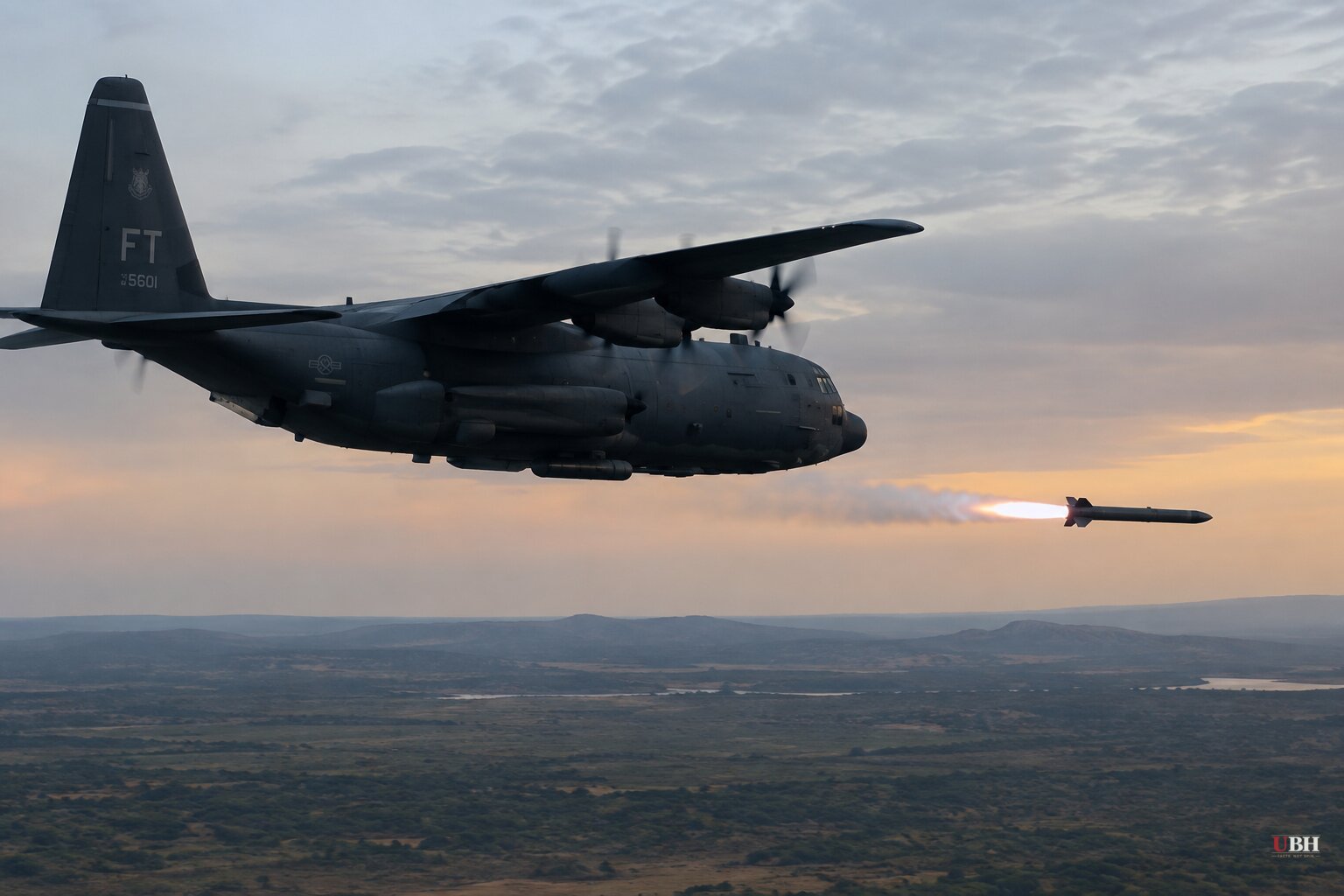
Air Force Special Operations Command says a new cruise missile just proved itself in combat, and now the command wants it on nearly everything that flies.
In a press release, AFSOC revealed that the AGM-190A Havoc Spear, built by Leidos, struck two separate targets in U.S. Africa Command's area of responsibility during a combat evaluation in spring 2026. Both missiles were launched from an AC-130J gunship, according to a command spokesperson cited by Defense Scoop.
AFSOC has not said what the targets were, who the adversary was, or the exact date of the strikes. Col. Robert Johnston, AFSOC's director of strategic plans, programs and requirements, told reporters in a briefing ahead of the announcement that the missile "confirmed that the Havoc Spear is both accurate, reliable, and operationally ready."
What the Missile Does
The Havoc Spear is a 200-pound-class missile with a demonstrated standoff range of more than 400 nautical miles, or roughly 460 miles, according to Leidos. Josh Cantera, who works on AFSOC's requirements staff, said the cost per unit in low-rate initial production runs about $600,000.
Development started in 2022 through a cooperative research and development agreement between U.S. Special Operations Command and Leidos, a mechanism Johnston said lets the Pentagon move faster than traditional acquisition pipelines allow. "To outpace our adversaries, we can't rely on traditional acquisition pipelines," Johnston said, according to Defence Industry.
SOCOM awarded Leidos a $27.2 million contract for the missile on July 8, per a Pentagon announcement. Cantera said missiles ordered under that deal should start arriving "around next fall," and AFSOC will "be looking to employ them when the time is right."
Leidos Chief Technology Officer Doug Jones said the company's Huntsville, Alabama, production line can turn out up to 15,000 Havoc Spears a year, and Leidos is also developing non-kinetic and palletized versions, according to ua.news.
The Scaling Ambition
Johnston made clear AFSOC isn't stopping at gunships. "Our ultimate goal is to try to get this on every type of SOF platform as well as conventional platform possible, in multiple launch modes," he said, adding the command is looking at options including firing from the cargo ramp of any C-130 variant or off a pylon.
One constraint is AFSOC's own operational tempo. Cantera acknowledged the command has to "piecemeal what assets we can actually employ and get test dates on" because aircraft are tied up on missions.
Johnston also floated folding Havoc Spear into the Air Force's Family of Affordable Mass Missiles program, an initiative aimed at churning out thousands of cheaper munitions after the U.S. arsenal was drawn down amid the war with Iran, according to Breaking Defense. "If we can nest it under there, and the Air Force thinks it's valuable within that FAMM portfolio, now we're postured to take full advantage of that, and we can now use their resources in order to do more of a bulk buy," Johnston said.
A Broader Munitions Push
Havoc Spear isn't the only new missile the Pentagon rolled out this month. The Navy has unveiled the AIM-424 Long Range Air-to-Air Missile, nicknamed Malice, a 1,500-pound, 13.5-foot missile built by Raytheon with an effective range beyond 250 nautical miles, according to the Navy's own release cited by the Daily Wire. The Navy says Malice will give Marine and Naval aviators a "first look, first shot, first kill advantage" against advanced threats.
Both programs land against the backdrop of a war in Ukraine where munitions consumption is staggering. CNN reported that Russia fired roughly 1,500 drones and missiles at Ukraine over four days in early September, more than half of them jet-powered Shahed variants that travel three times faster than earlier models. Ukrainian President Volodymyr Zelensky said the barrages are constant, and Kyiv's defenses are struggling to keep pace with the volume.
That volume problem is exactly what the Air Force's FAMM concept is built to answer: cheap, mass-produced munitions instead of small batches of exquisite ones. Whether Havoc Spear ultimately gets folded into that program, or stays a bespoke special-operations weapon, is still an open call the Air Force hasn't made.
What's Unverified
AFSOC's account of the strikes rests entirely on the command's own statements. No independent confirmation of the target, casualties, or precise strike date has been offered, and officials declined to identify the adversary. That's standard operational security for special operations missions, and AFRICOM Commander Gen. Dagvin Anderson framed the secrecy as necessary to "disrupt the networks that have made Africa the epicenter of global terrorism." Still, it means the public is taking the military's word on how the weapon actually performed in a real fight, with no outside verification possible.
The next concrete marker is the delivery of missiles from the $27.2 million SOCOM contract, which Cantera said should start arriving "around next fall." Whether AFSOC gets the wide-scale, multi-platform integration Johnston described, and whether Havoc Spear ends up bankrolled by the FAMM program, remains to be decided by Air Force budget planners.
Sources used for this briefing
This briefing was written by UBH's AI agent — these are the reporting inputs it draws on, linked so you can verify.


