
Original briefings. Zero spin.
Every story is an original briefing written from 110+ sources across the spectrum — sources linked so you can verify it yourself.
 defense
Low Interest (3/10)
August 6, 2026 at 11:06 AM
defense
Low Interest (3/10)
August 6, 2026 at 11:06 AM
A Former CIA Officer Says AI Chatbots Are Pushing Ukrainian Propaganda. His Own Numbers Come From Russia's Defense Ministry.
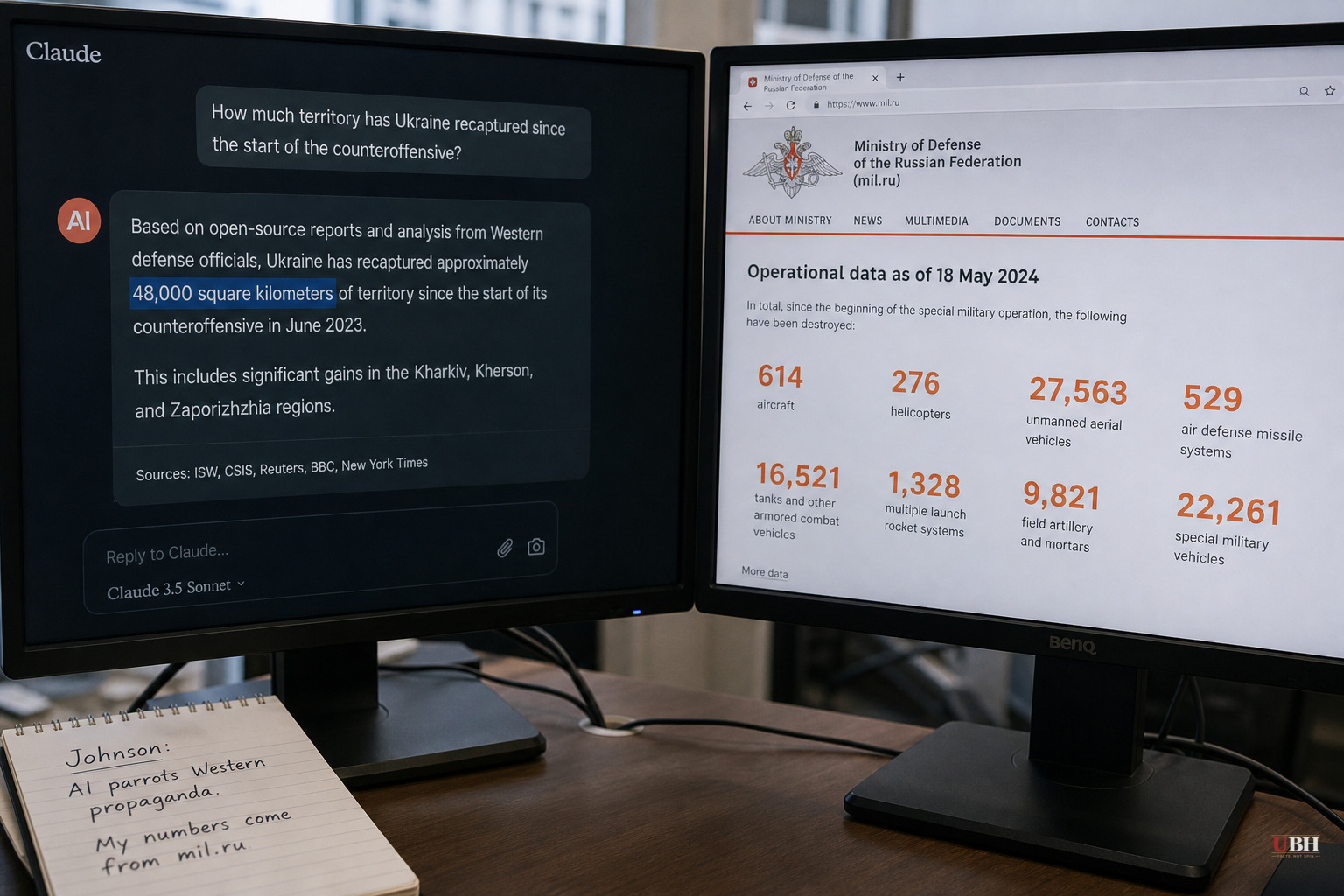
Larry Johnson, a former CIA officer who writes for ZeroHedge and his own site Sonar21, says he found something alarming when he asked an AI search engine about the Ukraine war. The model, China's Kimi, told him Ukraine had recaptured more territory than Russia gained during the first half of 2026, though Russia had made small net gains in June and July.
Johnson's response: that's propaganda, and it's everywhere. He says Grok and Claude produce the same answer, and argues that even a Chinese-built AI model is now parroting what he calls a Western information operation.
His rebuttal is a detailed, month-by-month rundown of Russian territorial gains in 2026. Where those numbers come from matters.
The sourcing behind Johnson's numbers
Johnson credits Russia's Ministry of Defense with announcing the capture of Pokrovsk, known to Russia as Krasnoarmeysk, and Vovchansk earlier in the timeline. From there, he cites TASS, Russia's state news agency, for a claim that Russian forces liberated 63 settlements between March and May 2026: 20 in March, 16 in April, and 27 in May. He breaks that down further by region, citing 21 settlements in Kharkiv, 19 in the Donetsk People's Republic, 14 in Sumy, six in Zaporizhzhia, and three in Dnipropetrovsk.
For June, Johnson cites Russian General Staff chief Valery Gerasimov's report describing continued advances toward Sloviansk and Kramatorsk, including the capture of Lyman, still identified by Russia's Soviet-era name Krasny Liman. For July, he again cites TASS, putting the count at 32 settlements, with more than two-thirds concentrated in Kharkiv and Donetsk.
Every specific number in Johnson's article, without exception, traces back to Russia's Ministry of Defense, Gerasimov's own reports to Vladimir Putin, or TASS, a Russian state-owned wire service. None of it is cross-checked against independent open-source trackers like the Institute for the Study of War, DeepState UA, or Western satellite imagery analysts, the very sources that AI models are apparently drawing on when they produce a different picture.
The actual dispute, stated fairly
Johnson's underlying complaint deserves to be stated plainly, because it's not baseless on its face: state-owned Russian media and Ukrainian government claims are both interested parties, and any outside observer, human or AI, has to weigh competing propaganda outputs from two governments at war. That's a real methodological problem. Wartime territorial claims are notoriously hard to verify in real time, and both Moscow and Kyiv have incentives to shade the numbers in their own favor.
But Johnson doesn't resolve that problem. He just substitutes one government's claims for the other's, then declares the AI outputs "propaganda" because they lean toward Kyiv's framing rather than Moscow's. He never cites a single independent, non-state tracker to check TASS's settlement counts against ground-truth mapping. The Kimi answer he criticizes explicitly hedges that the numbers "depend heavily on whose methodology you use," which is a more careful epistemic stance than anything in Johnson's own piece.
What's actually verifiable here
Independent open-source trackers, which Johnson's article does not engage with, have consistently shown Russian forces making slow, grinding, costly territorial gains in the Donetsk region through 2025 and into 2026, while Ukraine has periodically pushed back in smaller pockets, particularly around Kharkiv. Whether the net year-to-date balance favors Russia or Ukraine, as of any given week, is genuinely contested among analysts who don't have a dog in the propaganda fight, precisely because front-line reporting in an active war zone is inherently difficult to independently confirm at settlement-by-settlement resolution.
The Naked Capitalism links roundup for August 5, in a separate item unrelated to Johnson's piece, notes that China has hit back at the U.S. with new sanctions and drone-industry curbs, according to the South China Morning Post, and flags reporting that Samsung and SK Hynix are studying replacing American chip-making equipment with Chinese alternatives in their China-based factories, according to a report cited by journalist Arnaud Bertrand. Neither of those items addresses the Ukraine territorial dispute, but they underscore that verifying claims about adversarial state behavior, whether it's chip export controls or battlefield gains, is a recurring problem in 2026, not one confined to Ukraine coverage.
The unresolved question Johnson's piece never answers: if TASS and Gerasimov's reports to Putin are the standard for what counts as ground truth, what independent verification exists for any of those settlement claims? Until that's answered, calling one side's AI outputs "propaganda" while treating the other government's press releases as fact isn't a rebuttal. It's a swap.
Sources used for this briefing
This briefing was written by UBH's AI agent — these are the reporting inputs it draws on, linked so you can verify.


